
The digital advertising world is evolving rapidly, and 2025 will demand even greater agility and innovation from marketers. As platforms multiply and consumer expectations shift, only those who master advertising campaign management will achieve measurable results.
This guide offers a comprehensive, step-by-step approach to advertising campaign management for the coming year. You will explore essential strategies for campaign planning, audience targeting, omnichannel execution, creative optimization, analytics, and adapting to future trends.
Ready to outperform the competition? Dive in and equip yourself with the knowledge and tools to make your campaigns smarter, faster, and more effective in 2025.
Understanding the 2025 Advertising Landscape
The digital advertising world is evolving at a rapid pace as we approach 2025. Brands must adapt their advertising campaign management strategies to meet shifting consumer behaviors, new technologies, and regulatory demands. Let's break down the key forces shaping the future of advertising.

Evolving Consumer Behaviors and Expectations
Consumers in 2025 are more selective about the ads they engage with. Digital fatigue is common, leading audiences to actively avoid irrelevant or intrusive ads. At the same time, privacy concerns are front and center, with people demanding greater control over their data.
Brands must shift their advertising campaign management to focus on personalized, value-driven messaging. According to Salesforce (2024), 68% of consumers expect brands to understand their unique needs and deliver tailored experiences.
To succeed, marketers should:
- Prioritize relevance and authenticity in creative.
- Offer clear value in exchange for attention.
- Respect privacy preferences and transparency.
Meeting these expectations is essential for building trust and long-term engagement in your advertising campaign management approach.
Key Industry Trends Shaping Campaigns
Several major trends are redefining advertising campaign management for 2025. Artificial intelligence, automation, and machine learning are becoming central to campaign execution, enabling real-time optimization and smarter targeting.
The growth of connected TV (CTV), programmatic audio, and interactive ad formats is transforming how brands reach audiences. In fact, CTV ad spend globally is projected to surpass $40 billion in 2025, according to eMarketer.
To navigate these complexities, advertisers are turning to resources like the IAB’s 2025 Media Planning Playbook for strategic guidance on unified media approaches.
Staying ahead of these trends is critical for maximizing results through effective advertising campaign management.
Regulatory and Privacy Changes
The regulatory landscape for advertising campaign management is more complex than ever. Global frameworks like GDPR and CCPA are reshaping how marketers collect and use data. The deprecation of third-party cookies and Apple's App Tracking Transparency (ATT) framework have made audience tracking and attribution more challenging.
To remain compliant and effective:
- Invest in first-party data collection with clear consent.
- Implement robust consent management systems.
- Shift toward privacy-safe targeting, such as contextual advertising.
Adapting your advertising campaign management to these new requirements is vital for maintaining trust and legal compliance.
Competitive Landscape and Platform Diversification
The digital ecosystem is increasingly fragmented, with audiences scattered across social, search, programmatic, and emerging platforms. For example, TikTok's rapid growth among Gen Z has significant implications for where and how brands advertise.
Effective advertising campaign management now requires an omnichannel presence to maximize reach and frequency. This means:
- Testing new and emerging platforms early.
- Adapting creative for each channel's unique audience.
- Coordinating messaging across all touchpoints.
By embracing platform diversification, brands can stay competitive and ensure their campaigns resonate with a diverse, evolving digital audience.
Step 1: Strategic Campaign Planning for Maximum Impact
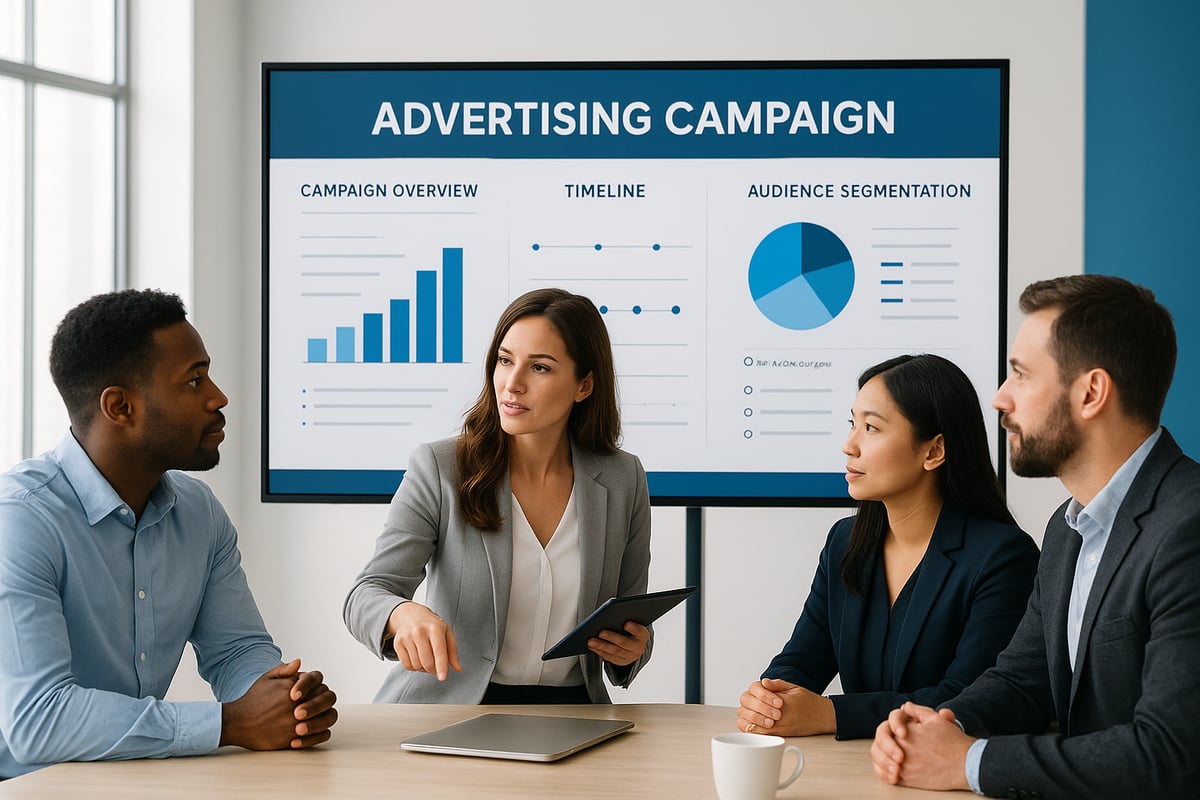
Effective advertising campaign management starts with a robust strategic plan. In 2025, success hinges on aligning your campaign’s direction with business objectives, data-driven insights, and a flexible approach. This step-by-step guide ensures your team sets a strong foundation for measurable results.
Setting Clear Objectives and KPIs
The first step in advertising campaign management is defining clear, actionable objectives. These goals must directly support your business’s overall targets, whether driving brand awareness, generating leads, or increasing sales.
Apply the SMART framework—Specific, Measurable, Achievable, Relevant, and Time-bound—to structure your objectives. For example, set a goal to “Increase qualified leads by 30 percent in Q2 via paid search.” This clarity enables your team to track progress and pivot when needed.
Establishing transparent KPIs ensures everyone measures success the same way. Regular reviews keep your advertising campaign management focused on what matters most.
Audience Research and Segmentation
Knowing your audience is fundamental to advertising campaign management. Leverage first-party data, psychographics, and lookalike modeling to understand who your ideal customers are and what motivates them.
Use customer journey mapping tools to identify touchpoints and pain points. Surveys, interviews, and analytics platforms provide additional context for segmentation.
Organize your audiences by needs, behaviors, or demographics. Segmented campaigns see higher ROI, as tailored messaging resonates more deeply. By personalizing outreach, your advertising campaign management becomes more precise and effective.
Budget Allocation and Channel Selection
Strategic budget allocation is crucial for advertising campaign management. Review historical performance data and forecast trends to inform your spend.
Distribute your budget across channels based on where your audience is most active. For example, allocate 40 percent to social, 30 percent to search, 20 percent to programmatic, and 10 percent to emerging platforms. This diversified approach maximizes reach and minimizes risk.
Regularly review and adjust allocations as campaigns progress. Informed budget management ensures your advertising campaign management delivers optimal results.
Creative Strategy and Messaging Frameworks
Great creative is the engine of advertising campaign management. Develop value propositions and hooks that speak directly to each audience segment.
A/B test creative concepts before full launch. Use clear, concise messaging that drives action. For instance, Brand X improved click-through rates by 22 percent after clarifying their ad message.
Structure your creative around proven frameworks, such as problem-solution or benefit-driven approaches. Strong creative strategy is essential for memorable, high-performing campaigns. For real-world inspiration, explore case studies of campaign success.
Timeline and Resource Planning
Organized execution is a hallmark of successful advertising campaign management. Build a detailed campaign calendar with milestones for creative, media buying, compliance, and analytics.
Assign clear roles and responsibilities using project management tools like Asana or Monday.com. This structure keeps teams accountable and workflows efficient.
Anticipate resource needs, from design to data analysis. Proactive planning ensures your advertising campaign management adapts quickly to challenges and opportunities.
Step 2: Data-Driven Audience Targeting and Personalization
Understanding your audience is at the heart of effective advertising campaign management in 2025. As privacy expectations and digital behaviors shift, brands must adopt data-driven targeting and personalized messaging to drive meaningful results.

Harnessing First-Party and Zero-Party Data
With third-party cookies fading, first-party and zero-party data now form the foundation of successful advertising campaign management. Brands collect this data directly from customers through website interactions, app usage, surveys, and preference quizzes.
First-party data includes behavioral signals, purchase histories, and engagement metrics. Zero-party data is intentionally shared by users, such as product preferences or intent, often gathered through interactive content. According to Forrester, 74% of marketers consider zero-party data critical for campaign targeting post-cookie.
To maximize value:
- Use transparent consent forms and clear value exchanges.
- Implement interactive elements, like polls, to gather preferences.
- Integrate this data into your audience segmentation tools.
By prioritizing consented data, brands build trust while enabling precise campaign targeting.
Advanced Targeting Tactics
Modern advertising campaign management leverages AI and machine learning to predict audience intent and optimize targeting. Predictive modeling identifies high-value segments based on browsing patterns, purchase signals, and engagement history.
Dynamic retargeting allows marketers to deliver sequential messages tailored to where users are in the customer journey. For instance, e-commerce brands have improved ROAS by up to 35% using predictive audience segments.
Emerging frameworks, such as the Agentic Multimodal AI Framework, enable hyper-personalized outreach by analyzing multiple data types simultaneously. These AI-driven approaches ensure your campaigns reach the right consumer with the right message at the right time.
Personalization at Scale
Scaling personalization in advertising campaign management requires dynamic creative optimization (DCO) and robust testing. DCO platforms automatically tailor ad visuals and copy for each audience segment, updating creative assets in real time based on user data.
Marketers employ multivariate testing to refine which combinations of images, headlines, and calls-to-action drive the best engagement. A leading example is Netflix, which increased user engagement by personalizing thumbnails for each viewer.
To succeed:
- Set up automated rules for creative swaps.
- Monitor performance by segment and channel.
- Continuously test variations to maximize relevance.
Personalization at scale turns data insights into higher engagement and conversion rates.
Privacy-First Targeting Solutions
Privacy-first strategies are reshaping advertising campaign management. With regulations like GDPR and CCPA, brands must prioritize compliant data collection and consent management.
Contextual advertising, which targets ads based on page content rather than user identity, is regaining popularity. Privacy-safe identifiers, such as Google’s Privacy Sandbox, offer new ways to reach audiences without compromising user trust.
Key tactics include:
- Adopting contextual targeting for privacy compliance.
- Using hashed or anonymized identifiers.
- Balancing personalization with transparency about data use.
By integrating privacy-first solutions, marketers build long-term credibility and maintain effective audience targeting.
Measuring Audience Engagement and Feedback Loops
Measurement is essential for optimizing advertising campaign management. Real-time analytics platforms track segment performance, helping marketers understand which audiences engage and convert.
Brands gather direct feedback through post-click surveys, reviews, and social listening tools. Integrating customer feedback into your targeting strategy refines future campaigns and improves relevance.
According to Gartner, brands using real-time feedback loops improve conversion rates by 19%. Set up dashboards to monitor engagement and establish regular review cycles to keep your campaigns agile and effective.
Step 3: Omnichannel Campaign Execution and Optimization
In 2025, advertising campaign management demands a truly omnichannel approach. Brands must connect with consumers across a fragmented landscape, ensuring each touchpoint is coordinated for maximum impact. Synchronizing messages, creative assets, and data insights is essential for driving measurable results.

Building a Cohesive Omnichannel Strategy
A successful advertising campaign management framework starts with a unified omnichannel strategy. This means delivering consistent messages and creative across social, search, connected TV, digital out-of-home, and audio platforms.
Brands should map the customer journey, identifying where and how audiences interact with content. For example, campaigns that integrate Facebook, YouTube, and Spotify often see higher brand lift due to repeated, relevant exposure.
Key steps include:
- Aligning messaging and visuals to reinforce brand identity
- Scheduling campaigns for coordinated launches across all platforms
- Personalizing content for each channel, while ensuring a unified narrative
A strong omnichannel approach builds trust and recognition, making it easier for consumers to engage and convert.
Cross-Platform Media Buying and Placement
The heart of advertising campaign management lies in strategic media buying. In 2025, programmatic platforms streamline buying across channels, enabling efficient scaling and precise targeting.
Marketers must choose between manual and automated bidding strategies, weighing control against efficiency. Programmatic ad spend is projected to reach 155 billion dollars, reflecting its dominance in cross-platform execution.
For a deeper dive into effective approaches, review these media advertising strategies to enhance campaign performance and placement.
To maximize reach, diversify spend across established and emerging channels. For example, a brand might allocate budgets to paid social, search, and connected TV, while reserving a portion for testing new platforms.
Creative Adaptation and Consistency
Creative consistency is vital for omnichannel success. Each platform has unique requirements for ad formats, dimensions, and user expectations.
Adapt creative assets by resizing visuals and tailoring copy to fit each channel. Always maintain core brand elements, such as logos, colors, and tone of voice, to reinforce recognition.
Consider the global impact of campaigns like Coca-Cola’s “Share a Coke,” which succeeded by adapting creative for local markets while preserving the central message.
A/B testing different creative variations before launch helps identify the most effective messaging and visuals. This proactive approach reduces wasted spend and boosts engagement.
Real-Time Monitoring and Troubleshooting
Effective advertising campaign management relies on real-time data. Dashboards offer instant insights into campaign performance, allowing teams to spot issues and optimize quickly.
Monitor key metrics such as click-through rates, conversions, and cost per acquisition. If an ad underperforms, pause it within 24 hours and reallocate resources to higher-performing placements.
Rapid troubleshooting prevents budget waste and ensures campaigns stay on track. Being agile and responsive is crucial in a dynamic, competitive environment.
Optimization Loops and Incremental Testing
Continuous optimization is the backbone of modern advertising campaign management. Regular A/B and multivariate testing of creative, copy, and targeting reveal what resonates with each audience segment.
Set up weekly reviews to analyze data and shift budgets toward the best-performing channels. Brands that optimize on a weekly basis see up to 25 percent higher ROI compared to those with slower cycles.
Use incremental testing to refine strategies, ensuring every campaign iteration delivers improved results. This disciplined approach transforms insights into measurable business growth.
Step 4: Analytics, Attribution, and Performance Measurement
Unlocking true value from advertising campaign management requires a robust analytics and attribution foundation. In 2025, success hinges on more than just launches—it demands precise measurement, real-time insights, and continuous optimization. Brands must master advanced tracking, interpret key metrics, and adapt to evolving privacy standards to stay ahead.
Setting Up Advanced Tracking and Attribution Models
Modern advertising campaign management starts with accurate tracking and attribution. Marketers must move beyond last-click models to understand the full customer journey. Multi-touch and data-driven attribution reveal how each touchpoint contributes to conversions, offering a clearer picture of ROI.
Integrating platforms like Google Analytics 4, Facebook Pixel, and offline conversion data ensures campaigns are measured holistically. For example, a retailer improved campaign ROI by 18% after switching to multi-touch attribution. Evaluating different models helps identify which channels and tactics deserve greater investment.
| Attribution Model | Pros | Cons |
|---|---|---|
| Last-click | Simple, easy to implement | Ignores upper-funnel impact |
| Multi-touch | Holistic, values all touchpoints | Complex setup |
| Data-driven | Uses AI for accuracy | Requires ample data |
Key Metrics for Campaign Success
Selecting the right metrics is crucial for effective advertising campaign management. Standard metrics include impressions, clicks, CTR, conversions, CPA, ROAS, LTV, and incrementality. Custom dashboards allow marketers to monitor these KPIs in real time, improving transparency and agility.
According to Deloitte, 67% of marketers say unified dashboards enhance decision-making. For brands investing in connected TV, the Samba TV’s 2025 Ad Impressions Report highlights a notable increase in TV ad impressions, underscoring the need to track cross-channel performance. Establish clear benchmarks and review them regularly to ensure campaign goals align with business outcomes.
Interpreting Data and Identifying Insights
Turning raw data into actionable insights is essential for advertising campaign management. Marketers should look for trends, anomalies, and patterns that reveal what is working and what needs adjustment. Data storytelling transforms numbers into strategies, empowering teams to make informed decisions.
For example, a SaaS provider reallocated budget after identifying high-performing segments, maximizing efficiency. Frequent deep dives into analytics uncover hidden opportunities, while regular reporting cycles keep stakeholders aligned. Use both quantitative and qualitative feedback to refine campaign direction.
Continuous Improvement with Data-Driven Decisions
Sustained success in advertising campaign management requires ongoing analysis and iterative improvement. Leverage analytics to optimize creative, audience targeting, and channel selection regularly. Set up weekly or monthly review cycles to assess performance and recalibrate as needed.
Brands that review performance monthly have achieved a 21% reduction in CPA. Implementing structured feedback loops ensures campaigns remain agile and responsive to market changes. Encourage collaboration across creative, analytics, and media teams for holistic optimization.
Overcoming Attribution Challenges
Privacy changes and device fragmentation present new hurdles for advertising campaign management. Cross-device attribution gaps, offline conversions, and cookie deprecation can obscure results. Solutions like conversion modeling and incrementality testing help bridge these gaps.
Post-cookie, 52% of marketers report attribution difficulties. Adopting emerging tools—including AI-powered analytics such as Reddit’s AI-Powered Ad Tools—can improve measurement accuracy. Stay informed about evolving privacy frameworks and invest in technologies that future-proof your measurement approach.
Step 5: Future-Proofing Campaigns—Emerging Technologies and Trends
Staying ahead in advertising campaign management requires ongoing adaptation to new technologies and evolving consumer expectations. As 2025 approaches, brands must embrace innovation and agility to remain competitive. The following trends will shape how you plan, execute, and optimize advertising campaign management for measurable results.
AI and Machine Learning in Campaign Management
AI and machine learning are transforming advertising campaign management by enabling predictive analytics, smarter bidding, and rapid creative production.
- Predictive analytics forecast consumer behavior, allowing for proactive adjustments.
- Automated bidding optimizes ad spend in real time.
- AI-generated copy and assets increase creative relevance and speed.
For example, AI-driven copywriting tools help marketers quickly produce personalized ads, reducing turnaround times while improving campaign outcomes. As automation deepens, teams can focus on strategic decision-making and creative innovation within advertising campaign management.
Voice, Visual, and Interactive Advertising
The next wave of advertising campaign management includes voice search, visual formats, and interactive experiences.
- Voice-enabled ads reach consumers through smart speakers and voice assistants.
- Shoppable videos and augmented reality (AR) allow audiences to engage with products directly.
- Weekly, 40% of Gen Z interacts with AR ads, highlighting the importance of immersive formats.
By incorporating these channels, brands can make advertising campaign management more engaging and relevant, especially for younger, tech-savvy audiences.
Sustainability and Ethical Advertising
Consumers increasingly demand that advertising campaign management reflects transparency and ethical values.
- Audiences value honest, socially responsible messaging.
- Avoiding greenwashing is critical for building trust.
- Brands like Patagonia have earned loyalty through purpose-driven campaigns.
Prioritizing sustainability in advertising campaign management not only meets consumer expectations but also strengthens brand reputation in a crowded marketplace.
Preparing for the Cookieless Future
The deprecation of third-party cookies is changing the landscape of advertising campaign management.
- Brands are investing in first-party data and contextual targeting.
- Privacy-safe solutions are essential for compliance and audience trust.
- 88% of marketers are increasing their first-party data efforts.
Collaborating with data partners and adopting new targeting methods will be vital for advertising campaign management success in a privacy-first era.
Building Agile Teams and Processes
To future-proof advertising campaign management, brands must build agile, cross-functional teams capable of rapid iteration and adaptation.
- Upskilling staff in data analysis, creative, and compliance is key.
- Agile methodologies enable faster campaign launches and adjustments.
- According to McKinsey, agile teams execute campaigns twice as quickly.
For guidance on structuring your team for effective advertising campaign management, explore this resource on digital marketing team structure.