
Did you know that digital and multimedia advertising are projected to account for over 70% of global ad spend by 2026? This remarkable growth signals a new era for businesses and marketers ready to harness the power of multimedia advertising.
This guide is designed to help you navigate the dynamic landscape ahead. You will learn how to leverage evolving formats, build strategic plans, adopt the latest technologies, measure results, segment your audience, and anticipate future trends.
Digital and multimedia ads now lead the way, outpacing traditional channels. The opportunities are vast, but so are the challenges of managing multiple media platforms.
With the right approach, you can achieve stronger ROI, deeper engagement, and accelerated brand growth. Use this essential guide as your roadmap to mastering multimedia advertising for success in 2026.
The Evolution of Multimedia Advertising: 2020–2026
The past several years have seen a dramatic transformation in multimedia advertising. Brands have shifted from relying on traditional channels to adopting digital-first, multimedia strategies. This evolution is reshaping how companies connect with consumers, optimize spend, and drive results.
The Shift from Traditional to Digital and Multimedia
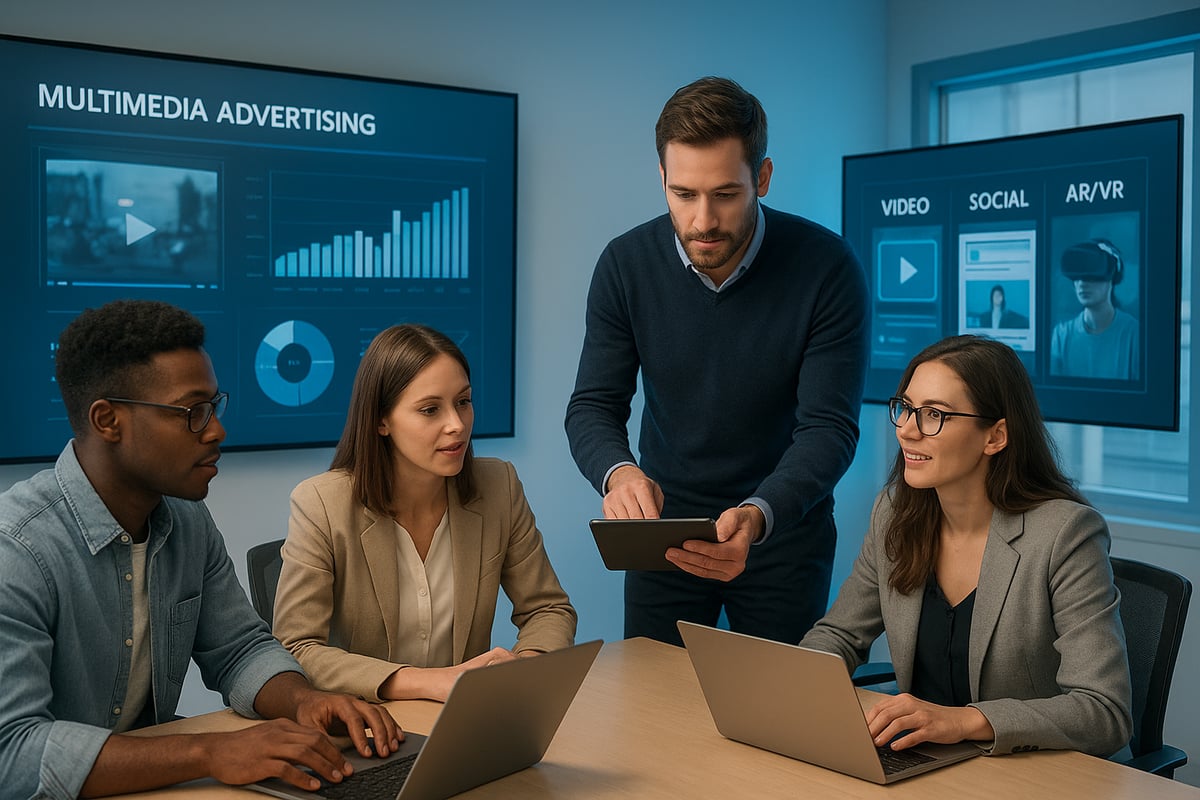
The transition from print, TV, and radio to digital-first campaigns has accelerated at an unprecedented pace. By 2019, digital spending accounted for more than half of all media investment worldwide. This milestone signaled a new era for multimedia advertising.
Mobile device adoption played a pivotal role. As consumers increasingly accessed content on smartphones and tablets, businesses were compelled to innovate. Brands such as Nike and Coca-Cola leveraged multimedia advertising, integrating video, social, and interactive formats to reach audiences wherever they are.
Key Drivers of Change in the Multimedia Landscape
Several factors have fueled the rapid rise of multimedia advertising. The proliferation of smart devices has made digital content more accessible than ever. Over 66 percent of the global population now owns a mobile device, and mobile web traffic continues to surge year-over-year.
High-speed mobile internet has enabled on-demand content consumption. Digital giants like Google and Facebook have expanded their influence, making multimedia advertising a central strategy for reaching connected consumers. The demand for instant, relevant content continues to grow.
The Rise of Integrated Campaigns and Cross-Channel Synergy
Brands now unify their advertising budgets across digital and offline channels to maximize impact. This integrated approach allows for greater flexibility and more effective messaging. Macy’s, for example, consolidated its marketing budget to enable seamless coordination between traditional and digital media.
Research shows that multimedia advertising campaigns produce nonlinear, segment-specific effects. By leveraging cross-channel synergy, brands can engage consumers across multiple touchpoints, leading to higher returns and stronger brand awareness.
Emerging Multimedia Formats and Platforms
The landscape of multimedia advertising is continuously evolving. Digital video, connected TV, audio, and interactive ads are gaining traction. The rise of AR and VR experiences is opening new creative possibilities for brands.
Innovative formats are appearing in video games and broadband platforms, both of which are among the fastest-growing segments. Video games see annual growth rates exceeding 14 percent, while broadband-driven formats grow by over 9 percent each year. Leading brands are experimenting with these channels to stay ahead.
Global and Economic Trends Shaping 2026
Economic forces are cementing the dominance of multimedia advertising. Digital ad spend has maintained a compound annual growth rate of 11 to 12 percent from 2015 to 2020. By 2019, digital consumer spending made up 55 percent of total media outlays.
According to Digital Advertising Statistics 2026, these trends are projected to accelerate, with digital formats outpacing traditional channels in both reach and revenue. The impact on business models is profound, as companies adapt to a multimedia-centric future.
Building a Future-Ready Multimedia Advertising Strategy
To thrive in 2026, brands must adopt a robust multimedia advertising strategy that flexes with changing technology and consumer behavior. Below is a step-by-step framework designed to help businesses craft campaigns that deliver measurable impact and sustainable growth.
Step 1: Setting Clear Objectives and KPIs
Every successful multimedia advertising campaign starts with well-defined goals. Are you aiming for brand awareness, lead generation, conversions, or something else? Establishing clear objectives allows you to select the right KPIs for each channel.
For example, if your goal is awareness, focus on reach and impressions. For performance-driven campaigns, track CTR, conversion rates, and ROI. Companies like JetBlue have integrated TV and digital metrics to measure both reach and conversion, ensuring alignment across platforms.
Regularly revisit these KPIs as your campaign evolves. Setting measurable targets early keeps your multimedia advertising efforts focused and accountable.
Step 2: Audience Research and Consumer Segmentation
Understanding your audience is crucial for multimedia advertising success. Leverage big data and analytics to identify high-value segments based on demographics, behavior, and purchase intent.
Modern segmentation tools, such as machine learning and causal forest algorithms, can uncover patterns traditional methods miss. These tools help correct for selection bias, ensuring you target the right consumers without wasting budget.
By refining your segments, you can craft messages that resonate and drive higher engagement. The more precise your audience targeting, the stronger your multimedia advertising results.
Step 3: Channel Selection and Media Mix Optimization
Choosing the right channels is vital for an effective multimedia advertising strategy. Evaluate the strengths and weaknesses of each platform, including online, offline, social, video, and audio.
Consider how channels interact. Research shows that the synergy between online and offline ads varies by consumer segment. Brands are increasingly integrating budgets and messaging for maximum impact. For more insights on optimizing your approach, explore these multimedia and media advertising strategies.
Test and refine your media mix based on performance data. An agile approach helps you adapt to shifting consumer preferences and emerging platforms.
Step 4: Creative Development for Multimedia Campaigns
Creative excellence is at the core of successful multimedia advertising. Develop unified messaging tailored to each format—video, display, audio, interactive, and AR/VR.
Follow best practices for engaging ad experiences:
- Use animation and graphic design for visual impact.
- Craft compelling stories that connect emotionally.
- Optimize assets for each device and context.
Sensory-rich content grabs attention and boosts recall. Strong creative elevates your multimedia advertising and differentiates your brand.
Step 5: Budget Allocation and Resource Planning
Move away from siloed budgets and embrace integrated, flexible campaign funding. Allocate resources based on historical performance and predictive analytics, not just tradition.
Brands such as Macy’s have shifted to a single marketing budget, allowing for real-time adjustments and optimal media mix. Data-driven budget allocation ensures your multimedia advertising spend delivers the highest return.
Plan for contingencies. Set aside funds for rapid optimization and emerging opportunities. This proactive approach keeps your campaigns agile and effective.
Step 6: Campaign Execution and Real-Time Optimization
Coordinated execution is essential for multimedia advertising. Launch campaigns across selected channels simultaneously to maximize reach.
Leverage advanced tracking and attribution tools to monitor performance in real time. Rapid iteration—adjusting creative, targeting, and spend based on live data—can significantly boost results.
Continuous optimization ensures your multimedia advertising adapts to market shifts and consumer feedback. Stay responsive to maintain momentum.
Step 7: Compliance, Privacy, and Ethical Considerations
Staying compliant with privacy regulations is non-negotiable in multimedia advertising. Understand and adhere to evolving laws like GDPR and CCPA.
Implement transparent data collection and consent mechanisms. Prioritize ethical guidelines to build trust with your audience and safeguard your brand’s reputation.
Regular audits and staff training help maintain standards. Responsible multimedia advertising not only meets legal requirements but also aligns with consumer expectations.
Leveraging Technology and Data in Multimedia Advertising
The future of multimedia advertising is being shaped by rapid advancements in technology and data analytics. As brands strive for greater impact and efficiency, leveraging these tools is no longer optional but essential. From big data to AI-driven automation, the right tech stack empowers marketers to create, deliver, and measure campaigns with unprecedented precision.
Harnessing Big Data and Predictive Analytics
Big data has become the driving force behind effective multimedia advertising. Marketers now gather immense volumes of information from digital touchpoints, enabling them to understand audience behaviors, preferences, and purchase intent with remarkable clarity.
By analyzing these vast datasets, brands can predict trends, segment audiences, and personalize messaging. For example, companies routinely use thousands of consumer attributes to refine targeting and forecast campaign outcomes. This approach transforms multimedia advertising from guesswork to science, ensuring every dollar spent is backed by data-driven insights.
AI, Machine Learning, and Automation in Campaign Management
Artificial intelligence and machine learning are revolutionizing how multimedia advertising campaigns are managed. These technologies automate complex tasks like audience segmentation, creative optimization, and bid management, freeing marketers to focus on strategy.
Tree-based models such as causal forests help identify which consumers respond best to specific ad formats. AI tools can dynamically allocate budgets and adjust campaigns in real time, maximizing ROI. According to the IAB 2026 Outlook Study, AI-driven targeting and measurement innovations will be central to future campaign success.
Advanced Tracking and Attribution Solutions
Accurate measurement is critical for multimedia advertising. Marketers are moving beyond last-click attribution, embracing multi-touch and cross-device tracking to gain a comprehensive view of the customer journey.
With proprietary tracking technologies, brands can link online and offline behaviors, capturing more conversions and understanding the true impact of each channel. Granular attribution enables continuous optimization, helping businesses identify which touchpoints drive the most value. This holistic approach is transforming how multimedia advertising is evaluated and improved.
Personalization and Dynamic Creative Optimization
Personalization is at the heart of successful multimedia advertising. Using real-time data, brands deliver tailored ad experiences that resonate with individual users across devices and platforms.
Dynamic creative optimization allows marketers to adapt images, messages, and offers based on user behavior and context. This strategy increases engagement by serving content that feels relevant and timely. As multimedia advertising evolves, personalization will remain key to capturing attention and driving conversions.
Integrating Offline and Online Data Sources
True multimedia advertising success relies on integrating data from both online and offline sources. By combining CRM records, point-of-sale data, and digital analytics, marketers achieve a unified view of each customer.
This integration enables precise measurement of cross-channel effects and reveals the synergy between traditional and digital campaigns. Brands that excel at merging these data streams can optimize their media mix, ensuring that their multimedia advertising delivers consistent results regardless of where the consumer interacts.
Measuring and Optimizing Multimedia Campaign Effectiveness
Accurate measurement is the cornerstone of successful multimedia advertising. Without robust tracking and actionable insights, brands risk missing key opportunities for growth and optimization. In this section, we break down the essential steps to evaluate, refine, and maximize the impact of your multimedia advertising campaigns.
Key Performance Metrics for Multimedia Advertising
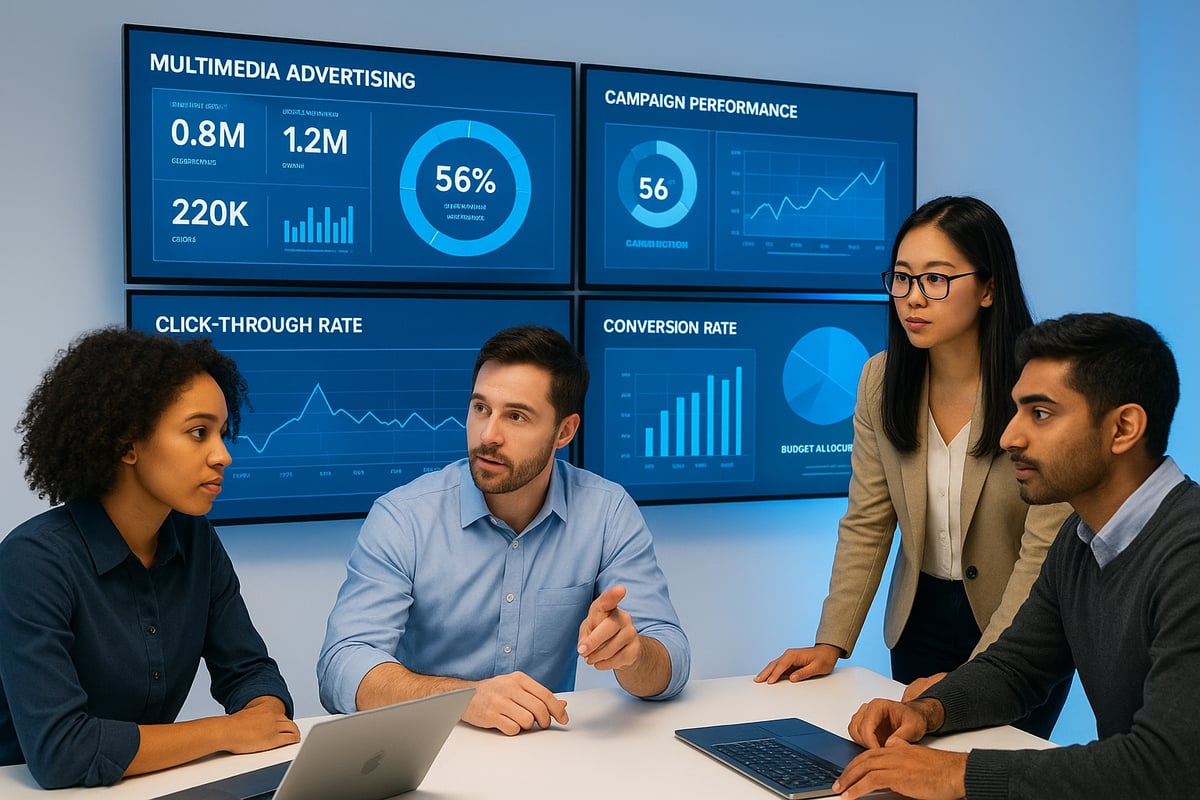
Measuring the right metrics is critical for multimedia advertising success. Each channel—video, audio, display, social, and offline—offers unique indicators. Core metrics include:
- Impressions and reach to gauge audience size.
- Engagement rates for interaction levels.
- Conversions and sales lift to assess return on investment.
- ROI and cost per acquisition for financial efficiency.
| Metric | Description | Channel Examples |
|---|---|---|
| Impressions | Number of times an ad is shown | Display, video |
| Engagement | Clicks, shares, comments, likes | Social, video |
| Conversions | Completed desired actions (sales, signups) | All |
| ROI | Return generated per dollar spent | All |
Understanding how these metrics differ by campaign objective and channel ensures your multimedia advertising is both accountable and performance driven.
Methods for Evaluating Campaign Impact
To truly understand the effectiveness of multimedia advertising, brands must adopt rigorous evaluation methods. Randomized experiments, such as A/B testing, provide unbiased measures of campaign impact by comparing exposed and unexposed groups.
However, in multi-channel environments, observational data analysis becomes essential. Traditional uplift models often fall short when dealing with complex, non-linear consumer journeys. Advanced causal inference and machine learning approaches, like uplift modeling, allow marketers to estimate the incremental effect of each channel and exposure. This leads to more accurate assessments and smarter investment decisions.
Correcting for Selection Bias and Segment Heterogeneity
Selection bias can skew multimedia advertising results if not properly addressed. When campaigns are not randomized, certain consumer groups may be over- or under-represented. This makes it difficult to determine true effectiveness.
Segment heterogeneity is another challenge. Different groups respond uniquely to the same ad. Using machine learning models, such as causal forests, enables automatic splitting of audiences into homogeneous segments. This corrects for bias and reveals which groups deliver the highest value, allowing brands to tailor multimedia advertising strategies for optimal results.
Frequency and Exposure Optimization
Optimizing exposure frequency is vital in multimedia advertising. Too few impressions may fail to drive action, while too many can cause ad fatigue or wasted spend.
Research shows the effect of repeated exposures is non-linear and varies across segments. Marketers should analyze segment-specific response curves to determine the ideal number of exposures per consumer group. This ensures each segment receives just the right amount of messaging to maximize conversions, without overspending or diminishing returns.
Real-Time Reporting and Continuous Improvement
Continuous improvement is at the heart of effective multimedia advertising. Real-time dashboards enable marketers to monitor live performance, identify underperforming segments, and adjust creative or budget allocation instantly.
Leveraging advertising campaign management best practices empowers teams to iterate quickly and respond to shifting consumer behaviors. By combining actionable insights with agile execution, brands can optimize campaigns on the fly, driving better results and long-term growth.
Consumer Segmentation and Personalization Strategies for 2026
Unlocking the full potential of multimedia advertising in 2026 requires a deep understanding of consumer segmentation and personalization. As audiences become more diverse and media channels expand, delivering the right message to the right person is essential for campaign success.
The Importance of Advanced Segmentation
Advanced segmentation is foundational in multimedia advertising today. With fragmented media consumption patterns, brands must move beyond basic demographic targeting. Biological, cognitive, psychological, and behavioral differences all influence how consumers respond to ads.
By leveraging advanced segmentation, marketers can identify the most receptive audiences for each campaign. This approach maximizes ROI and ensures that multimedia advertising efforts are not wasted on indifferent or mismatched segments. In 2026, segmentation is not just a tactic, but a strategic imperative.
Data-Driven Segmentation Techniques
Modern multimedia advertising thrives on data-driven segmentation. Automated grouping with machine learning, such as tree-based models, uncovers meaningful patterns among millions of consumers. These models evaluate thousands of variables, from purchase history to device usage, to create actionable audience groups.
| Segmentation Method | Key Features | Benefits |
|---|---|---|
| Tree-Based Models | Automated, scalable | Unbiased, segment-specific insights |
| Causal Forest | Corrects selection bias | Accurate uplift measurement |
| Behavioral Analysis | Real-time signals | Timely, relevant targeting |
By adopting these techniques, marketers can ensure their multimedia advertising is both precise and impactful.
Personalization at Scale
Personalization transforms multimedia advertising from generic to genuinely engaging. Using segmentation insights, brands deliver tailored content across every channel, from social to connected TV. Dynamic creative adapts messaging and offers to match each segment’s preferences, driving conversion rates higher.
Emerging trends, such as live commerce and creator-driven content, are reshaping expectations for personalization. According to Amazon Ads Marketing Trends 2026, brands that invest in personalization at scale are seeing measurable gains in engagement and sales. In this environment, multimedia advertising becomes a catalyst for long-term brand loyalty.
Addressing Segment-Specific Challenges
No two audience segments are alike. Differences in device preferences, media habits, and response triggers require marketers to stay agile. For multimedia advertising to succeed, brands must:
- Analyze segment-specific media consumption patterns
- Adapt creative formats for each device and channel
- Develop unique offers and messages for distinct groups
Avoiding one-size-fits-all strategies prevents wasted resources and ensures that each segment receives the most relevant multimedia advertising experience.
Measuring Segmentation Effectiveness
Success in multimedia advertising depends on continuous measurement. Tracking segment-level performance and conversion rates reveals what works and what needs refinement. Uplift modeling helps validate the true impact of personalized campaigns, highlighting areas for optimization.
Ongoing data analysis allows marketers to iterate segmentation models, keeping pace with changing consumer behaviors. As a result, multimedia advertising strategies remain effective, future-ready, and aligned with business goals.
Future Trends and Innovations in Multimedia Advertising
As we approach 2026, the landscape of multimedia advertising is being redefined by innovation and evolving consumer expectations. Brands are leveraging technology to create immersive experiences, deliver personalized content, and measure performance with unprecedented precision. Staying ahead requires not only embracing new formats but also anticipating shifts in privacy, commerce, and responsibility.
The Emergence of Immersive and Interactive Formats
Immersive and interactive experiences are at the forefront of multimedia advertising. Augmented reality (AR) and virtual reality (VR) campaigns allow consumers to engage with products in lifelike environments, increasing both interest and recall. Interactive video and shoppable media transform passive viewers into active participants, letting them explore products and make purchases directly within ads.
Brands are rapidly adopting connected TV, AR filters, and in-game advertising to capture attention across screens. For a closer look at how leading companies use emerging formats, explore these connected TV and CTV ads examples.
This evolution empowers brands to foster deeper engagement and build memorable experiences, ensuring multimedia advertising resonates with diverse audiences.
The Role of AI-Driven Creative and Content Generation
Artificial intelligence is revolutionizing multimedia advertising by automating the creation and optimization of content. Generative AI tools now produce video, audio, and display ads at scale, enabling brands to deploy campaigns faster and with greater personalization.
According to the IAB 2025 Digital Video Ad Spend Report, nearly 90 percent of advertisers are expected to use generative AI for video ads by 2026, with projections indicating that 40 percent of video ads will be AI-generated. This shift accelerates creative production and unlocks new possibilities for dynamic storytelling.
Brands can rapidly test and iterate creative assets, ensuring their multimedia advertising adapts in real time to consumer preferences and market trends.
Privacy-First Advertising and Cookieless Solutions
As privacy regulations evolve, multimedia advertising is shifting toward privacy-centric strategies. The phase-out of third-party cookies is prompting brands to rely on contextual and intent-based targeting methods. These solutions respect consumer privacy while still delivering relevant messages.
Advertisers are investing in first-party data collection, transparent consent mechanisms, and privacy-safe measurement tools. This approach builds trust with audiences and ensures compliance with global standards.
The result is a more ethical and sustainable ecosystem, where multimedia advertising delivers value without compromising user privacy.
Convergence of Commerce and Content
The boundaries between content and commerce are blurring, with multimedia advertising leading the charge. Features like live shopping, social commerce, and shoppable video allow consumers to discover, engage, and purchase within a single experience.
Brands are integrating e-commerce functionality directly into their ads, reducing friction and boosting conversion rates. Case studies show that interactive, commerce-enabled ads drive higher engagement and measurable sales growth.
This convergence not only streamlines the customer journey but also positions multimedia advertising as a primary driver of business outcomes.
The Evolution of Measurement and Attribution
Measuring the impact of multimedia advertising is becoming more sophisticated. Next-generation attribution models now account for multi-touch, cross-channel consumer journeys, providing a holistic view of performance.
Blockchain and decentralized technologies are emerging as tools for transparent ad verification, ensuring data integrity and combating fraud. These innovations empower marketers to make data-driven decisions and maximize return on investment.
With advanced measurement, brands can continuously refine their multimedia advertising strategies for optimal results.
Sustainability and Social Responsibility in Advertising
Consumers increasingly demand that brands demonstrate ethical, inclusive, and eco-friendly values in their multimedia advertising. Campaigns that prioritize sustainability and social responsibility resonate more deeply and foster long-term loyalty.
Best practices include using sustainable materials in production, promoting diversity in creative assets, and supporting social causes. Aligning multimedia advertising with brand values not only meets consumer expectations but also differentiates brands in a crowded market.
This commitment to responsibility establishes trust and enhances brand reputation.
Preparing for the Next Wave: Strategic Recommendations
To thrive in the future of multimedia advertising, brands must invest in technology, talent, and data infrastructure. Agility is key, as platforms, formats, and consumer behaviors continue to evolve.
Building a culture of experimentation and continuous learning enables organizations to adapt quickly and seize new opportunities. Strategic recommendations include:
- Prioritize ongoing training in emerging technologies
- Foster cross-functional collaboration
- Regularly test and optimize creative and media strategies
- Embrace ethical and privacy-first practices
By following these guidelines, marketers can ensure their multimedia advertising remains effective, relevant, and future-ready in 2026 and beyond.