
Effective digital marketing campaign management represents the difference between scattered marketing efforts and systematic revenue generation. Healthcare providers and franchise systems face unique challenges in patient acquisition, from navigating regulatory compliance to converting high-intent prospects into scheduled appointments. The strategic orchestration of campaigns across multiple channels, combined with rigorous performance tracking and continuous optimization, creates predictable growth outcomes that transform marketing from an expense center into a revenue-generating asset. For organizations serving specialized healthcare markets, mastering campaign management fundamentals while implementing advanced conversion techniques separates industry leaders from competitors struggling with inconsistent results.
Understanding Digital Marketing Campaign Management Fundamentals
Digital marketing campaign management encompasses the systematic planning, execution, monitoring, and optimization of marketing initiatives across digital channels to achieve specific business objectives. This discipline requires coordinating creative assets, budget allocation, audience targeting, message delivery, and performance analysis within a unified framework that drives measurable outcomes.
The healthcare sector introduces additional complexity layers that demand specialized approaches. Patient privacy regulations, medical advertising restrictions, and the high-stakes nature of healthcare decisions require campaigns built on trust, compliance, and value demonstration rather than aggressive promotional tactics.
Core components of effective campaign management include:
- Strategic goal setting aligned with revenue targets
- Audience segmentation based on healthcare needs and demographics
- Channel selection optimized for patient acquisition costs
- Creative development that addresses specific health concerns
- Budget allocation across awareness, consideration, and conversion stages
- Performance tracking with patient-centric metrics
Healthcare providers must recognize that campaign management extends beyond launching advertisements. The complete patient journey from initial awareness through appointment scheduling, consultation completion, and treatment adherence requires integrated management that connects marketing activities to clinical operations.

Building Strategic Campaign Foundations
Strategic planning forms the bedrock of successful digital marketing campaign management. Healthcare organizations often rush into tactical execution without establishing clear objectives, resulting in campaigns that generate activity without producing revenue.
Defining Campaign Objectives and Success Metrics
Begin by establishing specific, measurable objectives tied directly to business outcomes. For wound care centers, this might mean generating 50 qualified patient consultations monthly. Compounding pharmacies may target 100 prescription transfer requests from specific therapeutic categories. Medical spas could aim for 75 aesthetic consultation bookings for high-value services.
Success metrics must extend beyond vanity indicators like impressions or clicks. Healthcare-focused campaigns require tracking metrics that predict revenue:
| Metric Category | Key Performance Indicators | Healthcare Application |
|---|---|---|
| Lead Generation | Cost per qualified lead, lead volume by source | Track acquisition costs across platforms |
| Conversion | Consultation booking rate, appointment show rate | Measure patient journey completion |
| Revenue Impact | Patient lifetime value, cost per acquisition | Calculate true marketing ROI |
| Engagement Quality | Time on landing page, form completion rate | Assess prospect intent levels |
Campaign management best practices emphasize continuous monitoring and agile optimization, particularly relevant in healthcare where patient needs and competitive dynamics shift rapidly.
Audience Segmentation for Healthcare Markets
Effective digital marketing campaign management requires granular audience segmentation that reflects the diverse needs within healthcare markets. A telehealth provider serving both men's health and women's health patients cannot deploy identical messaging across these segments.
Segment audiences based on multiple dimensions:
- Demographic factors: Age, gender, location, income level
- Psychographic elements: Health consciousness, treatment preferences, lifestyle factors
- Behavioral indicators: Previous healthcare engagement, online research patterns
- Clinical characteristics: Specific conditions, treatment history, urgency levels
Advanced segmentation enables personalized messaging that addresses specific patient concerns. Orthopedic practices can create distinct campaigns for sports injury recovery, joint replacement candidates, and chronic pain management, each with tailored value propositions and creative approaches.
Executing Multi-Channel Healthcare Campaigns
Digital marketing campaign management achieves maximum impact through coordinated multi-channel execution that meets patients where they conduct health-related research and decision-making.
Channel Selection and Budget Allocation
Healthcare providers must strategically allocate resources across channels based on patient acquisition efficiency and lifecycle stage alignment. Search advertising captures high-intent prospects actively seeking specific treatments. Social media builds awareness and educates potential patients about conditions and solutions. Display remarketing re-engages website visitors who demonstrated interest but haven't scheduled consultations.
Recommended budget allocation framework:
- Search advertising (35-40%): Captures immediate demand from patients seeking specific treatments
- Social media advertising (25-30%): Builds awareness and nurtures consideration among targeted demographics
- Display remarketing (15-20%): Re-engages previous website visitors with personalized messaging
- Content marketing (10-15%): Establishes authority and supports organic search visibility
- Email nurturing (5-10%): Converts leads through systematic follow-up sequences
Channel performance varies significantly across healthcare specialties. Addiction treatment centers may find search advertising dominates patient acquisition, while medical spas achieve superior results through Instagram and Facebook campaigns showcasing visual transformations.
Creative Development and Message Testing
Compelling creative assets differentiate effective campaigns from mediocre efforts. Healthcare creative must balance emotional resonance with clinical credibility, addressing patient concerns while demonstrating professional expertise.
Develop creative variations that test different angles:
- Problem-focused messaging highlighting patient pain points
- Solution-oriented content emphasizing treatment outcomes
- Authority-building creative showcasing credentials and expertise
- Social proof incorporating patient testimonials and success metrics
A/B testing represents a non-negotiable element of digital marketing campaign management. Test headlines, images, calls-to-action, and landing page layouts to identify combinations that maximize conversion rates. Data-driven approaches to campaign optimization demonstrate how systematic testing improves marketing efficiency and ROI.

Optimizing Landing Pages for Patient Conversion
Landing page performance determines whether digital marketing campaign management efforts translate into actual patient appointments. Healthcare providers frequently direct traffic to generic website pages that lack conversion focus, wasting advertising investment on unoptimized experiences.
High-converting healthcare landing pages incorporate specific elements:
- Clear value proposition: Immediate communication of treatment benefits and outcomes
- Trust indicators: Credentials, certifications, patient reviews, and professional associations
- Simplified forms: Minimal friction with only essential information requested
- Strong calls-to-action: Prominent scheduling buttons with urgency elements
- Mobile optimization: Seamless experience across all devices
- Fast load times: Sub-three-second page loads to prevent abandonment
Create dedicated landing pages for each campaign segment rather than directing all traffic to homepage experiences. A men's health clinic running separate campaigns for testosterone therapy, erectile dysfunction treatment, and weight management should build distinct landing pages addressing each condition's specific concerns and treatment approaches.
Implementing Systematic Performance Monitoring
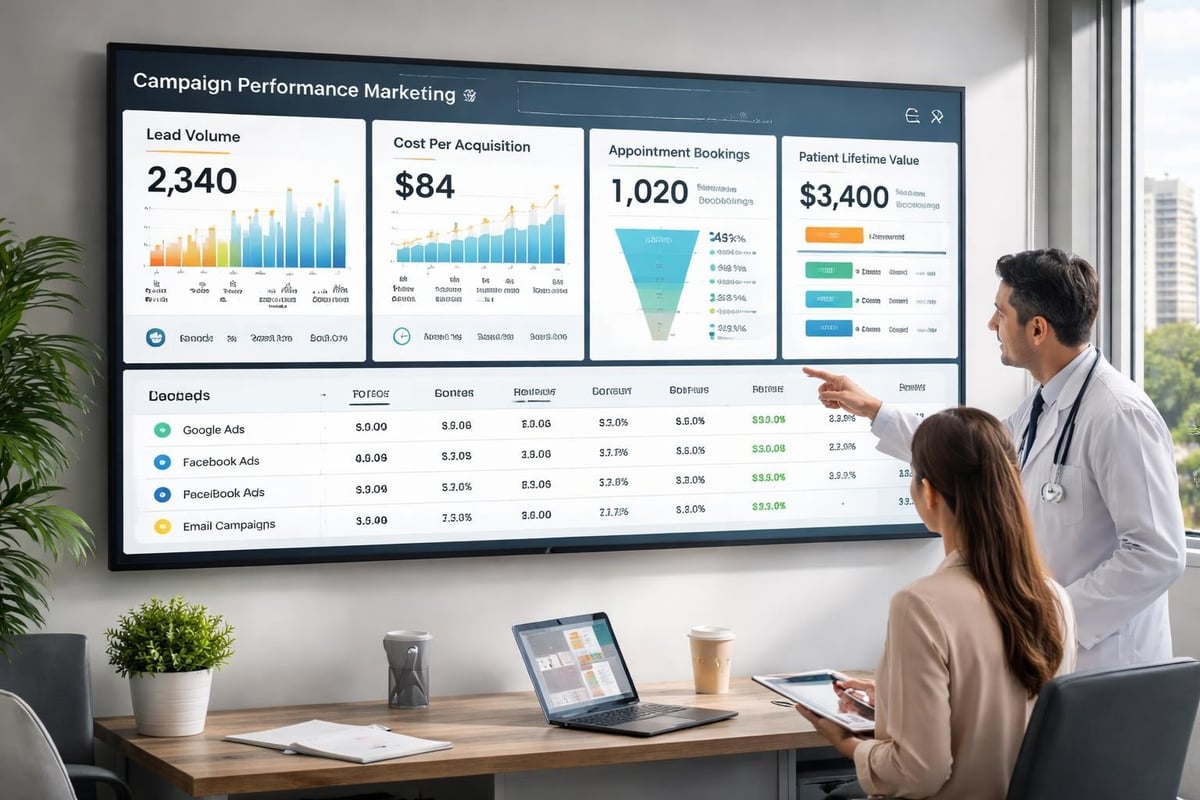
Continuous performance monitoring separates professional digital marketing campaign management from amateur efforts. Healthcare organizations must track campaign metrics in real-time, identifying underperforming elements before significant budget waste occurs.
Essential Tracking Infrastructure
Implement comprehensive tracking systems that capture the complete patient journey from initial ad exposure through consultation completion and treatment initiation. This requires proper integration between advertising platforms, website analytics, CRM systems, and practice management software.
Critical tracking components include:
- Conversion tracking pixels on all landing pages and thank-you pages
- Call tracking numbers unique to each campaign and channel
- UTM parameters for granular source attribution
- CRM integration capturing lead source through patient lifecycle
- Revenue attribution connecting marketing activities to patient value
Many healthcare providers fail to close the loop between marketing activities and actual patient revenue. Without tracking which campaigns generate patients who complete treatments versus those producing low-quality leads that never convert, optimization becomes impossible.
Performance Analysis and Reporting
Regular performance analysis identifies optimization opportunities and informs budget reallocation decisions. Review campaign metrics weekly at minimum, with daily monitoring during campaign launches or significant creative tests.
| Analysis Frequency | Focus Areas | Decision Impact |
|---|---|---|
| Daily | Spend pacing, critical metric alerts | Pause underperforming ads, adjust budgets |
| Weekly | Campaign-level performance, conversion trends | Shift budget between campaigns, test new creative |
| Monthly | Channel effectiveness, patient quality assessment | Strategic reallocation, audience refinement |
| Quarterly | Overall marketing ROI, lifetime value analysis | Budget planning, strategic direction |
Successful digital marketing campaigns demonstrate consistent monitoring and rapid iteration based on performance data, principles equally applicable to healthcare marketing contexts.
Advancing Campaign Performance Through Optimization
Digital marketing campaign management excellence requires continuous optimization that incrementally improves performance across all campaign elements. Small percentage improvements compound over time, dramatically increasing patient acquisition efficiency and marketing ROI.
Systematic Testing Methodology
Implement structured testing protocols that isolate variables and produce statistically significant results. Random creative changes without proper testing methodology waste resources and obscure performance insights.
Priority testing sequence:
- Audience targeting: Test demographic variations, interest categories, and lookalike audiences
- Ad headlines: Experiment with problem-focused versus solution-oriented messaging
- Visual creative: Compare lifestyle imagery, clinical settings, and before/after presentations
- Landing page layouts: Test form placement, page length, and trust element positioning
- Call-to-action language: Evaluate different urgency levels and action phrases
Run tests with sufficient budget and duration to achieve statistical significance. Testing audiences with 50 conversions minimum provides reliable performance indicators. Premature test conclusions based on limited data lead to incorrect optimization decisions.
Budget Optimization and Scaling
As campaigns identify winning combinations of targeting, creative, and landing pages, systematic scaling amplifies results while maintaining efficiency. Increase budgets gradually on top performers, monitoring for performance degradation as spend levels rise.
Healthcare markets have finite qualified patient populations within geographic areas. Aggressive scaling beyond market capacity inflates costs per acquisition as campaigns exhaust high-intent audiences and expand into lower-quality prospects. Strategic campaign management approaches emphasize sustainable growth that balances volume increases with efficiency maintenance.
Diversification protects against platform changes and market shifts. Organizations relying exclusively on single channels face catastrophic impact when algorithm updates or policy changes disrupt performance. Develop strong secondary and tertiary channels that provide volume insurance and leverage different patient acquisition patterns.
Integrating Lead Management Systems
Digital marketing campaign management extends beyond generating website conversions to ensuring leads receive systematic follow-up that converts interest into scheduled appointments. Healthcare providers frequently lose 50-70% of marketing-generated leads through inadequate response times and incomplete nurturing processes.
Rapid Response Protocols
Response speed dramatically impacts healthcare lead conversion rates. Prospects researching treatment options typically contact multiple providers, with the first practice to engage often winning the patient relationship. Implement systems ensuring lead contact within two minutes of form submission or call initiation.
Automated response systems acknowledge inquiries immediately while routing leads to appropriate team members. Pre-sales development teams dedicated to lead qualification and appointment scheduling outperform models where clinical staff handle initial contact alongside patient care responsibilities.
CRM Integration and Nurturing Sequences
Complete CRM integration connects marketing activities to patient outcomes, enabling accurate attribution and optimization decisions. Track each lead from initial campaign source through consultation booking, appointment completion, treatment initiation, and lifetime revenue generation.
Develop nurturing sequences that maintain engagement with prospects not ready for immediate appointments:
- Educational content addressing common treatment questions and concerns
- Social proof showcasing patient success stories and outcomes
- Promotional offers creating urgency for consultation scheduling
- Reminder sequences for prospects who scheduled but haven't completed consultations
Healthcare decision timelines vary significantly across specialties. Aesthetic procedures may convert within days, while addiction treatment often requires weeks of consideration and preparation. Adapt nurturing cadences and messaging to match typical patient journey timelines for specific services.
Leveraging Advanced Campaign Techniques
Sophisticated digital marketing campaign management incorporates advanced techniques that maximize performance beyond basic campaign execution capabilities.
Proprietary Data and Audience Intelligence
Anonymous website visitor identification technology transforms campaign effectiveness by enabling direct outreach to prospects who demonstrated interest but didn't complete contact forms. This capability dramatically expands the addressable audience generated from marketing investments.
Identifying 60% of anonymous visitors creates opportunities for:
- Personalized remarketing: Display ads addressing specific pages viewed and treatments researched
- Direct outreach: Email and phone contact with qualified prospects who visited high-intent pages
- Lookalike modeling: Creating expanded audiences matching characteristics of identified visitors
- Conversion optimization: Understanding paths taken by visitors who don't convert
Combine visitor identification with CRM data to build comprehensive patient acquisition models. Analyze characteristics shared by high-lifetime-value patients to refine targeting parameters and creative messaging that attracts similar prospects.
Conversion Rate Optimization Programs
Digital marketing best practices emphasize systematic conversion rate optimization as a force multiplier for campaign performance. A 20% improvement in landing page conversion rates effectively reduces patient acquisition costs by 20% without increasing advertising spend.
Implement quarterly conversion optimization initiatives focused on specific funnel stages:
- Quarter 1: Landing page layouts and trust elements
- Quarter 2: Form design and information requirements
- Quarter 3: Call-to-action language and placement
- Quarter 4: Mobile experience and page speed optimization
Heat mapping, session recording, and user testing reveal friction points in patient conversion paths. Small modifications removing obstacles or clarifying value propositions produce substantial performance improvements.
Addressing Healthcare-Specific Campaign Challenges
Digital marketing campaign management in healthcare contexts faces unique challenges requiring specialized approaches and compliance awareness.
Regulatory Compliance and Advertising Restrictions
Healthcare advertising operates under strict regulatory frameworks including HIPAA privacy requirements, state medical board advertising rules, and platform-specific restrictions on health-related content. Violations risk serious penalties and account suspension.
Compliance essentials include:
- Avoiding disease treatment claims not supported by clinical evidence
- Protecting patient privacy in testimonials and case studies
- Accurately representing practitioner credentials and specializations
- Following prescription medication advertising regulations
- Adhering to platform policies for healthcare and wellness content
Work with legal counsel familiar with healthcare advertising to review campaign creative and landing page content. Proactive compliance review prevents costly violations and protects brand reputation.
Managing Patient Acquisition Costs
Healthcare services command higher patient lifetime values than most industries, justifying elevated acquisition costs that would be unsustainable in other markets. A patient seeking ongoing men's health treatment might generate $5,000-$15,000 lifetime revenue, supporting acquisition costs of $500-$1,500 while maintaining healthy margins.
Calculate maximum acceptable cost per acquisition based on service-specific lifetime value and profit margins. Franchise systems must consider both immediate franchise fees and ongoing royalty revenue when determining acquisition cost thresholds. This financial clarity guides budget allocation and channel selection decisions.
Track acquisition costs across patient types and service categories. Medical spas may find Botox patients acquire at $150 cost per patient but generate limited lifetime value, while laser treatment patients cost $400 to acquire but produce $3,000 average lifetime revenue through multiple sessions and service expansion.
Scaling Healthcare Marketing Operations
Organizations achieving consistent campaign performance face scaling challenges as they expand to new markets, add service lines, or grow franchise networks. Digital marketing campaign management at scale requires systems and processes that maintain quality while increasing volume.
Standardization and Replication
Develop standardized campaign frameworks that replicate successfully across locations and service offerings. Create templates for landing pages, ad creative, and audience targeting that customize for local markets while maintaining core messaging and conversion elements.
Franchise systems benefit particularly from centralized campaign management that provides locations with proven marketing systems. Individual franchisees lack expertise and resources to build effective campaigns independently, but centralized support democratizes access to professional digital marketing campaign management.
Scaling framework components:
- Campaign templates for core services and patient types
- Creative asset libraries with approved imagery and messaging
- Audience targeting protocols adapted for local demographics
- Performance benchmarks establishing acceptable metric ranges
- Optimization playbooks documenting successful improvement tactics
Team Structure and Expertise Development
In-house teams managing healthcare campaigns require specialized skills spanning advertising platform expertise, healthcare industry knowledge, conversion optimization capabilities, and analytical proficiency. Building this expertise internally takes years and significant investment in training and retention.
Full-service marketing partners provide immediate access to established teams with healthcare-specific experience and proven systems. This approach eliminates the learning curve and execution mistakes that cost organizations significant resources when building campaigns without specialized expertise.
Organizations generating $100M+ in client growth demonstrate the compounding effects of systematic digital marketing campaign management executed by experienced teams leveraging proprietary technology and refined processes.
Mastering digital marketing campaign management transforms healthcare marketing from unpredictable lead generation into systematic patient acquisition that drives measurable revenue growth. The integration of strategic planning, multi-channel execution, rapid lead response, and continuous optimization creates sustainable competitive advantages in increasingly crowded healthcare markets. RevSpark Media specializes in complete campaign management for healthcare providers and franchise systems, combining proprietary visitor identification technology with in-house pre-sales teams that convert marketing leads into scheduled patients through 2-minute response protocols and systematic follow-up. If you're ready to transform your patient acquisition into a predictable revenue channel, contact RevSpark Media to explore how their performance-driven approach can accelerate your practice growth.