
Healthcare providers face a unique challenge in 2026: attracting new patients while navigating strict advertising regulations and standing out in an increasingly competitive digital landscape. Effective clinic advertising requires a strategic approach that balances compliance, credibility, and conversion optimization. Whether you operate a women's health clinic, orthopedic practice, medical spa, or specialty care center, understanding the fundamentals of ethical, high-performing advertising can transform your patient acquisition strategy and drive sustainable growth for your practice.
Understanding Regulatory Compliance in Healthcare Advertising
Before launching any clinic advertising campaign, healthcare providers must understand the regulatory landscape governing medical marketing. The Federal Trade Commission (FTC) oversees advertising truthfulness across industries, while state medical boards enforce specific rules for healthcare practitioners.
Professional organizations provide essential guidance for ethical advertising. The American Dental Association’s advertising standards emphasize truthfulness and avoiding misleading claims, while the American College of Obstetricians and Gynecologists outlines ethical marketing practices that prioritize patient welfare over promotional interests.
Key Compliance Considerations
HIPAA Regulations remain paramount in clinic advertising. Any patient testimonials, case studies, or before-and-after photos require explicit written consent. More importantly, your advertising platforms must protect patient privacy through secure data handling practices.
State-Specific Requirements vary significantly. Some states prohibit specific claims about treatment outcomes or require disclaimers on certain advertisements. Research your state medical board's advertising guidelines before launching campaigns.
Professional Board Standards often exceed legal minimums. The American Board of Facial Plastic and Reconstructive Surgery provides ethical advertising guidelines that emphasize professional dignity and patient education over sensationalism.

Digital Advertising Channels for Medical Practices
The digital landscape offers numerous opportunities for clinic advertising, each with distinct advantages for different practice types and patient demographics. Selecting the right mix of channels determines campaign efficiency and patient acquisition costs.
Search Engine Marketing
Pay-Per-Click (PPC) advertising represents the most direct path to patients actively seeking medical services. Google Ads allows clinics to target specific conditions, treatments, and geographic areas with precision. A wound care center might bid on terms like "diabetic foot ulcer treatment near me," while a telehealth provider could target "online doctor consultation" across multiple states.
The key to successful PPC campaigns lies in intent matching. High-intent keywords (those indicating immediate need) justify higher cost-per-click rates because they convert at significantly higher percentages. Track metrics beyond clicks, focusing on appointment bookings and patient lifetime value.
Local Service Ads provide verified badge placement at the top of Google search results for healthcare providers. These ads build immediate trust through Google's screening process and allow pay-per-lead pricing rather than pay-per-click.
Social Media Advertising Platforms
Different platforms serve different purposes in clinic advertising strategies:
| Platform | Best For | Average CPC | Patient Demographics |
|---|---|---|---|
| Broad awareness, community building | $1.50-$3.00 | Ages 35-65, diverse conditions | |
| Visual results (med spas, dermatology) | $2.00-$4.00 | Ages 25-45, aesthetic services | |
| B2B healthcare, corporate wellness | $5.00-$12.00 | Professional patients, franchise recruitment | |
| YouTube | Education, procedure explanations | $0.10-$0.30 (CPV) | All ages, research-focused patients |
Facebook and Instagram excel for awareness campaigns and retargeting. Medical spas advertising hormone therapy or aesthetic treatments can showcase results (with proper consent) and build engaged communities. The platform's detailed targeting allows clinics to reach specific age groups, life stages (new parents, approaching retirement), and interest categories.
YouTube advertising provides exceptional value for educational content. A 30-second pre-roll ad explaining new arthritis treatment options costs significantly less than search ads while building authority and trust. Video completion rates indicate genuine interest, making subsequent retargeting highly effective.
Creating High-Converting Landing Pages
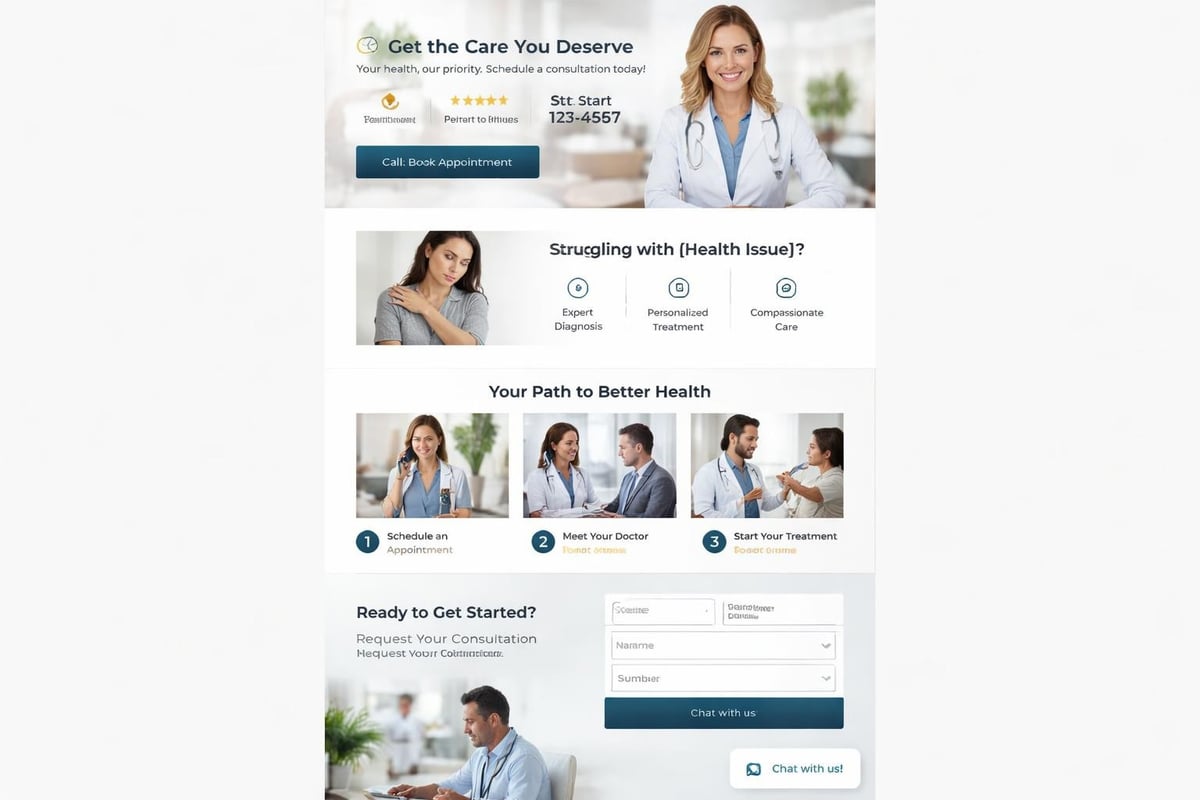
Traffic means nothing without conversion. The landing page determines whether an interested prospect becomes a scheduled patient. Successful clinic advertising campaigns direct traffic to dedicated, purpose-built landing pages rather than generic website homepages.
Essential Landing Page Elements
Headline Clarity immediately communicates the specific solution. "Revolutionary Knee Pain Relief Without Surgery" outperforms vague statements like "Orthopedic Excellence." Patients arrive with specific problems; your headline must address that problem directly.
Trust Indicators overcome skepticism inherent in healthcare decisions:
- Board certifications and professional memberships
- Years of experience and number of procedures performed
- Patient reviews and testimonials (compliant with regulations)
- Professional facility photos
- Insurance partnerships and payment options
Streamlined Conversion Paths eliminate friction. Every additional form field reduces conversion rates by approximately 10%. Request only essential information: name, phone number, preferred appointment time. Comprehensive intake forms can wait until after booking.
Mobile Optimization Requirements
Over 65% of healthcare searches occur on mobile devices. Mobile-optimized landing pages aren't optional; they're fundamental. Click-to-call buttons must be prominently displayed, forms should use large input fields, and page load times must remain under three seconds to prevent abandonment.
Testing reveals that mobile users prefer different conversion methods than desktop users. Offering both form submissions and direct phone calls increases total conversions by 40-60% compared to form-only pages.
Measuring Advertising Performance and ROI
Effective clinic advertising requires rigorous performance tracking beyond surface-level metrics. Vanity metrics like impressions and clicks matter less than patient acquisition costs and lifetime value calculations.
Critical Performance Indicators
Cost Per Acquisition (CPA) measures total advertising spend divided by new patients acquired. This metric varies dramatically by specialty. A men's health clinic might maintain a $200 CPA for testosterone therapy patients with high lifetime values, while urgent care centers target $50 CPAs for higher-volume, lower-value visits.
Appointment Show Rates significantly impact true acquisition costs. A campaign generating 100 appointments at $100 each appears to achieve a $100 CPA, but if only 60% show for appointments, the actual CPA rises to $167. Systematic follow-up and appointment confirmation processes improve show rates and reduce true acquisition costs.
Patient Lifetime Value (LTV) justifies advertising investments. A weight loss clinic patient might generate $5,000 in revenue over 18 months, supporting much higher acquisition costs than single-visit services. Calculate LTV by specialty and treatment type to determine appropriate CPA targets.
| Metric | Calculation | Target Benchmark | What It Reveals |
|---|---|---|---|
| Cost Per Click (CPC) | Ad Spend ÷ Clicks | $2-$8 (varies by specialty) | Keyword competition and ad relevance |
| Click-Through Rate (CTR) | (Clicks ÷ Impressions) × 100 | 3-8% for search ads | Ad copy effectiveness |
| Conversion Rate | (Conversions ÷ Clicks) × 100 | 5-15% for healthcare | Landing page performance |
| Cost Per Lead | Ad Spend ÷ Leads Generated | $50-$300 (specialty dependent) | Top-of-funnel efficiency |
| Lead-to-Patient Rate | (New Patients ÷ Leads) × 100 | 25-50% | Follow-up effectiveness |
Attribution Modeling Challenges
Healthcare decision-making rarely follows linear paths. A patient might see a Facebook ad, visit the website, research the provider on Google, read reviews, and then call three weeks later. Multi-touch attribution models assign partial credit to each touchpoint, providing clearer pictures of which channels actually drive conversions.
First-click attribution credits the initial discovery channel. Last-click attribution credits the final touchpoint before conversion. Linear attribution distributes credit evenly. Most sophisticated clinic advertising strategies use time-decay models that weight recent touchpoints more heavily while acknowledging the full patient journey.
Retargeting Strategies for Extended Patient Journeys
Healthcare decisions require time and consideration. Few patients book procedures immediately after first exposure to clinic advertising. Retargeting campaigns nurture prospects through extended decision-making processes.
Segmented Retargeting Approaches
Website Visitor Retargeting reaches prospects who visited your site but didn't convert. Proprietary technology can now identify 60% of anonymous website visitors, enabling more sophisticated follow-up than standard cookie-based retargeting. This expanded identification dramatically increases addressable audience sizes for retargeting campaigns.
Segment visitors by behavior:
- Homepage visitors receive broad awareness messaging
- Service page visitors see specific treatment information
- Pricing page visitors receive offers or financing information
- Blog readers receive educational content establishing expertise
Engagement-Based Sequences vary messaging based on interaction level. Someone who watched 75% of a procedure explanation video demonstrates higher intent than someone who watched 10%. Higher-intent audiences warrant more direct calls-to-action and potentially higher retargeting budgets.
Time-Based Nurturing recognizes that decision timelines vary by service type. Elective cosmetic procedures often require months of consideration, supporting longer retargeting windows. Acute pain management demands shorter, more aggressive sequences focused on immediate relief.
Content Marketing Integration with Paid Advertising
The most effective clinic advertising strategies combine paid promotion with valuable content. Building a compelling website and starting a blog creates assets that improve organic visibility while providing rich material for paid promotion.
Content Types That Drive Engagement
Educational Video Content performs exceptionally well in paid promotion. A three-minute video explaining regenerative medicine options for knee pain costs little to produce but can be promoted across YouTube, Facebook, and Instagram, driving awareness and establishing authority simultaneously.
Condition-Specific Guides address patient questions comprehensively. A downloadable guide titled "Understanding Your Hormone Replacement Therapy Options" serves as a valuable lead magnet, offering genuine educational value in exchange for contact information. Promoting these guides through paid advertising generates higher-quality leads than direct appointment requests.
Patient Success Stories (compliant with HIPAA and professional standards) provide social proof that overcomes hesitation. Video testimonials showing real patients discussing their experiences create emotional connections that clinical information alone cannot achieve.
Email Marketing and Marketing Automation
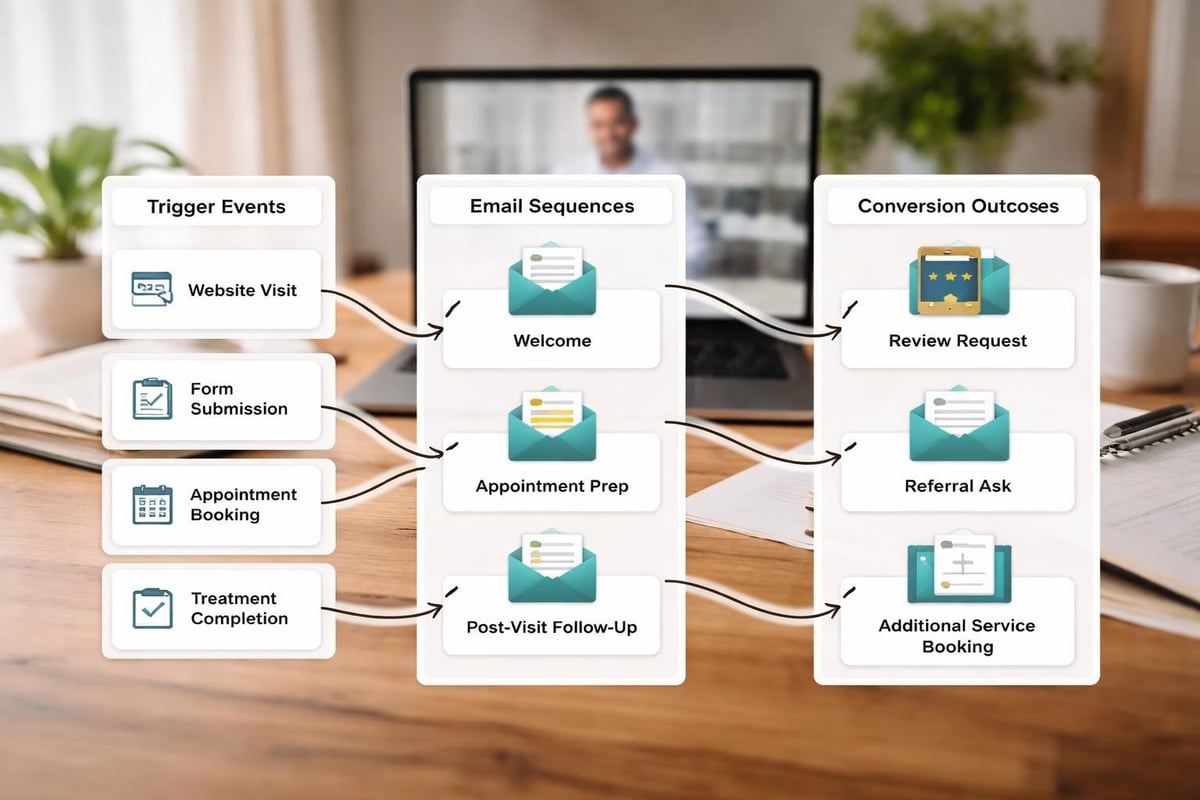
Clinic advertising extends beyond initial acquisition. Email marketing transforms one-time patients into long-term relationships while reactivating dormant patients at minimal cost compared to new patient acquisition.
Automated Campaign Sequences
Welcome Series introduce new patients to your practice philosophy, team, and services beyond their initial treatment reason. A patient who visits for acute back pain might benefit from learning about your comprehensive wellness programs, preventive care options, or related services.
Appointment Reminders and Preparation reduce no-show rates while demonstrating professionalism. Automated sequences can send confirmation immediately after booking, preparation instructions three days before, and final reminders 24 hours before appointments. Each touchpoint reinforces the appointment commitment and reduces last-minute cancellations.
Post-Visit Follow-Up encourages reviews, referrals, and continued engagement. A sequence beginning with "How are you feeling after your procedure?" demonstrates genuine care while creating opportunities to address concerns before they become negative reviews.
Reactivation Campaigns target patients who haven't visited recently. Segmenting by last visit date and previous service allows personalized messaging: "It's been six months since your last dental cleaning" or "Annual physicals are recommended-schedule yours today."
Local SEO and Directory Optimization
While not strictly paid advertising, local search optimization represents essential infrastructure for clinic advertising success. Paid campaigns drive traffic, but local search presence determines whether patients find you through organic searches and directories.
Google Business Profile Optimization
Your Google Business Profile serves as your primary local search asset. Complete profiles with accurate hours, services, photos, and regular posts receive preferential placement in local search results and Google Maps.
Review Generation directly impacts local rankings and conversion rates. Systematic review requests following positive patient experiences build social proof that amplifies paid advertising effectiveness. Responding to all reviews (positive and negative) demonstrates engagement and professionalism.
Post Regular Updates about new services, seasonal offerings, or health tips. Google Business posts appear in search results and signal active practice management to both Google's algorithm and potential patients.
Healthcare Directory Listings
Specialized healthcare directories provide targeted traffic:
- Healthgrades
- Vitals
- RateMDs
- Zocdoc
- WebMD Physician Directory
Maintaining consistent NAP (Name, Address, Phone) information across all directories improves local SEO while providing additional patient discovery channels. Many directories offer paid placement options that deliver qualified traffic at lower costs than general search advertising.
Emerging Technologies in Healthcare Advertising
The clinic advertising landscape continues evolving with new technologies offering unprecedented targeting precision and conversion optimization capabilities.
Artificial Intelligence and Predictive Analytics
AI-powered advertising platforms analyze millions of data points to identify patterns in patient behavior, optimal ad timing, and highest-converting audience segments. Machine learning algorithms continuously optimize campaign performance, adjusting bids, ad placements, and targeting parameters faster and more accurately than manual management.
Predictive lead scoring identifies which prospects demonstrate highest conversion likelihood, allowing sales teams to prioritize follow-up efforts. A lead who viewed pricing information, watched a procedure video, and visited the contact page scores higher than someone who simply read a blog post.
Conversational Marketing and Chatbots
Website chat functionality transforms passive browsing into active conversations. AI-powered chatbots answer common questions 24/7, qualify leads, and schedule appointments without human intervention. Advanced systems integrate with practice management software, checking real-time availability and confirming bookings directly.
This technology proves particularly valuable for practices serving multiple time zones or patients researching care options outside business hours. A telehealth provider advertising nationally benefits tremendously from automated conversation capabilities that never sleep.
Advanced Visitor Identification Technology
Traditional website analytics reveal that 95-98% of visitors remain anonymous. Proprietary identification technology now unmasks 60% of anonymous website traffic, revealing contact information for follow-up even when visitors don't complete forms. This breakthrough dramatically expands addressable audiences for retargeting and direct outreach campaigns.
Combined with automated follow-up systems and rapid response protocols (2-minute response times significantly increase conversion rates), this technology transforms clinic advertising from simple awareness generation into comprehensive patient acquisition systems.
Compliance-First Advertising Practices
Maintaining ethical standards and regulatory compliance protects your practice from legal risks while building patient trust. Understanding how to advertise your clinic responsibly requires ongoing attention to evolving regulations and professional standards.
Avoiding Common Compliance Pitfalls
Testimonial Regulations vary by state and specialty. Always obtain written consent before using patient names, photos, or stories. Include appropriate disclaimers stating that results vary and testimonials reflect individual experiences, not guaranteed outcomes.
Outcome Claims require careful wording. "Board-certified orthopedic surgeon specializing in knee replacement" states factual credentials. "Guaranteed pain-free recovery" makes unprovable promises that violate most medical advertising standards.
Comparative Advertising claiming superiority over competitors faces strict scrutiny. Rather than stating "better than other clinics," focus on specific differentiators: "20+ years experience," "same-day appointments available," or "accepting new patients."
The legal and ethical issues in dental advertising outlined by professional associations apply broadly across healthcare specialties, emphasizing truthfulness, patient welfare, and professional dignity as core principles.
Budget Allocation and Resource Planning
Effective clinic advertising requires strategic budget allocation across channels, testing, and optimization. Most successful practices dedicate 5-10% of revenue to marketing, with new practices or those in competitive markets investing 10-15% during growth phases.
Channel Budget Distribution
Diversification reduces risk while testing reveals highest-performing channels:
- Search Advertising: 30-40% of budget (high intent, immediate needs)
- Social Media Advertising: 20-30% (awareness, retargeting)
- Display/Retargeting: 15-20% (nurturing extended journeys)
- Email Marketing: 5-10% (retention, reactivation)
- Testing Budget: 10-15% (new channels, creative approaches)
Track performance by channel and specialty. Women's health clinics might find Facebook advertising exceptionally effective for hormone therapy, while orthopedic practices generate better results from Google search ads for joint pain keywords.
Scaling Successful Campaigns
Once campaigns prove profitable (patient LTV exceeds acquisition costs by target margins), systematic scaling amplifies results. Gradually increase budgets while monitoring efficiency metrics. Most campaigns maintain efficiency through 30-50% budget increases before experiencing diminishing returns requiring strategic adjustments.
Geographic Expansion offers scaling opportunities for practices with capacity. If clinic advertising succeeds in a 10-mile radius, expanding to 15-20 miles typically maintains similar efficiency while accessing new patient populations.
Service Line Expansion diversifies revenue streams. A medical spa successfully advertising Botox might expand into hormone replacement therapy, leveraging existing brand recognition and patient relationships to launch new services more efficiently than starting from scratch.
Strategic clinic advertising combines regulatory compliance, multi-channel execution, and systematic conversion optimization to transform healthcare practices into thriving patient-centered businesses. Success requires more than running ads; it demands comprehensive systems that nurture prospects from first awareness through appointment booking and beyond. RevSpark Media specializes in building these complete patient acquisition systems for healthcare providers, combining proprietary visitor identification technology with in-house pre-sales development teams that ensure your advertising investment translates into actual scheduled patients through 2-minute response times, systematic follow-up, and complete CRM integration. If you're ready to move beyond basic advertising into a performance-driven growth platform that guarantees results, explore how RevSpark Media's proven approach has generated over $100M in client growth.