
The healthcare industry faces unique challenges when it comes to marketing, from strict regulatory requirements to patient privacy concerns and complex decision-making processes. Successfully navigating this landscape requires a strategic approach that combines educational content with targeted advertising campaigns. Content and advertising must work together seamlessly to attract qualified leads, build trust with potential patients, and convert interest into booked appointments. For healthcare providers ranging from wound care centers to addiction treatment facilities, understanding how to integrate these two marketing pillars creates a foundation for sustainable growth and patient acquisition.
The Relationship Between Content and Advertising in Healthcare Marketing
Content and advertising serve complementary roles in modern healthcare marketing strategies. While advertising drives immediate visibility and traffic, content builds the trust and authority necessary to convert that traffic into actual patients. Healthcare consumers today conduct extensive research before making treatment decisions, often reviewing multiple providers and educational resources.
Quality content establishes credibility by demonstrating expertise, answering patient questions, and addressing concerns before they arise. This educational approach proves particularly valuable in specialized healthcare sectors like telehealth services, medical spas, and compounding pharmacies where patients may lack familiarity with treatment options.
Building a Content Foundation for Advertising Success
Effective advertising campaigns require strong landing destinations. When potential patients click on an advertisement for orthopedic services or women's health treatments, they expect to find relevant, informative content that validates their decision to click. This connection between ad promise and content delivery determines conversion rates.
Creating a robust content library involves several strategic components:
- Educational blog posts addressing common patient questions and concerns
- Service-specific landing pages with clear value propositions and calls-to-action
- Video content explaining procedures, introducing providers, and showcasing patient testimonials
- Downloadable resources like treatment guides, preparation checklists, and FAQ documents
- Case studies demonstrating successful patient outcomes (with appropriate privacy protections)
The seven essential content marketing best practices emphasize using customer language and optimizing for various search result types, which applies directly to healthcare marketing where patients search using symptom-based queries rather than medical terminology.
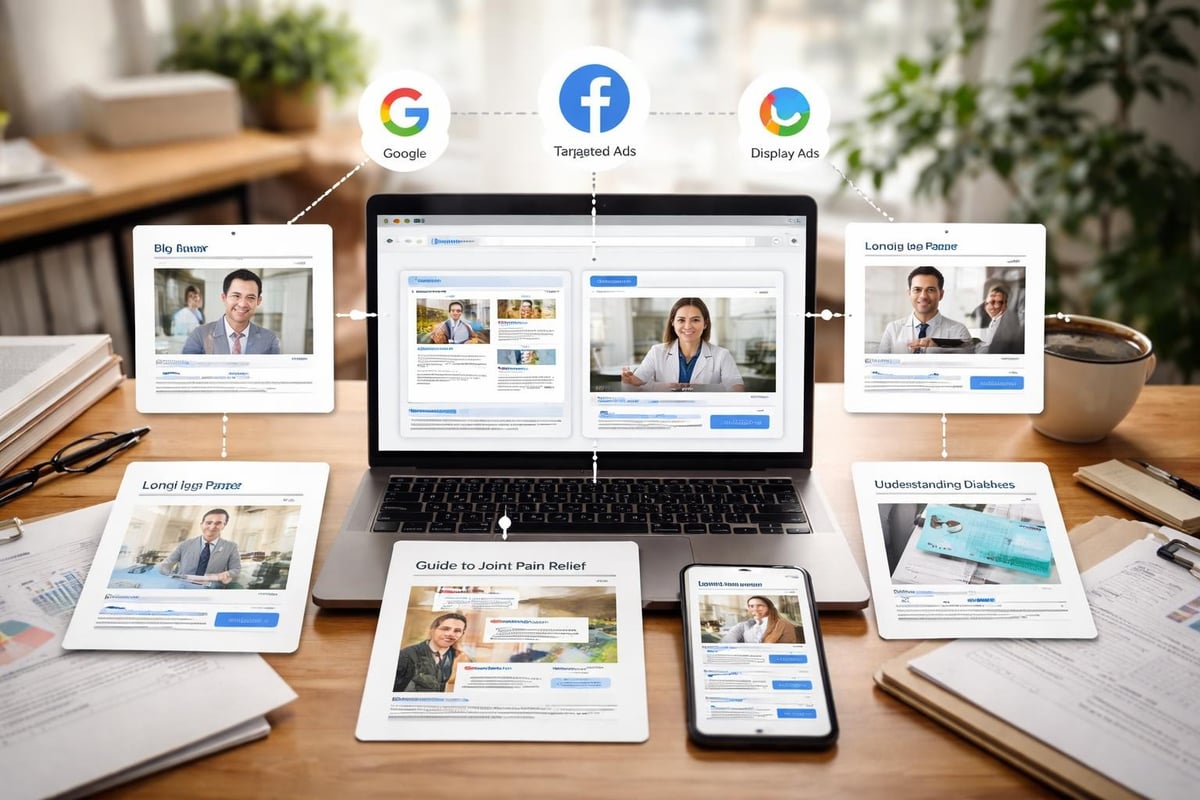
Strategic Content Development for Healthcare Advertising Campaigns
Content and advertising alignment begins with understanding patient journey stages and creating corresponding content assets. A potential patient researching addiction treatment options has different information needs than someone ready to book a consultation at a men's health clinic.
| Patient Journey Stage | Content Type | Advertising Approach |
|---|---|---|
| Awareness | Educational blog posts, symptom guides | Broad keyword targeting, educational ad copy |
| Consideration | Treatment comparisons, provider credentials | Competitive keyword targeting, benefit-focused ads |
| Decision | Pricing information, consultation booking pages | Brand keywords, urgent calls-to-action |
| Retention | Follow-up care guides, wellness content | Remarketing campaigns, email nurture sequences |
Crafting Healthcare-Specific Content That Converts
Healthcare content must balance medical accuracy with accessibility. Patients need enough information to make informed decisions without feeling overwhelmed by technical jargon. This balance becomes especially critical for complex specialties like pharmaceutical distribution or veterinary medicine franchise systems.
Successful healthcare content incorporates:
- Clear explanations of conditions and treatments using patient-friendly language
- Transparency about procedures, timelines, and expected outcomes
- Credibility signals including provider qualifications and certifications
- Trust-building elements like patient reviews and success metrics
- Strong calls-to-action guiding visitors toward appointment booking
The research on advertising demand and media content demonstrates how advertising influences content creation, a dynamic particularly relevant in healthcare where advertising regulations shape messaging strategies.
Advertising Strategies That Amplify Healthcare Content
While organic content builds long-term authority, paid advertising accelerates patient acquisition by placing your services directly in front of qualified prospects. Content and advertising integration ensures every ad dollar works harder by directing traffic to optimized conversion pathways.
Platform Selection for Healthcare Advertising
Different advertising platforms serve distinct purposes in healthcare marketing. Google Ads captures high-intent searches from patients actively seeking solutions, while Facebook and Instagram enable targeted awareness campaigns reaching specific demographics.
Google Search Ads excel at capturing demand from patients searching for specific treatments like "wound care specialist near me" or "telehealth women's health consultation." These campaigns require:
- Tightly themed ad groups matching specific services
- Landing pages directly addressing the searched keywords
- Ad copy highlighting unique value propositions and urgency factors
- Call extensions enabling immediate phone contact
Social Media Advertising builds awareness and nurtures relationships with potential patients who may not yet recognize their need for services. Medical spas, wellness clinics, and preventive care providers particularly benefit from visual platforms showcasing treatment results and lifestyle benefits.

Creating High-Performance Healthcare Ad Copy
Effective advertising copy in healthcare balances compliance requirements with persuasive messaging. Claims must be substantiated, privacy regulations respected, and patient safety prioritized while still communicating compelling reasons to choose your services.
The guide to making ads more engaging emphasizes high-quality visuals and compelling offers, principles that translate directly to healthcare advertising when applied within regulatory boundaries.
Proven ad copy frameworks include:
- Problem-Solution: "Struggling with chronic pain? Our orthopedic specialists offer same-day consultations."
- Unique Mechanism: "FDA-approved compounded medications tailored to your specific needs."
- Risk Reversal: "Free initial consultation to discuss treatment options with no obligation."
- Social Proof: "Trusted by 5,000+ patients for addiction treatment and recovery support."
Integration Tactics for Content and Advertising Synergy
Maximum marketing effectiveness comes from strategic integration where content and advertising reinforce each other across multiple touchpoints. A patient might first encounter your practice through a Facebook ad, read several blog posts, receive remarketing ads, and finally book an appointment after downloading a treatment guide.
Remarketing Strategies for Healthcare Services
Remarketing campaigns re-engage website visitors who didn't initially convert, a critical tactic considering the lengthy decision-making process for many healthcare services. A potential patient researching franchise opportunities in pharmaceutical distribution or exploring options for a medical spa treatment rarely commits on the first visit.
Effective remarketing sequences include:
- Immediate follow-up ads (1-3 days) reminding visitors of your services with educational content
- Value-building ads (4-10 days) highlighting credentials, patient success stories, and unique benefits
- Incentive-based ads (11-21 days) offering limited-time consultation discounts or free assessments
- Final push ads (22-30 days) creating urgency with expiring offers or appointment availability
Content and advertising alignment in remarketing means creating specific content assets for each retargeting stage, guiding prospects progressively toward conversion.
Lead Nurturing Through Content Sequences
Not every website visitor is ready to book immediately. Building automated content sequences that nurture leads over time increases eventual conversion rates while maintaining top-of-mind awareness. Email sequences triggered by content downloads or page visits deliver targeted information matching demonstrated interests.
A prospect who downloaded a guide about wound care treatment options receives different follow-up content than someone who viewed your franchise opportunity page. This personalization increases relevance and engagement throughout the patient journey.
Measuring Performance and Optimizing Content and Advertising
Data-driven optimization separates successful healthcare marketing from wasteful spending. Tracking both content performance and advertising metrics provides insights for continuous improvement. Modern analytics platforms reveal not just which ads drive clicks, but which content converts visitors into booked appointments.
Key Performance Indicators for Healthcare Marketing
| Metric Category | Specific KPIs | Why It Matters |
|---|---|---|
| Advertising Performance | Cost per click, click-through rate, impression share | Indicates ad relevance and competitive positioning |
| Content Engagement | Time on page, pages per session, bounce rate | Reveals content quality and visitor interest level |
| Conversion Metrics | Form submissions, phone calls, appointment bookings | Measures actual business impact |
| Patient Acquisition | Cost per lead, cost per appointment, show rate | Determines marketing ROI and profitability |
Attribution tracking becomes especially important when content and advertising work together across multiple touchpoints. A patient might click a Google ad, read three blog posts, receive remarketing ads, and finally convert through a direct website visit. Understanding this complete journey informs budget allocation decisions.

Continuous Improvement Through Testing
Systematic testing improves both content and advertising performance over time. A/B testing different ad headlines, landing page layouts, call-to-action placements, and content formats reveals what resonates most with your target audience.
For healthcare providers serving diverse specialties from veterinary medicine to addiction treatment, testing proves particularly valuable because patient motivations and concerns vary significantly across service lines. What works for medical spa advertising may fail completely for telehealth mental health services.
Testing priorities should include:
- Ad headline variations emphasizing different benefits
- Landing page layouts with varied information hierarchy
- Call-to-action button text and placement
- Content length and format (long-form vs. concise)
- Visual elements including images, videos, and graphics
Compliance Considerations for Healthcare Content and Advertising
Healthcare marketing operates under stricter regulations than most industries. HIPAA privacy requirements, state medical board restrictions, and platform-specific policies for healthcare advertising all influence what content you can create and how you can advertise it.
Navigating Healthcare Advertising Regulations
Understanding regulatory boundaries prevents costly violations while still enabling effective marketing. Claims about treatment outcomes must be substantiated, patient testimonials require proper consent, and certain treatments face advertising restrictions on major platforms.
Compliance best practices include:
- Review all content and advertising with legal counsel familiar with healthcare marketing
- Implement processes ensuring patient testimonials include proper authorization
- Avoid absolute claims like "cure" or "guarantee" unless substantiated
- Maintain clear distinction between advertising and medical advice
- Document substantiation for any statistical claims or treatment benefits
The systematic review of healthcare-related advertisements highlights how content analysis reveals compliance patterns and potential issues in healthcare advertising, providing a framework for evaluating your own campaigns.
Building Trust Through Transparent Marketing
Compliance serves not just legal requirements but also trust-building objectives. Patients increasingly value transparency, authenticity, and clear communication from healthcare providers. Marketing materials that acknowledge limitations alongside benefits demonstrate integrity that attracts quality patients.
Transparent content and advertising approaches include discussing realistic timelines, acknowledging when multiple treatment options exist, providing clear pricing information when possible, and setting appropriate expectations about outcomes and recovery processes.
Advanced Integration: Technology Platforms Connecting Content and Advertising
Modern marketing technology enables sophisticated integration between content creation, advertising deployment, and patient relationship management. CRM systems track every interaction from initial ad click through content consumption to final appointment booking and beyond.
Marketing Automation for Healthcare Providers
Automation platforms connect advertising campaigns with content delivery and lead nurturing sequences. When a potential patient clicks an ad for orthopedic services, automation can trigger personalized email sequences, assign leads to sales development representatives, and update CRM records in real-time.
Key automation capabilities include:
- Triggered email sequences based on content downloads or page visits
- Automatic lead scoring identifying high-intent prospects
- CRM integration ensuring sales teams access complete visitor history
- Dynamic content personalization based on referral source or interest area
- Automated appointment reminders reducing no-show rates
These systems prove especially valuable for multi-location practices or franchise systems where centralized marketing drives leads to numerous individual facilities requiring coordinated follow-up processes.
Visitor Identification Technology
Advanced platforms now identify a significant percentage of anonymous website visitors, revealing which companies or households visited your site even when they don't complete forms. This technology transforms content and advertising effectiveness by enabling targeted outreach to engaged prospects who didn't initially convert.
For high-value services like franchise partnerships or specialized treatment programs, knowing which prospects engaged with your content provides sales teams actionable intelligence for personalized follow-up. This bridges the gap between passive content consumption and active sales conversations.
Content Types That Support Different Healthcare Advertising Goals
Strategic content development aligns with specific advertising objectives and patient acquisition goals. Brand awareness campaigns require different content support than conversion-focused initiatives targeting patients ready to book appointments immediately.
Educational Content for Top-of-Funnel Awareness
Early-stage prospects need informational content addressing symptoms, treatment options, and decision criteria without aggressive sales messaging. Blog posts answering common questions, comparison guides evaluating treatment alternatives, and educational videos explaining procedures all serve awareness-stage advertising.
Effective awareness content includes:
- Symptom checkers helping patients identify conditions
- Treatment comparison guides providing objective information
- Provider credential explanations building authority
- Industry news and research updates demonstrating expertise
- Preventive care guides establishing your practice as a wellness partner
Conversion-Optimized Content for Decision-Stage Advertising
Prospects ready to choose a provider need content facilitating that decision with specific details about your services, credentials, processes, and next steps. Landing pages for conversion campaigns should minimize distractions while maximizing relevant information and clear calls-to-action.
Decision-stage content emphasizes unique differentiators, removes objections, provides social proof through testimonials and reviews, explains booking processes clearly, and creates appropriate urgency without high-pressure tactics.
Scaling Content and Advertising for Multi-Location Healthcare Operations
Healthcare franchise systems, multi-location practices, and expanding service networks face unique challenges coordinating content and advertising across numerous facilities while maintaining brand consistency and local relevance.
Centralized Strategy with Local Customization
Successful multi-location marketing combines centralized strategic direction with localized execution. Corporate teams develop core messaging, advertising frameworks, and content templates while individual locations customize for their specific markets and patient populations.
This approach ensures brand consistency while enabling the local relevance that drives conversions. A wound care center in Miami requires different content emphasis than one in Minneapolis, even when both belong to the same franchise system.
Multi-location content strategies include:
- Core content library accessible to all locations covering common services and conditions
- Localized landing pages optimized for geo-specific searches
- Location-specific blog content addressing regional health concerns
- Centralized advertising campaign management with location-based targeting
- Shared patient success stories from across the network
Franchise Development Content and Advertising
For healthcare franchise systems seeking to attract qualified franchise partners, content and advertising strategies differ significantly from patient acquisition campaigns. Prospective franchisees evaluate investment potential, operational support, brand strength, and growth trajectory.
Franchise development content includes financial performance data, training and support documentation, market opportunity analyses, and existing franchisee testimonials. Advertising targets entrepreneurs and healthcare professionals exploring business ownership opportunities rather than patients seeking treatment.
Successful healthcare marketing requires sophisticated integration where content and advertising work together to attract qualified leads, build trust through education, and convert interest into scheduled appointments. By aligning content development with advertising objectives, implementing systematic testing and optimization, maintaining regulatory compliance, and leveraging modern marketing technology, healthcare providers can achieve sustainable patient acquisition and revenue growth. RevSpark Media specializes in this comprehensive approach for healthcare providers and franchise systems, combining proprietary visitor identification technology with expert content creation, advertising management, and in-house pre-sales teams that ensure leads convert into actual patients with industry-leading 2-minute response times. Contact RevSpark Media to discover how their performance-driven platform can transform your patient acquisition results.