
Understanding your marketing efficiency starts with knowing exactly what you pay for each potential patient or client who shows interest in your healthcare services. For medical practices, wound care centers, telehealth providers, and healthcare franchises, tracking this fundamental metric determines whether your marketing investments generate sustainable growth or drain resources without adequate returns. The healthcare industry faces unique challenges in lead generation, including strict compliance requirements, longer sales cycles, and higher patient acquisition costs compared to other sectors, making precise measurement and optimization critical for profitability.
What Cost Per Lead Means for Healthcare Marketing
Cost per lead represents the total amount you spend on marketing divided by the number of leads generated during a specific period. In healthcare contexts, a lead might be someone who requests information about hormone replacement therapy, schedules a consultation at your medical spa, inquires about franchise opportunities, or completes a form for addiction treatment services.
Understanding cost per lead involves more than simple division. You must define what qualifies as a lead for your specific practice type. A telehealth provider might count anyone who completes an online intake form, while an orthopedic practice might only count leads who schedule initial consultations. This distinction matters because it affects how you calculate efficiency and compare performance across different marketing channels.

Healthcare providers often work with multiple lead definitions:
- Information Qualified Leads (IQLs): Prospects who download content or request general information
- Marketing Qualified Leads (MQLs): Contacts who meet demographic and behavioral criteria indicating purchase intent
- Sales Qualified Leads (SQLs): Leads vetted by your team as ready for consultation or treatment discussion
- Appointment Set Leads: Prospects with confirmed consultation times on the calendar
Each category carries different costs and conversion probabilities. A compounding pharmacy generating 100 information requests monthly at $50 each faces different economics than generating 20 appointment-set leads at $250 each, even though both scenarios cost $5,000 total.
Calculating Your Healthcare Lead Generation Costs
The basic formula for cost per lead divides total marketing spend by leads generated. However, healthcare marketers must account for several expense categories that other industries might overlook.
Complete Cost Components
Your true marketing investment includes direct advertising costs plus supporting infrastructure:
- Paid advertising spend across Google Ads, Facebook, Instagram, and other platforms
- Creative development costs for compliant ad copy and medical imagery
- Landing page hosting and maintenance with HIPAA-appropriate security
- CRM subscription fees for lead management systems
- Marketing automation tools for follow-up sequences
- Compliance review expenses to ensure regulatory adherence
- Agency or internal team salaries allocated to lead generation
A men's health clinic spending $8,000 monthly on Facebook ads, $2,000 on landing page tools, $1,500 on CRM systems, and $3,000 in allocated staff time invests $14,500 total. If this generates 290 leads, the cost per lead equals $50, not the $27.59 you would calculate using advertising spend alone.
| Cost Category | Monthly Investment | Often Overlooked? |
|---|---|---|
| Platform Ad Spend | $8,000 | No |
| Technology Stack | $3,500 | Yes |
| Team Allocation | $3,000 | Yes |
| Total Investment | $14,500 | – |
| Leads Generated | 290 | – |
| Actual CPL | $50.00 | – |
This comprehensive calculation reveals your true acquisition economics and prevents underestimating the resources required for sustainable lead generation.
Healthcare Industry Benchmarks and Expectations
Cost per lead varies dramatically across healthcare specialties based on service value, competition intensity, and patient lifetime value. Medical services with higher revenue potential naturally support higher acquisition costs while maintaining profitability.
Addiction treatment centers, for example, often see costs ranging from $100 to $400 per lead because treatment programs generate substantial revenue and insurance reimbursements justify premium acquisition investments. Conversely, routine primary care practices might target costs between $25 and $75 since individual visit values are lower.
Specialty-Specific Expectations
Understanding where your practice falls within industry norms helps set realistic budgets and performance standards:
- Medical Spas and Aesthetics: $40-$120 per lead depending on service mix and geographic market
- Orthopedic and Sports Medicine: $75-$200 per lead for surgical and interventional services
- Telehealth Platforms: $30-$90 per lead with variation based on specialty and prescription authority
- Wound Care Centers: $100-$250 per lead reflecting specialized nature and reimbursement rates
- Veterinary Medicine: $35-$100 per lead varying by service type and clinic positioning
- Franchise Lead Generation: $150-$500 per qualified franchise inquiry given long-term partnership value
These ranges reflect qualified leads, not simple form submissions. Industry benchmarks for cost per lead demonstrate that healthcare consistently ranks among higher-cost sectors due to regulatory complexity, trust requirements, and longer decision cycles.
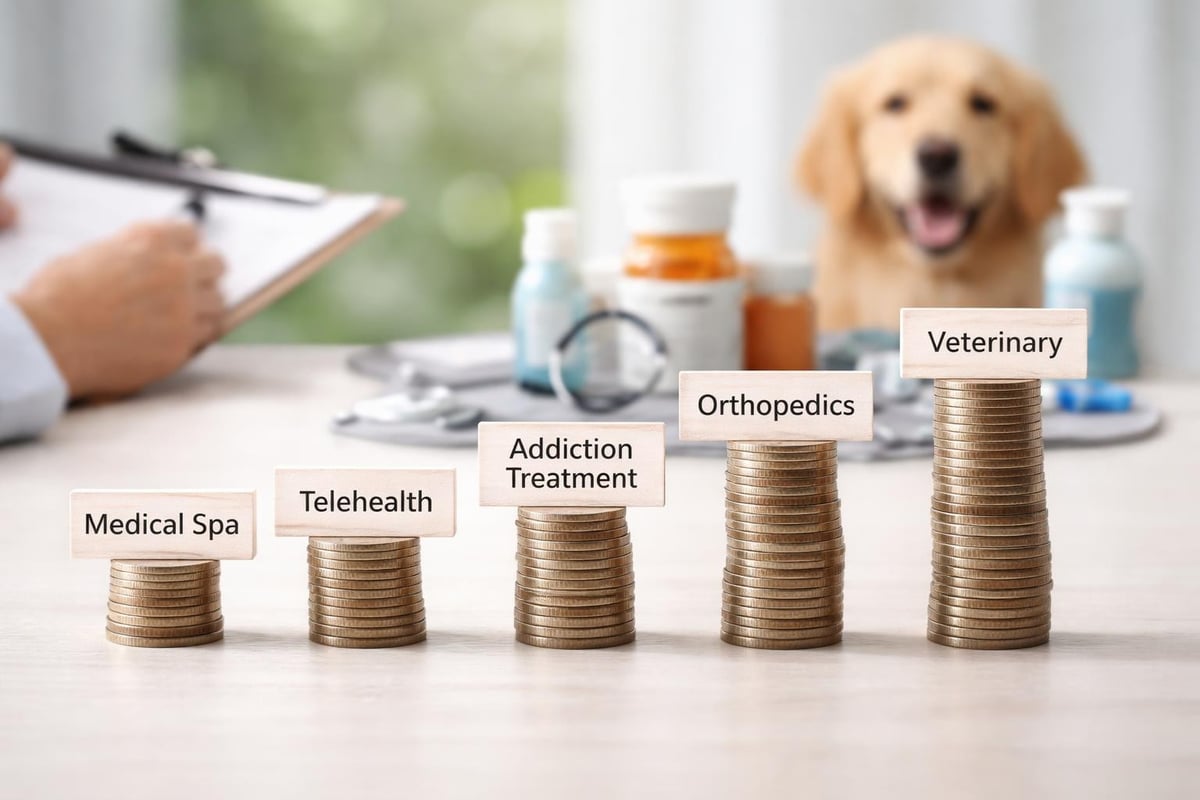
Geographic location significantly impacts these figures. Practices in competitive metropolitan markets like Los Angeles, New York, or Miami typically pay 30-50% more per lead than similar providers in mid-sized cities or rural areas where advertising inventory costs less and competition remains lighter.
Strategies to Reduce Cost Per Lead in Healthcare
Lowering acquisition costs without sacrificing lead quality requires systematic optimization across multiple touchpoints in your marketing funnel. Healthcare providers often focus exclusively on reducing advertising costs, but comprehensive efficiency gains come from improving conversion rates at each stage.
Audience Targeting Refinement
Precise targeting ensures your budget reaches prospects most likely to convert into patients. Rather than broad demographic campaigns, successful healthcare marketers layer multiple criteria:
- Geographic radius appropriate for your service area and patient willingness to travel
- Age ranges specific to your specialty (fertility services versus senior care)
- Income levels that align with your pricing and insurance acceptance
- Behavioral signals indicating active health concern research
- Lookalike audiences modeled from your highest-value existing patients
A women's health clinic targeting hormone replacement therapy might focus on females aged 35-55 within 25 miles, with household incomes above $75,000, who have engaged with menopause-related content in the past 90 days. This precision increases conversion rates and decreases wasted spend on unlikely prospects.
Landing Page Conversion Optimization
Improving your cost per lead efficiency often requires less spending reduction and more conversion improvement. If your current campaign generates leads at $80 each with a 3% landing page conversion rate, improving that conversion to 4.5% drops your cost to $53 without changing ad spend.
High-performing healthcare landing pages include:
- Clear value proposition addressing specific patient pain points in the headline
- Trust signals including provider credentials, accreditations, and patient testimonials
- Simple forms requesting only essential information to reduce friction
- Mobile optimization since 60-70% of healthcare searches occur on smartphones
- HIPAA-compliant security messaging to address privacy concerns
- Minimal navigation keeping visitors focused on conversion action
- Strategic social proof with before/after images where appropriate and compliant
Testing different elements systematically reveals which changes drive conversion improvements. An addiction treatment center might test headlines emphasizing discretion versus recovery success rates, or forms requesting phone numbers versus email addresses.
The Relationship Between CPL and Patient Lifetime Value
Cost per lead becomes meaningful only when viewed against the revenue each converted patient generates over their relationship with your practice. A $200 cost per lead that converts 40% into patients generating $8,000 average lifetime value delivers exceptional returns, while a $50 lead with 5% conversion into $600 patients proves unsustainable.
Calculating Acceptable Acquisition Costs
Healthcare providers should work backward from patient economics to determine viable cost per lead thresholds. Start with these metrics:
Patient Lifetime Value (LTV) = Average transaction value × Number of visits per patient × Gross margin percentage
Allowable Cost Per Acquisition (CPA) = LTV × Target acquisition cost percentage (typically 10-30%)
Required Lead-to-Patient Conversion Rate = Allowable CPA ÷ Cost per lead
For a medical spa where average patients spend $3,500 annually over 2.5 years with 60% margins, lifetime value reaches $5,250. If you target 20% of LTV for acquisition costs, you can spend $1,050 per new patient. With a 25% lead-to-patient conversion rate, your maximum sustainable cost per lead equals $262.
| Metric | Example Calculation | Result |
|---|---|---|
| Annual Patient Revenue | $3,500 | – |
| Average Relationship Length | 2.5 years | – |
| Total Revenue Per Patient | $3,500 × 2.5 | $8,750 |
| Gross Margin | 60% | – |
| Patient LTV | $8,750 × 0.60 | $5,250 |
| Target Acquisition % | 20% of LTV | – |
| Allowable CPA | $5,250 × 0.20 | $1,050 |
| Lead Conversion Rate | 25% | – |
| Maximum CPL | $1,050 ÷ 0.25 | $262 |
This framework prevents arbitrary cost decisions and grounds your marketing investment in actual business economics. Practices that understand these relationships make informed choices about channel selection, targeting parameters, and campaign optimization priorities.
Channel-Specific Cost Per Lead Performance
Different marketing channels deliver varying cost per lead results based on audience intent, competition levels, and format effectiveness. Healthcare providers benefit from diversifying across multiple channels while understanding each platform's strengths and typical economics.
Search Engine Marketing
Google Ads and Bing Ads typically generate higher-intent leads since users actively search for solutions to their health concerns. Someone searching "hormone replacement therapy near me" or "addiction treatment centers accepting insurance" demonstrates immediate need and purchase intent.
However, competition in healthcare search advertising drives up costs significantly. High-value keywords in lucrative specialties like plastic surgery, addiction treatment, or fertility services often cost $50-$150 per click, requiring strong landing page conversion to achieve viable economics.
Search campaigns excel for established practices with clear service offerings and good conversion infrastructure. New providers or those still refining their patient journey often find search too expensive during early growth phases.
Social Media Advertising
Facebook and Instagram deliver lower cost per lead in raw numbers but often generate earlier-stage prospects requiring more nurturing before conversion. These platforms work well for awareness-building, educational content promotion, and targeting specific demographics through detailed audience parameters.
Social media cost per lead for healthcare typically ranges from 30-60% lower than search campaigns, but conversion rates to actual patients may also run proportionally lower. A telehealth provider might generate leads at $35 on Facebook versus $80 on Google, but if Facebook leads convert at 15% while Google leads convert at 35%, the cost per acquired patient remains similar.
The key advantage lies in reaching patients before they actively search, establishing brand awareness, and building trust through educational content that positions your practice as the logical choice when treatment needs arise.

Content Marketing and Organic Channels
While organic strategies require time investment rather than direct advertising spend, calculating cost per lead remains valuable. Allocate content creation costs, SEO tool subscriptions, and team hours against leads generated through blog traffic, organic search, and content downloads.
These channels typically show higher upfront costs per lead but improve dramatically over time as content libraries grow and compound. A wound care center publishing weekly educational articles might see $400 cost per lead in month three but $60 per lead by month eighteen as accumulated content ranks and attracts consistent traffic.
Improving Lead Quality to Maximize Marketing ROI
Lower cost per lead means nothing if those leads never convert into revenue-generating patients. Healthcare providers must balance quantity metrics with quality standards to ensure marketing investments drive actual growth rather than simply filling CRM systems with unqualified contacts.
Qualification Criteria Implementation
Establishing clear lead qualification criteria helps your team focus follow-up efforts on genuine opportunities while filtering out tire-kickers, information gatherers, and unqualified prospects.
Strong qualification frameworks consider:
- Geographic eligibility: Located within practical service area
- Insurance alignment: Coverage matches your accepted plans or patient can pay out-of-pocket
- Service fit: Needs match your actual capabilities and specialties
- Timeline: Ready for treatment within reasonable timeframe
- Decision authority: Contact person can make or influence healthcare decisions
A veterinary medicine franchise generating leads for new franchise partners might qualify based on minimum capital requirements, relevant industry experience, and desired territory availability. Meanwhile, a compounding pharmacy qualifying patient leads focuses on prescription requirements, insurance coverage, and physician referral status.
By implementing pre-qualification questions in lead forms or during initial contact, you can calculate cost per lead separately for all leads versus qualified leads, revealing true acquisition efficiency.
Technology's Role in Cost Per Lead Optimization
Modern healthcare marketing increasingly relies on technology platforms that improve targeting precision, accelerate follow-up, and provide attribution visibility. These tools justify their costs by lowering overall acquisition expenses and improving conversion rates.
Visitor Identification Systems
Advanced platforms now identify 50-60% of anonymous website visitors by matching IP addresses, behavioral patterns, and data partnerships to reveal company information and contact details. For healthcare providers, this technology transforms website traffic into actionable leads even when visitors don't complete forms.
A men's health clinic with 3,000 monthly website visitors might traditionally capture 90 leads through form submissions (3% conversion). Visitor identification technology could reveal an additional 1,200 identifiable prospects, dramatically changing economics. While not all identified visitors represent genuine leads, even a 10% qualification rate adds 120 leads monthly, potentially cutting cost per lead in half.
Rapid Response Systems
Research consistently shows that leads contacted within five minutes convert at 10x the rate of those reached after one hour. Healthcare prospects researching multiple providers will engage with whoever responds first, making speed a critical competitive advantage.
Automated response systems, integrated calling platforms, and properly staffed follow-up teams ensure immediate engagement. A two-minute response time standard transforms lead economics by dramatically improving conversion rates without increasing acquisition costs.
| Response Time | Lead-to-Patient Conversion Rate | Effective CPL (if base CPL = $100) |
|---|---|---|
| Under 5 minutes | 35% | $100 |
| 5-30 minutes | 20% | $175 |
| 30-60 minutes | 12% | $292 |
| 1-24 hours | 8% | $438 |
| 24+ hours | 3% | $1,167 |
These numbers demonstrate how operational excellence in lead handling matters as much as marketing campaign optimization for controlling effective patient acquisition costs.
Attribution Modeling for Accurate Cost Per Lead Tracking
Healthcare patient journeys rarely follow simple linear paths from advertisement to appointment. Prospects typically interact with multiple touchpoints including search ads, social media content, review sites, website visits, remarketing campaigns, and email sequences before converting.
Single-touch attribution models that credit only the first or last interaction oversimplify this reality and distort cost per lead calculations. A patient who first discovers your practice through a Facebook ad, later searches your brand name on Google, reads three blog articles, and finally books through a remarketing email involved four distinct marketing investments.
Multi-Touch Attribution Approaches
Healthcare marketers should implement attribution models that distribute credit across the patient journey:
First-touch attribution credits the initial awareness channel, useful for understanding which campaigns introduce new prospects to your practice.
Last-touch attribution credits the final conversion point, highlighting which campaigns close deals but potentially undervaluing earlier awareness investments.
Linear attribution distributes credit equally across all touchpoints, providing balanced perspective but not distinguishing particularly influential interactions.
Time-decay attribution gives more credit to recent touchpoints, reflecting the reality that prospects close to decision receive disproportionate influence from late-stage marketing.
Position-based attribution assigns higher credit to first and last touches while distributing remaining credit across middle interactions, acknowledging that introduction and closing matter most.
Sophisticated healthcare providers test multiple models to understand channel contribution from different perspectives, then allocate budgets based on comprehensive performance analysis rather than oversimplified last-click metrics.
Seasonal Variations in Healthcare Lead Costs
Cost per lead fluctuates throughout the year based on seasonal demand patterns, competitive intensity, and platform dynamics. Healthcare marketers who recognize these patterns can optimize spending timing and set appropriate performance expectations.
Predictable Seasonal Patterns
Many healthcare specialties experience consistent seasonal demand variations:
- Medical spas and aesthetics: Lower costs in January-March (New Year's resolution motivation) and September-November (preparing for holidays)
- Orthopedics and sports medicine: Higher volume in spring and summer (sports injuries and activity-related issues)
- Addiction treatment: Increased demand post-holidays (January) and after summer (September)
- General healthcare: Spikes in January (new insurance deductibles reset) and December (using remaining benefits)
Understanding your specialty's patterns allows budget allocation toward high-intent periods when conversion rates justify premium costs, while scaling back during slower periods or adjusting messaging to address seasonal-specific motivations.
Competitive Intensity Fluctuations
Beyond demand variations, competitive advertising intensity affects costs. Many healthcare providers increase spending during high-demand periods, driving up auction prices on advertising platforms. This creates a strategic choice: compete aggressively during peak periods despite higher costs, or focus on shoulder seasons with less competition and lower cost per lead.
A telehealth platform might find that while lead volume drops 30% in summer months, costs decrease 45%, creating better overall economics despite lower absolute numbers.
Optimizing Follow-Up to Improve Effective CPL
Your actual cost to acquire a patient depends not just on generating the lead but on converting that lead through effective follow-up systems. Two practices with identical $75 cost per lead can achieve vastly different patient acquisition costs based on their conversion processes.
Systematic Follow-Up Frameworks
High-performing healthcare providers implement structured follow-up sequences that persistently engage leads across multiple channels and touchpoints:
- Immediate automated response confirming receipt and setting expectations
- Personal phone call within 2-5 minutes from trained representative
- Text message follow-up for unreached leads with scheduling link
- Email sequence providing educational content and social proof
- Retargeting ads keeping your practice top-of-mind for unconverted prospects
- Periodic re-engagement attempts over 30-90 days for dormant leads
Addiction treatment centers and high-value services often benefit from 10-15 touch attempts before classifying leads as unresponsive, while routine services might limit follow-up to 5-7 attempts based on economic viability.
A wound care center converting 18% of leads with a three-touch sequence might improve to 28% conversion with an eight-touch sequence, dropping effective patient acquisition cost by 36% without changing upstream marketing spend or cost per lead.
Understanding and optimizing your cost per lead represents just the first step in building profitable patient acquisition systems for healthcare practices. The true measure of marketing success comes from converting those leads into scheduled appointments, completed treatments, and long-term patient relationships that drive sustainable revenue growth. RevSpark Media specializes in the complete lead-to-patient journey for healthcare providers, combining proprietary visitor identification technology with rapid-response follow-up teams that ensure your marketing investment translates into actual practice growth, not just database entries.