
The dental industry has undergone a profound transformation in how practices attract and retain patients. While referrals and traditional advertising once dominated the landscape, today's patients begin their healthcare journey online, searching for dental services, reading reviews, and evaluating practices before ever picking up the phone. Digital marketing for dental practices has become essential rather than optional, representing the primary channel through which modern practices build their patient base and maintain competitive advantage in increasingly crowded markets. Healthcare providers who ignore this shift risk losing market share to competitors who have embraced comprehensive digital strategies.
Why Digital Marketing Matters for Dental Practices
The healthcare consumer has evolved dramatically over the past five years. According to recent data, over 77% of patients use search engines before booking a medical appointment, and this percentage continues to climb. For dental practices specifically, the decision-making process increasingly happens online.
Digital marketing for dental practices offers measurable advantages over traditional advertising methods. Unlike billboard campaigns or direct mail, digital strategies provide real-time data on patient acquisition costs, conversion rates, and return on investment. This transparency allows practice managers to allocate budgets strategically and optimize campaigns based on performance rather than guesswork.
Key benefits include:
- Precise targeting of patients by location, demographics, and service needs
- Immediate tracking of campaign performance and patient acquisition costs
- Ability to adjust strategies in real-time based on data insights
- Lower cost per acquisition compared to traditional advertising methods
- Enhanced patient engagement through multiple digital touchpoints
The shift to digital channels has created unprecedented opportunities for practices of all sizes. Small practices can compete effectively with larger dental groups by implementing smart digital strategies that maximize visibility and conversion rates.
Building a High-Converting Dental Website
Your website serves as the digital storefront for your practice and often represents the first interaction potential patients have with your brand. A professional, user-friendly website forms the foundation of effective digital marketing, making this investment critical for long-term success.
Essential Website Components
Modern dental websites must balance aesthetic appeal with functional performance. Patients expect fast loading times, mobile responsiveness, and intuitive navigation. A website that fails to meet these standards will drive potential patients directly to competitors.
Critical elements every dental website needs:
- Mobile-optimized design – Over 60% of healthcare searches happen on mobile devices
- Clear service descriptions – Detailed explanations of procedures, costs, and what patients can expect
- Online booking integration – Seamless appointment scheduling reduces friction in the patient acquisition process
- Trust signals – Patient testimonials, certifications, before-and-after galleries, and staff credentials
- Strategic calls-to-action – Prominent phone numbers, booking buttons, and contact forms
The website should communicate the practice's unique value proposition within seconds of landing. Patients need to understand immediately what services you offer, why they should choose your practice, and how to take the next step.

Website Performance Metrics
Tracking website performance reveals opportunities for optimization. Monitor metrics including bounce rate, time on site, pages per session, and conversion rate from visitor to booked appointment. These data points indicate whether your website effectively moves prospects through the patient acquisition funnel.
| Metric | Industry Benchmark | Action Threshold |
|---|---|---|
| Bounce Rate | 40-55% | Optimize if above 60% |
| Average Session Duration | 2-3 minutes | Improve content if under 1:30 |
| Mobile Traffic | 55-65% | Prioritize mobile UX |
| Conversion Rate | 2-5% | Test CTAs if under 2% |
Search Engine Optimization for Dental Practices
Search engine optimization remains fundamental to digital marketing strategies that deliver sustained patient growth. When implemented correctly, SEO generates consistent organic traffic from patients actively searching for dental services in your area.
Local SEO Strategies
Local search dominates dental marketing because patients typically choose providers within a limited geographic radius. Optimizing for local search ensures your practice appears when nearby patients search for dental services.
Local SEO priorities include:
- Claiming and optimizing your Google Business Profile with accurate information, photos, and regular updates
- Building consistent citations across online directories with matching name, address, and phone number
- Generating authentic patient reviews on Google, Yelp, and healthcare-specific platforms
- Creating location-specific content that addresses community dental health needs
- Optimizing for "near me" searches that represent high-intent patient queries
The Google Business Profile deserves particular attention as it directly impacts visibility in local pack results. Practices that regularly update their profile with posts, photos, and responses to reviews typically achieve higher rankings than competitors with neglected profiles.
On-Page and Technical SEO
Beyond local factors, comprehensive digital marketing for dental practices requires attention to technical website elements that influence search rankings. This includes optimizing page titles, meta descriptions, header tags, and content structure for target keywords.
Content quality significantly impacts SEO performance. Creating valuable, informative content around dental procedures, oral health tips, and common patient questions establishes authority while targeting relevant search queries. Each service page should thoroughly address patient concerns, explain procedures, and answer frequently asked questions.
Technical factors such as site speed, mobile responsiveness, secure HTTPS protocol, and proper schema markup also influence rankings. These backend elements may not be visible to patients but critically affect how search engines evaluate and rank your website.
Paid Advertising Strategies That Convert
Digital advertising platforms like Google Ads and Facebook provide immediate visibility while organic strategies gain traction. For dental practices, paid advertising delivers measurable results when campaigns are structured strategically.
Google Ads for Immediate Patient Acquisition
Google Ads places your practice at the top of search results for high-intent keywords. Patients searching for "emergency dentist near me" or "dental implants in [city]" demonstrate immediate service needs, making these clicks particularly valuable.
Effective Google Ads campaign structure:
- Service-specific campaigns – Separate campaigns for general dentistry, cosmetic procedures, orthodontics, and emergency services
- Geographic targeting – Precise radius targeting around your practice location
- Negative keywords – Filtering out irrelevant searches to improve cost efficiency
- Ad extensions – Location, call, and sitelink extensions that increase ad visibility
- Landing page alignment – Directing clicks to dedicated pages that match search intent
Successful Google Ads campaigns for dental practices typically achieve cost per acquisition ranging from $75 to $250 depending on service type and market competition. High-value procedures like implants justify higher acquisition costs compared to routine cleanings.
Social Media Advertising for Brand Building
While Google Ads captures active demand, social media advertising builds awareness and nurtures potential patients who may not yet be ready to book. Facebook and Instagram advertising allows precise demographic targeting and creative storytelling that showcases practice personality.
Social campaigns work particularly well for cosmetic dentistry, orthodontics, and elective procedures where visual results drive interest. Before-and-after content, patient testimonials, and educational videos generate engagement while positioning the practice as the local authority.
Content Marketing and Patient Education
Educational content serves dual purposes in digital marketing for dental practices: establishing clinical authority while improving search visibility. Patients increasingly research procedures, costs, and recovery expectations online before contacting providers.
Creating Valuable Dental Content
Content marketing and social media engagement boost online visibility while addressing patient concerns proactively. Blog posts, videos, and social media content that answer common questions build trust and demonstrate expertise.
High-performing content topics include:
- Detailed procedure guides explaining what patients can expect
- Cost transparency addressing pricing questions upfront
- Oral health tips for prevention and maintenance
- Technology explanations showcasing advanced equipment
- Patient success stories highlighting real outcomes
Publishing consistency matters more than volume. A well-researched, comprehensive article published monthly delivers better results than superficial posts published weekly. Focus on depth, accuracy, and addressing genuine patient concerns.
Video Marketing for Dental Practices
Video content generates higher engagement than text-based material across all digital platforms. For dental practices, video offers opportunities to humanize the practice, introduce staff, explain procedures, and alleviate patient anxiety.
Virtual office tours help nervous patients familiarize themselves with the environment before their first visit. Procedure explanations delivered by the dentist build confidence in clinical expertise. Staff introductions create personal connections that differentiate your practice from competitors.
Patient Review Management and Reputation
Online reputation directly impacts patient acquisition in healthcare. Studies show that 84% of patients trust online reviews as much as personal recommendations, making review management a critical component of digital marketing strategy.
Generating Authentic Patient Reviews
Systematic review generation requires integrating requests into the patient experience workflow. The optimal time to request reviews is immediately after successful treatment while patient satisfaction peaks.
Effective review generation tactics:
- Automated email or text message review requests sent 24-48 hours post-appointment
- Multiple platform options allowing patients to choose their preferred review site
- Simplified process with direct links to review profiles
- Staff training on appropriate ways to encourage reviews
- Follow-up with patients who had exceptional experiences
Never offer incentives for positive reviews as this violates platform policies and undermines authenticity. Focus instead on delivering exceptional patient experiences that naturally generate positive feedback.
Responding to Reviews Professionally
Both positive and negative reviews require timely, professional responses. Acknowledging positive reviews demonstrates appreciation while showing potential patients that you value feedback. Addressing negative reviews professionally shows commitment to patient satisfaction and problem resolution.
| Review Type | Response Timeline | Key Elements |
|---|---|---|
| Positive | Within 24-48 hours | Thank patient, reinforce relationship, invite return |
| Negative | Within 12-24 hours | Acknowledge concern, offer offline resolution, maintain HIPAA compliance |
| Neutral | Within 48 hours | Thank for feedback, highlight positives, address concerns |
Never discuss specific patient details in public responses. Always maintain HIPAA compliance by keeping responses general while inviting private communication to resolve concerns.
Email Marketing and Patient Retention
Acquiring new patients costs significantly more than retaining existing ones. Email marketing provides a cost-effective channel for maintaining relationships, encouraging repeat visits, and increasing patient lifetime value.
Segmented Email Campaigns
Effective email marketing for dental practices requires segmentation based on patient status, procedure history, and engagement level. Different patient segments need different messaging approaches.
Key email segments include:
- New patients receiving welcome series and practice information
- Active patients with upcoming appointment reminders and recall notifications
- Inactive patients who haven't visited recently receiving reactivation offers
- Procedure-specific segments educated about relevant follow-up or complementary services
Automated email sequences handle routine communications while freeing staff to focus on high-value patient interactions. Appointment reminders reduce no-shows, recall notifications maintain preventive care schedules, and educational sequences nurture patient relationships.
Email Performance Optimization
Track open rates, click-through rates, and conversion metrics to optimize email performance over time. Healthcare emails typically achieve 20-25% open rates, with click-through rates around 2-3%.
Subject lines significantly impact open rates. Personalization, urgency, and clear value propositions improve performance. "John, your dental checkup is due" outperforms generic reminders. Testing different approaches reveals what resonates with your specific patient base.

Lead Tracking and Conversion Optimization
Establishing a clear and effective digital marketing plan requires sophisticated tracking systems that measure performance across all channels. Understanding which marketing efforts generate appointments enables strategic budget allocation and campaign optimization.
Implementing Comprehensive Tracking
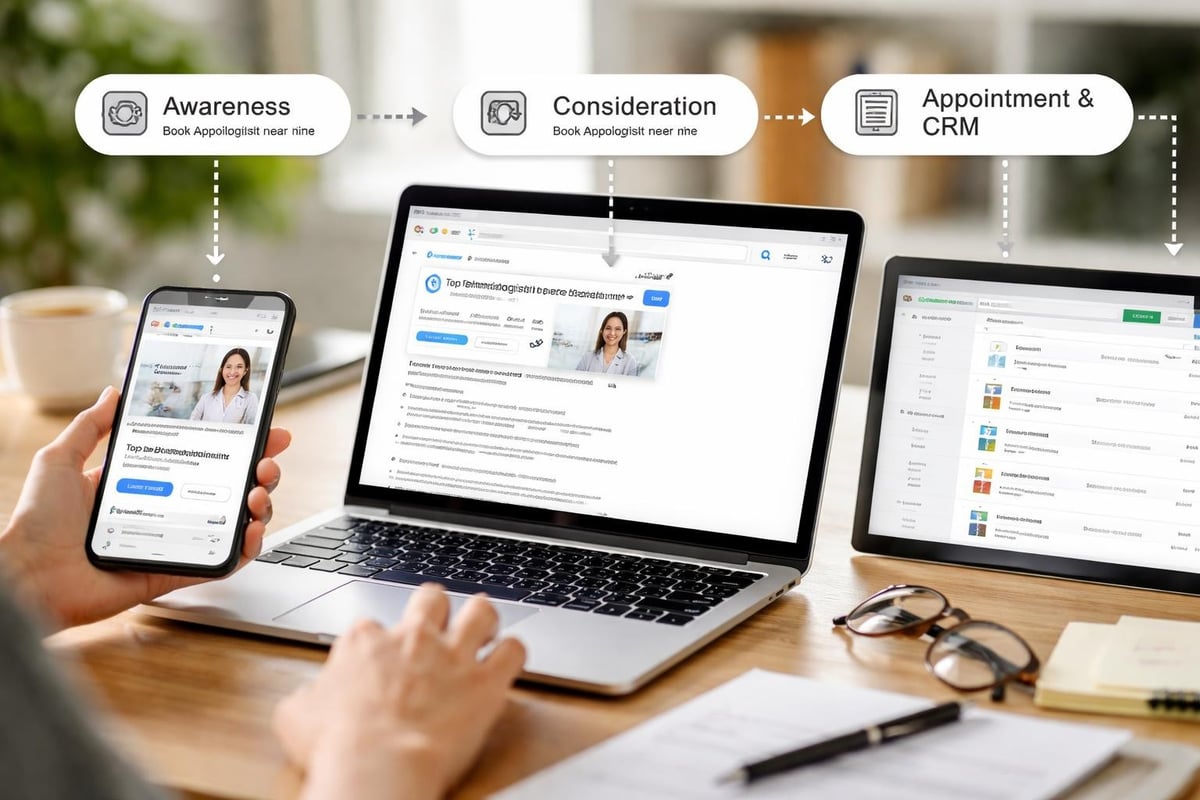
Modern marketing analytics extend beyond basic website traffic to track the complete patient journey from initial awareness through booked appointment. Call tracking reveals which campaigns drive phone inquiries. Form tracking shows which pages convert visitors into leads. CRM integration connects marketing touchpoints to actual patient acquisition and revenue.
Essential tracking components:
- Call tracking numbers – Unique numbers for each marketing channel identifying lead sources
- Form analytics – Tracking which pages and campaigns generate contact form submissions
- CRM integration – Connecting marketing data to patient records and appointment scheduling
- Revenue attribution – Tracking which marketing channels generate highest lifetime patient value
- Multi-touch attribution – Understanding how different touchpoints contribute to conversions
This data reveals true marketing ROI rather than relying on vanity metrics like website traffic or social media followers. Practices should evaluate channels based on cost per acquired patient and patient lifetime value rather than impressions or clicks.
Rapid Response Systems
Speed to contact dramatically impacts conversion rates in healthcare marketing. Studies show that practices responding to inquiries within five minutes convert leads at rates 100 times higher than those responding after 30 minutes. This data underscores the importance of systematic lead management.
Implementing rapid response requires dedicated systems and staff protocols. Automated acknowledgment messages confirm receipt while setting expectations for follow-up. Staff training emphasizes prioritizing lead response over other administrative tasks. CRM systems ensure no inquiry falls through cracks during busy periods.
Marketing Automation for Dental Practices
Automation technology allows practices to maintain consistent patient communication without proportionally increasing staff workload. Strategic automation enhances patient experience while improving operational efficiency.
Automated Patient Journey Workflows
Mapping the patient journey reveals automation opportunities at each stage. From initial inquiry through long-term retention, automated touchpoints maintain engagement while reducing manual tasks.
New patient workflows might include appointment confirmation, pre-visit instructions, financial policy information, and post-visit follow-up. These automated sequences ensure consistent communication while allowing staff to focus on personal interactions that require human touch.
Recall automation sends timely reminders when patients are due for preventive care. Birthday greetings and seasonal wellness tips maintain top-of-mind awareness between visits. These automated touchpoints strengthen relationships and increase patient lifetime value.
Choosing Marketing Technology
The dental practice technology stack should integrate seamlessly while avoiding unnecessary complexity. Essential tools include practice management software, CRM platform, email marketing system, and analytics dashboard.
| Tool Category | Primary Function | Integration Priority |
|---|---|---|
| Practice Management | Scheduling, billing, records | Core system |
| CRM Platform | Lead tracking, communication | High – connects marketing to operations |
| Email Marketing | Automated campaigns, newsletters | Medium – patient communication |
| Call Tracking | Source attribution, recording | Medium – measures marketing ROI |
| Analytics Dashboard | Performance reporting | High – guides strategy decisions |
Evaluate tools based on integration capability, ease of use, and support quality rather than feature count. Overly complex systems often go underutilized while simpler solutions with proper implementation deliver better results.
Measuring Digital Marketing Performance
Comprehensive measurement separates successful digital marketing for dental practices from unfocused activity. Establishing clear key performance indicators enables data-driven decision making and continuous improvement.
Critical Metrics for Dental Practices
Different marketing objectives require different measurement approaches. Practice growth goals should dictate which metrics receive primary attention.
Primary performance metrics:
- Cost Per Lead – Total marketing spend divided by new patient inquiries
- Lead-to-Patient Conversion Rate – Percentage of inquiries that schedule appointments
- Cost Per Acquisition – Total marketing spend divided by new patients acquired
- Patient Lifetime Value – Average revenue generated per patient over relationship duration
- Marketing ROI – Revenue attributed to marketing divided by marketing investment
Secondary metrics including website traffic, social media engagement, and email open rates provide context but shouldn't drive strategy. Focus on measurements that directly connect to practice growth and revenue generation.
Monthly Performance Review Process
Systematic performance review identifies trends and optimization opportunities. Monthly analysis should compare current performance against historical baselines and established goals.
Review sessions should evaluate each marketing channel independently while considering how channels work together. A patient may discover your practice through social media, research services on your website, and ultimately convert through a Google search. Multi-touch attribution provides more accurate understanding than last-click models.
Document insights and implement iterative improvements based on data rather than assumptions. Small, consistent optimizations compound over time into significant performance gains.
Advanced Strategies for Competitive Markets
Highly competitive dental markets require sophisticated approaches beyond fundamental digital marketing tactics. Practices in saturated markets must differentiate strategically and execute precisely to capture market share.
Niche Positioning and Specialization
Attempting to be everything to everyone dilutes marketing effectiveness. Strategic positioning around specific procedures, patient demographics, or service approaches creates competitive advantage.
Practices might specialize in cosmetic dentistry, pediatric care, sedation dentistry for anxious patients, or same-day emergency services. This focused positioning allows concentrated marketing investment in reaching ideal patients rather than broad campaigns with diluted messaging.
Specialization also supports premium pricing strategies. Patients pay more for recognized expertise in specific areas compared to generalist providers. This improved unit economics allows higher patient acquisition costs while maintaining profitability.
Competitive Intelligence and Market Analysis
Understanding proven digital marketing strategies used by successful practices provides valuable insights. Regular competitive analysis reveals gaps in local market coverage and opportunities for differentiation.
Monitor competitor websites, advertising presence, review ratings, and social media engagement. Identify services they emphasize, patient demographics they target, and positioning strategies they employ. This intelligence informs strategic decisions about where to compete directly and where to differentiate.
Market analysis extends beyond direct competitors to understand patient demand patterns, demographic trends, and emerging opportunities. Growing neighborhoods, demographic shifts, and changing consumer preferences create openings for practices positioned to capitalize.
Integration with Practice Operations
Digital marketing effectiveness depends on operational readiness to convert leads into patients. Marketing generates inquiries, but practice operations determine whether those inquiries become scheduled appointments and ultimately satisfied patients.
Staff Training and Patient Communication
Front desk staff serve as the critical bridge between marketing and patient acquisition. Their phone skills, scheduling efficiency, and patient communication directly impact conversion rates regardless of marketing quality.
Comprehensive staff training should cover phone etiquette, objection handling, insurance verification, and scheduling optimization. Staff should understand the cost of acquiring each lead and the importance of converting inquiries promptly and professionally.
Role-playing exercises prepare staff for common scenarios including price objections, insurance questions, and scheduling conflicts. Scripts provide consistency while allowing personalization based on individual patient needs.
Appointment Scheduling Optimization
Friction in the scheduling process destroys marketing ROI. Complicated scheduling procedures, limited availability, and poor communication create barriers that prevent interested patients from booking.
Online scheduling removes friction by allowing patients to book appointments at their convenience without phone calls. Integration with practice management systems prevents double-booking while providing real-time availability. Confirmation and reminder systems reduce no-shows that waste appointment slots and staff time.
Flexible scheduling accommodates patient preferences rather than forcing conformity to rigid practice schedules. Early morning, evening, and weekend availability captures patients who cannot take time off work for appointments.
Privacy Compliance and Healthcare Marketing
Healthcare marketing faces unique regulatory requirements that general marketers may ignore. HIPAA compliance, patient privacy protection, and advertising restrictions require careful attention to avoid violations.
HIPAA Compliance in Digital Marketing
Patient information protection extends to all marketing activities. Before-and-after photos require written consent. Patient testimonials need explicit permission. Email marketing must include opt-out mechanisms and respect privacy preferences.
Website analytics must be configured to protect patient identity. Tracking individual patient behavior raises privacy concerns even if used for marketing optimization. Work with legal counsel to ensure all digital marketing practices comply with HIPAA requirements.
Third-party vendors including marketing agencies, advertising platforms, and technology providers should sign Business Associate Agreements when handling protected health information. Verify vendor compliance practices before sharing any patient data.
Ethical Marketing Practices
Beyond legal compliance, ethical marketing builds sustainable practice reputation. Truthful advertising, realistic expectations, and transparent pricing create trust that supports long-term patient relationships.
Avoid exaggerated claims about procedure results or guaranteed outcomes. Present before-and-after photos that represent typical results rather than exceptional cases. Disclose material information about risks, recovery times, and costs that patients need to make informed decisions.
Ethical practices protect against legal liability while supporting authentic relationships with patients who appreciate honesty and transparency.
Digital marketing for dental practices combines strategic planning, systematic execution, and continuous optimization to generate measurable patient growth. Success requires comprehensive approaches that integrate multiple channels while maintaining focus on conversion metrics rather than vanity statistics. If your practice needs expert support implementing these strategies with proven systems that deliver results, RevSpark Media specializes in healthcare lead generation and patient acquisition with proprietary technology that identifies 60% of anonymous website visitors and an in-house team providing 2-minute response times to convert leads into scheduled appointments.