
The healthcare marketing landscape has transformed dramatically, with ads social strategies becoming essential for patient acquisition and practice growth. Healthcare providers, from compounding pharmacies to addiction treatment centers, now leverage social platforms to reach prospective patients where they spend their time-scrolling through feeds, watching videos, and engaging with content. Understanding how to effectively deploy ads social campaigns while maintaining HIPAA compliance and professional credibility separates successful healthcare marketing from wasted ad spend.
The Evolution of Ads Social in Healthcare Marketing
Social media advertising has shifted from experimental marketing tactics to mission-critical patient acquisition channels for healthcare providers. Social media has become the primary way consumers learn about brands, making it indispensable for medical practices seeking growth in 2026.
The healthcare sector faces unique challenges when implementing ads social campaigns. Medical practices must balance compelling advertising with strict regulatory compliance, patient privacy considerations, and the sensitive nature of health information. Despite these constraints, the opportunity remains substantial.
Platform Selection for Healthcare Advertising
Different social platforms serve distinct purposes in healthcare marketing funnels. Understanding where your ideal patients congregate determines campaign success more than creative excellence or budget allocation.
Facebook and Instagram remain dominant for healthcare advertising due to their sophisticated targeting capabilities and broad demographic reach. These platforms excel for practices targeting patients aged 35-65, including women's health clinics, orthopedics, and wound care centers. The visual nature of Instagram makes it particularly effective for medical spas and aesthetic practices.
LinkedIn serves specialized purposes in healthcare marketing. This platform works best for B2B healthcare services, pharmaceutical distribution, and franchise development campaigns. Medical practices seeking to attract referring physicians or healthcare administrators find LinkedIn's professional environment conducive to building credibility.
TikTok and YouTube represent emerging opportunities for healthcare providers willing to invest in video content. Telehealth providers and men's health clinics targeting younger demographics see substantial engagement on these platforms, though content creation demands are significantly higher.

Crafting Compliant and Effective Ads Social Campaigns
The intersection of healthcare regulations and social media advertising creates complexity that demands specialized expertise. Successful ads social campaigns in healthcare follow specific frameworks that balance persuasion with compliance.
Messaging Strategies for Patient Acquisition
Healthcare advertising must prioritize education over sensationalism. Patients researching treatment options respond to informative content that addresses their concerns without making unrealistic promises.
Problem-agnostic messaging focuses on symptoms and concerns rather than specific diagnoses. This approach keeps campaigns compliant while still resonating with prospective patients experiencing health challenges. A wound care center might target "non-healing wounds lasting more than three weeks" rather than specific diabetic complications.
Solution-oriented frameworks present your practice as the pathway to improved quality of life. Addiction treatment centers effectively use testimonials (with proper consent) and transformation narratives that emphasize hope and recovery without guaranteeing outcomes.
The critical element involves urgency without fear-mongering. Ads social campaigns for healthcare must motivate action while maintaining professional integrity. Orthopedic practices might emphasize "limited consultation availability" rather than suggesting dire consequences of delayed treatment.
| Messaging Type | Healthcare Application | Compliance Consideration |
|---|---|---|
| Educational | Treatment option overviews | Avoid outcome guarantees |
| Testimonial | Patient success stories | Obtain written consent, include disclaimers |
| Promotional | New patient specials | Clearly state terms and limitations |
| Awareness | Condition education | Cite reputable medical sources |
Targeting Precision for Healthcare Demographics
The power of ads social lies in granular audience targeting that traditional healthcare marketing could never achieve. Modern platforms enable healthcare providers to reach prospective patients based on demographics, interests, behaviors, and even life events.
Demographic targeting forms the foundation. Women's health clinics target females aged 25-55 within specific geographic radiuses, while veterinary practices might target pet owners within their service areas. Age, gender, location, and household income create the initial audience framework.
Interest and behavior targeting adds sophistication. Facebook and Instagram allow healthcare advertisers to reach users who have shown interest in health and wellness topics, fitness, nutrition, or specific medical conditions. A medical spa might target users interested in anti-aging skincare, while addiction treatment centers could reach those engaging with mental health and recovery content.
Custom audience strategies leverage existing patient data (within HIPAA guidelines) to create lookalike audiences. These campaigns target users who share characteristics with your best patients, dramatically improving conversion rates and reducing acquisition costs.
Optimizing Ad Creative for Healthcare Conversion
Creative execution determines whether targeted audiences stop scrolling or continue past your ads social campaigns. Healthcare advertising faces additional constraints that make creative development more challenging than standard e-commerce or service marketing.
Visual Elements That Drive Engagement
Healthcare ads social creative must balance professional credibility with thumb-stopping appeal. Stock medical photos featuring stethoscopes and lab coats have become invisible to modern audiences scrolling through feeds.
Authentic practice imagery outperforms generic medical photography. Photos of your actual facility, real staff members, and genuine patient interactions (with consent) build trust and differentiation. Telehealth providers benefit from showing their technology platforms and consultation experiences.
Before-and-after visuals work exceptionally well for certain healthcare specialties, particularly medical spas, dental practices, and wound care centers. These must include appropriate disclaimers stating that results vary and the images represent potential, not guaranteed, outcomes.
Video content dominates ads social performance across all platforms. Short-form videos (15-30 seconds) featuring providers explaining procedures, answering common questions, or introducing practice philosophies generate significantly higher engagement than static images. Social media advertising best practices emphasize platform-native content formats for maximum visibility.

Copy Frameworks for Medical Services
The text component of ads social campaigns requires precision and strategic thinking in healthcare contexts. Every word must advance the conversion goal while maintaining regulatory compliance and professional standards.
Attention-grabbing headlines focus on the patient's problem or desired outcome. "Living with Chronic Pain?" performs better than "Orthopedic Services Available." The headline should immediately identify the target audience and their primary concern.
Benefit-focused body copy articulates what patients gain from choosing your practice. Rather than listing services, explain how those services improve patients' lives. A compounding pharmacy might emphasize "customized medications that work with your unique body chemistry" instead of "compounding services available."
Clear calls-to-action remove friction from the conversion process. Healthcare ads social campaigns should specify exactly what action you want prospects to take: "Schedule Your Free Consultation," "Download Our Treatment Guide," or "Text Us Your Questions." Vague CTAs like "Learn More" underperform specific directives.
Budget Allocation and Performance Metrics
Financial stewardship determines long-term ads social success for healthcare providers. Understanding how to allocate budgets across platforms, campaigns, and audience segments separates profitable patient acquisition from expensive experimentation.
Strategic Budget Distribution
Healthcare practices should approach ads social spending with strategic frameworks rather than arbitrary budget allocations. The initial testing phase requires patience and methodical analysis.
Start with platform diversification to identify which channels deliver the best return for your specific practice type. Allocate 60% of initial budgets to proven platforms (typically Facebook/Instagram for most healthcare providers), 30% to emerging opportunities (TikTok, YouTube), and 10% to experimental channels.
Campaign-level budgeting should reflect the patient lifetime value for different service lines. Addiction treatment centers with high-value, long-term patient relationships justify higher acquisition costs than urgent care facilities with one-time visits. Your ads social spending should align with revenue potential.
Testing budgets deserve dedicated allocation separate from primary campaigns. Reserve 15-20% of monthly ad spend for creative testing, new audience exploration, and platform experimentation. This systematic approach to innovation prevents stagnation while maintaining accountability.
| Healthcare Specialty | Recommended Monthly Minimum | Primary Platform | Expected Cost Per Lead |
|---|---|---|---|
| Medical Spas | $3,000-$5,000 | Instagram/Facebook | $25-$75 |
| Addiction Treatment | $8,000-$15,000 | Facebook/Google Display | $100-$300 |
| Compounding Pharmacy | $2,000-$4,000 | $15-$40 | |
| Men's Health Clinics | $4,000-$7,000 | Facebook/YouTube | $50-$150 |
| Veterinary Practices | $1,500-$3,000 | Facebook/Instagram | $20-$50 |
Key Performance Indicators for Healthcare Campaigns
Measuring ads social success requires tracking metrics that actually correlate with business outcomes. Vanity metrics like impressions and reach matter less than conversion-focused KPIs.
Cost per qualified lead represents the most critical metric for healthcare advertising. A qualified lead meets specific criteria: correct geographic location, appropriate insurance coverage, genuine interest in services, and alignment with your ideal patient profile. Tracking total leads without qualification masks campaign inefficiency.
Appointment booking rate measures how effectively leads convert to scheduled consultations. This metric reveals landing page effectiveness, offer strength, and audience quality. Healthcare practices should aim for 30-50% booking rates from qualified leads generated through ads social campaigns.
Show rate and conversion to patient complete the attribution chain. The best ads social campaigns mean nothing if patients don't attend appointments or convert to active treatment. Statistics show social media advertising continues growing, but only providers tracking full-funnel metrics achieve sustainable ROI.
Advanced Strategies for Healthcare Ads Social
Sophisticated healthcare marketers implement advanced tactics that compound campaign effectiveness over time. These strategies require more investment but deliver exponential returns.
Retargeting and Nurture Sequences
Prospective patients rarely convert on first exposure to healthcare advertising. Multi-touch attribution models show that patients typically require 7-12 interactions before scheduling consultations for significant medical decisions.
Website visitor retargeting allows practices to show ads social campaigns specifically to users who have visited your site. These warm audiences convert at 3-5 times the rate of cold traffic, making retargeting budgets extremely efficient. Telehealth providers can retarget visitors who viewed specific service pages with tailored messaging about those exact treatments.
Engagement-based audiences enable targeting users who have interacted with your social media content, watched videos, or engaged with previous ads. These audiences demonstrate interest even without website visits, creating mid-funnel opportunities for conversion.
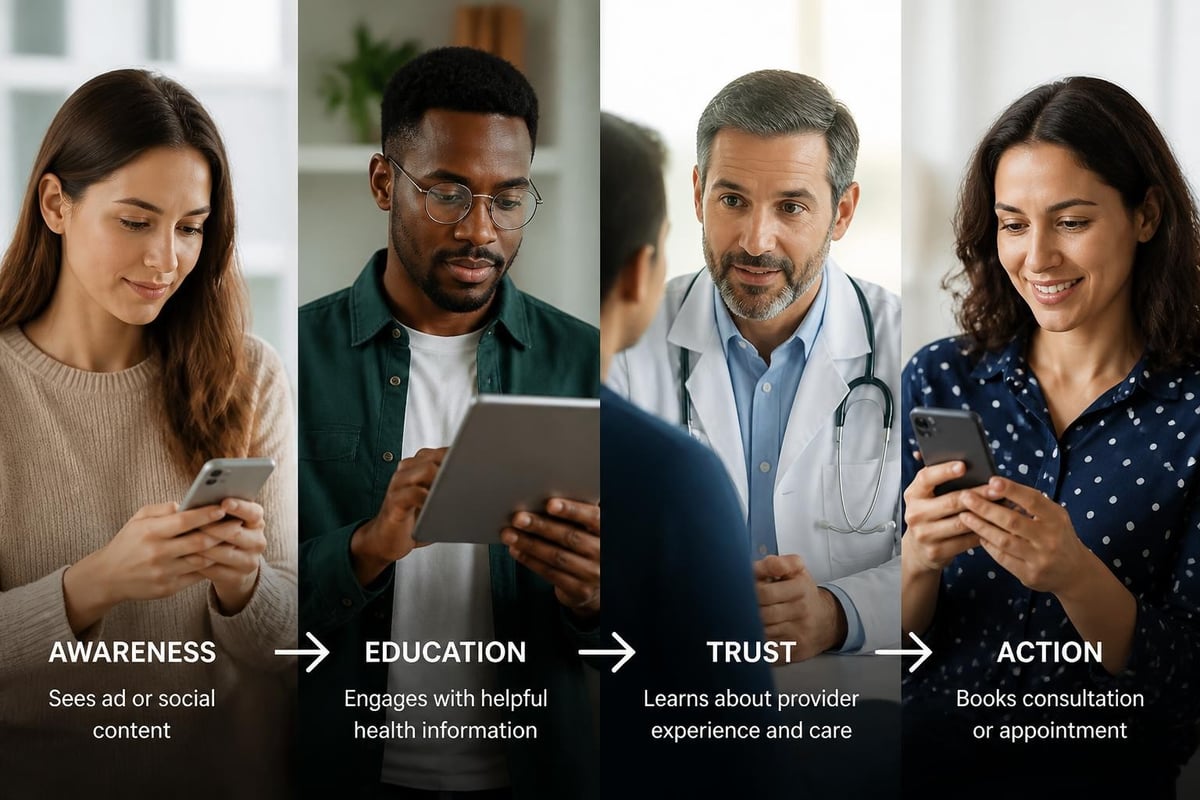
Sequential messaging campaigns guide prospects through educational journeys that build trust over time. A wound care center might start with educational content about chronic wounds, retarget engaged users with provider credentials and technology advantages, then finally offer consultation scheduling to those who have consumed multiple pieces of content.
Compliance and Security in Ads Social
Healthcare advertising faces regulatory scrutiny that demands constant vigilance. The consequences of non-compliant campaigns extend beyond wasted ad spend to potential legal and licensing issues.
HIPAA considerations prohibit using patient information for advertising without explicit consent. Healthcare providers must ensure their ads social campaigns never incorporate protected health information, even inadvertently through targeting or messaging. Custom audiences built from patient lists require careful legal review and proper data handling.
Platform security concerns have intensified as fraudulent advertising proliferates across social media. Research shows significant portions of social advertising contain scams or malware, damaging consumer trust. Healthcare providers must implement verification badges, maintain consistent branding, and use secure landing pages to differentiate legitimate medical advertising from fraudulent schemes.
Advertising claim substantiation requires that any statements made in ads social campaigns can be supported with evidence. Healthcare practices should avoid superlatives like "best" without third-party validation, never guarantee outcomes, and ensure all before-after images include appropriate disclaimers. Following social media advertising best practices helps maintain compliance while maximizing effectiveness.
Integration with Comprehensive Marketing Systems
Ads social campaigns achieve maximum ROI when integrated into holistic healthcare marketing systems rather than functioning as isolated initiatives. The connection between advertising, lead management, and patient conversion determines ultimate success.
CRM Integration and Lead Response
The speed and quality of lead follow-up often matter more than ad creative or targeting precision. Healthcare practices that respond to ads social leads within 2-5 minutes convert at dramatically higher rates than those with slower response times.
Automated lead routing ensures ads social prospects immediately enter structured follow-up sequences. Integration between advertising platforms and customer relationship management systems enables real-time lead notification, automatic appointment scheduling workflows, and systematic nurture campaigns for leads not immediately ready to book.
Multi-channel follow-up combines phone calls, text messages, and email to maximize contact rates. Modern healthcare consumers prefer text communication for initial outreach, with 78% of patients indicating they would engage with medical practices via text messaging. Ads social campaigns should feed into systems capable of omnichannel communication.
Attribution and ROI Measurement
Understanding which ads social campaigns generate actual patients and revenue requires sophisticated attribution modeling. Healthcare practices must connect advertising spend to patient acquisition and lifetime value.
First-touch attribution identifies which campaigns initially attracted patients to your practice. This model helps optimize top-of-funnel awareness campaigns and budget allocation across platforms.
Last-touch attribution shows which final interaction converted leads to patients. This perspective reveals which retargeting campaigns, offers, or messaging themes close sales most effectively.
Multi-touch attribution provides the most accurate picture by assigning fractional credit to every interaction in the patient journey. Advanced healthcare marketers use multi-touch models to optimize entire funnels rather than individual campaign elements.
The integration of ads social campaigns with comprehensive patient acquisition systems-including rapid lead response, qualification processes, consultation framework training, and systematic follow-up-transforms advertising from an expense into a predictable revenue generation engine. Best practices for social media presence extend beyond ads to include organic content, community management, and reputation monitoring that support paid campaign effectiveness.
Healthcare providers who master ads social strategies, maintain compliance rigor, and integrate advertising with robust patient conversion systems position themselves for sustainable growth in increasingly competitive markets. The combination of targeted advertising, rapid response infrastructure, and conversion optimization creates competitive advantages that translate directly to increased patient volume and practice revenue.
Mastering ads social for healthcare requires balancing platform expertise, regulatory compliance, and systematic lead conversion-a combination that separates growing practices from struggling ones. RevSpark Media specializes in this exact challenge, combining proprietary technology that identifies 60% of anonymous website visitors with an in-house team that responds to leads within 2 minutes, ensuring your advertising investment translates to booked appointments and actual patients. With a proven track record generating $100M+ in client growth across healthcare specialties, RevSpark Media handles everything from campaign creation and landing page development to CRM integration and systematic follow-up, delivering the comprehensive marketing infrastructure that turns ads social into predictable revenue.