
The healthcare industry faces unprecedented challenges in patient acquisition and retention. With consumers conducting extensive online research before selecting providers, healthcare organizations must orchestrate seamless experiences across every touchpoint. This necessity has driven the evolution of connected marketing, a strategic approach that unifies all marketing channels, data sources, and customer interactions into a cohesive system designed to guide prospects from initial awareness through conversion and long-term loyalty.
Understanding Connected Marketing in Healthcare
Connected marketing represents a fundamental shift from siloed campaign execution to integrated strategy development. Rather than managing separate initiatives for social media, email, paid advertising, and website optimization, this approach weaves all channels together through shared data, consistent messaging, and coordinated timing.
For healthcare providers, this integration proves particularly critical. A prospective patient might discover your wound care center through a Facebook ad, visit your website to research treatments, receive a retargeted display ad, and finally call to schedule a consultation. Connected marketing strategies ensure each touchpoint reinforces the others, creating a unified narrative that builds trust and drives action.
The foundation rests on three core pillars: unified data collection, cross-channel orchestration, and real-time responsiveness. When these elements work together, healthcare organizations can identify anonymous website visitors, trigger personalized follow-up sequences, and convert interested prospects into scheduled appointments with remarkable efficiency.
The Data Infrastructure Behind Effective Integration
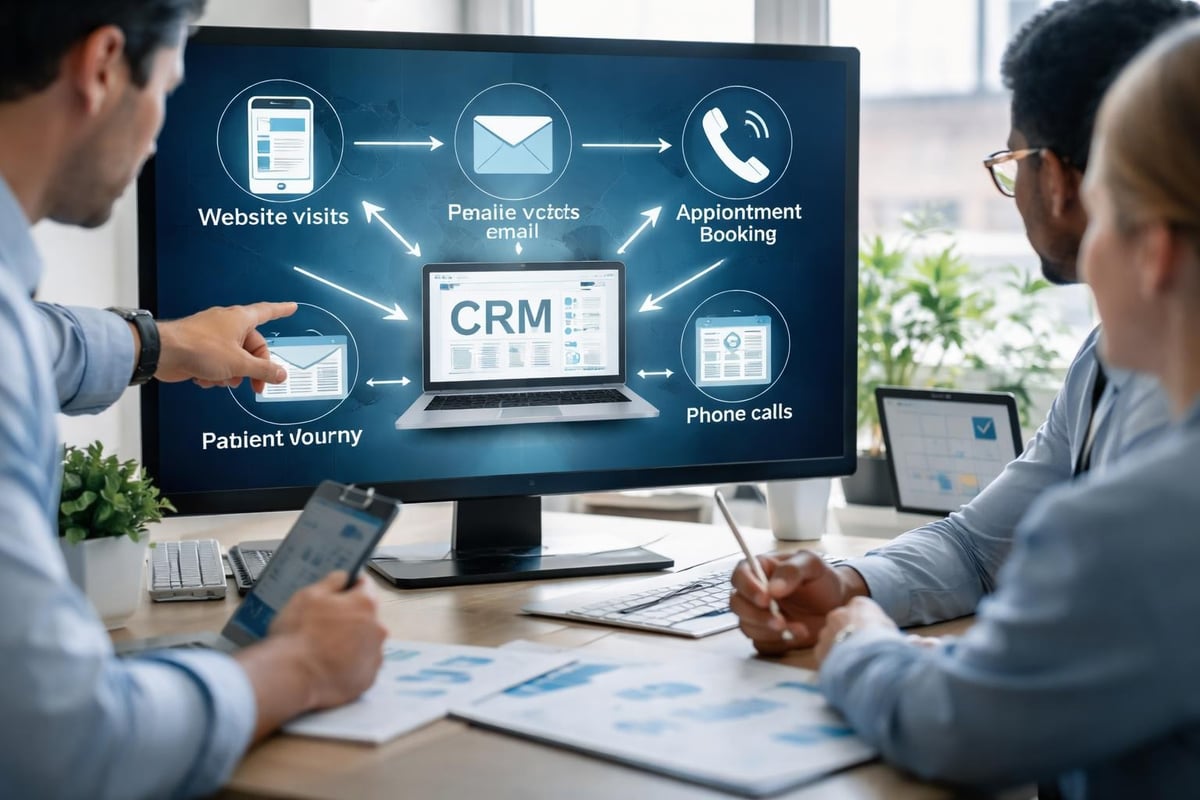
Modern connected marketing platforms aggregate information from multiple sources into a single customer view. For healthcare providers, this means tracking every interaction a prospect has with your brand, from initial website visits to email opens, form submissions, and phone calls.
Key data sources include:
- Website analytics tracking visitor behavior and engagement patterns
- CRM systems recording consultation bookings and patient communications
- Marketing automation platforms managing email sequences and lead scoring
- Call tracking software capturing phone inquiries and response times
- Social media platforms measuring ad performance and audience engagement
- Appointment scheduling systems monitoring booking rates and show rates
This comprehensive data collection enables healthcare marketers to understand which channels drive the highest-quality leads, which messaging resonates most effectively, and where prospects typically abandon the conversion journey. Armed with these insights, organizations can optimize their marketing spend and refine their approach continuously.
Implementing Cross-Channel Orchestration
The true power of connected marketing emerges when channels work together rather than competing for attribution credit. A medical spa implementing this approach doesn't just run separate campaigns on Google Ads, Facebook, and email. Instead, these channels communicate with each other to create coordinated patient experiences.
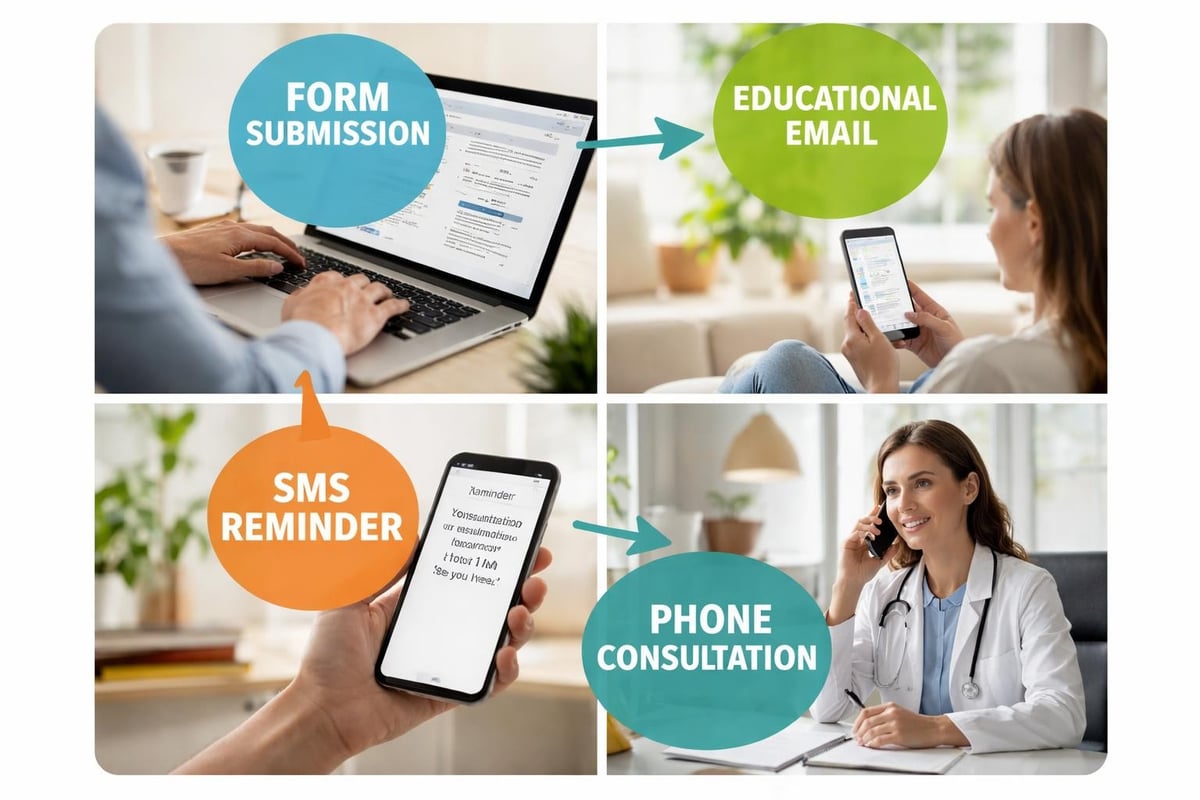
Consider a prospective patient who clicks a Google Ad for Botox treatments but doesn't schedule a consultation. With proper orchestration, this action triggers a sequence: the visitor sees retargeted Facebook ads highlighting patient testimonials, receives an email with educational content about the procedure, and gets a text message offering a limited-time consultation discount. Each touchpoint builds on the previous interaction, creating momentum toward booking.
Channel Synchronization Strategies
| Channel | Primary Function | Integration Point | Conversion Role |
|---|---|---|---|
| Paid Search | Initial discovery | Website tracking pixel | Awareness generation |
| Social Media | Trust building | CRM lead capture | Consideration nurturing |
| Email Marketing | Education delivery | Appointment scheduler | Decision facilitation |
| SMS Communication | Urgency creation | Phone tracking system | Action acceleration |
| Retargeting Ads | Recall maintenance | Marketing automation | Re-engagement driver |
The synchronization extends beyond digital channels. When a prospect calls your practice after engaging with your digital marketing, your team should have immediate access to their interaction history. This visibility allows for personalized conversations that reference the specific services they've researched, dramatically increasing conversion rates.
Healthcare franchises benefit particularly from this approach when coordinating corporate marketing efforts with local practice initiatives. A franchise system promoting a new service line can ensure that national brand awareness campaigns feed qualified leads to local practices equipped with synchronized follow-up systems and appointment scheduling protocols.
Real-Time Responsiveness and Lead Engagement
Speed represents a critical competitive advantage in healthcare marketing. Research consistently demonstrates that practices responding to inquiries within minutes convert leads at exponentially higher rates than those with delayed response times. Connected marketing enables this rapid engagement through automated triggers and immediate notifications.
When a website visitor submits a consultation request form, an integrated system can simultaneously:
- Send an instant confirmation email to the prospect
- Notify the practice's appointment coordinator via text message
- Create a CRM record with the visitor's complete interaction history
- Trigger a SMS message offering immediate callback scheduling
- Launch a retargeting campaign to maintain engagement if they don't answer
This multi-pronged response ensures no opportunity slips through the cracks while demonstrating professionalism that builds patient confidence. For specialized healthcare services like addiction treatment or telehealth, where prospects may be researching during moments of urgent need, this responsiveness can literally save lives while driving practice growth.
Automation Without Losing the Human Touch
Connected marketing platforms excel at routine tasks-sending follow-up emails, scheduling appointment reminders, updating lead scores based on behavior. This automation frees healthcare teams to focus on high-value activities like personalized consultation calls and patient education.
The key lies in strategic automation design. A compounding pharmacy might automate educational email sequences about hormone replacement therapy while ensuring actual consultation booking conversations happen with trained team members who can address specific concerns. Interactive marketing approaches balance automated efficiency with genuine human connection, creating experiences that feel personal despite systematic execution.
Personalization at Scale for Healthcare Providers
Generic marketing messages fail to resonate with today's healthcare consumers who expect tailored experiences reflecting their specific needs and concerns. Connected marketing enables personalization based on behavioral data, demographic information, and engagement patterns.
Personalization opportunities include:
- Service-specific landing pages matching the exact treatment a prospect researched
- Email content segmented by patient demographics and health concerns
- Retargeting ads featuring the specific providers or procedures viewed on your website
- SMS messages referencing previous interactions and addressing stated objections
- Phone scripts informed by complete digital journey history
A men's health clinic using connected marketing can differentiate messaging for prospects researching testosterone replacement therapy versus erectile dysfunction treatments, ensuring each audience receives relevant information addressing their specific concerns. This relevance builds trust and accelerates decision-making.
The multichannel marketing approach extends personalization across every touchpoint, creating consistent yet customized experiences. A prospect might receive a Facebook ad tailored to their age demographic, click through to a landing page addressing their specific symptoms, and receive follow-up emails that reference the exact treatment options they reviewed.
Measuring Performance Across the Patient Journey
Traditional healthcare marketing often struggles with attribution-determining which channels deserve credit for patient acquisitions. Connected marketing solves this challenge by tracking the complete conversion path and assigning appropriate value to each touchpoint.
Attribution Model Comparison
| Model Type | Best For | Healthcare Application | Limitations |
|---|---|---|---|
| Last-Click | Quick insights | Emergency services | Ignores awareness efforts |
| First-Click | Brand building | Franchise development | Undervalues conversion tactics |
| Linear | Balanced view | General practice growth | Oversimplifies complex journeys |
| Time-Decay | Recent emphasis | Seasonal promotions | Discounts early research |
| Data-Driven | Accuracy | Multi-location systems | Requires significant data |
Advanced platforms analyze thousands of patient journeys to identify patterns and calculate the true contribution of each marketing activity. This intelligence informs budget allocation decisions, ensuring investment flows toward the highest-performing channels and tactics.
For healthcare providers managing multiple service lines, this granular measurement proves invaluable. An orthopedic practice can determine that while social media generates awareness for sports medicine services, email nurturing drives most joint replacement consultations. This insight enables precise optimization that maximizes return on marketing investment.
Technology Stack Integration
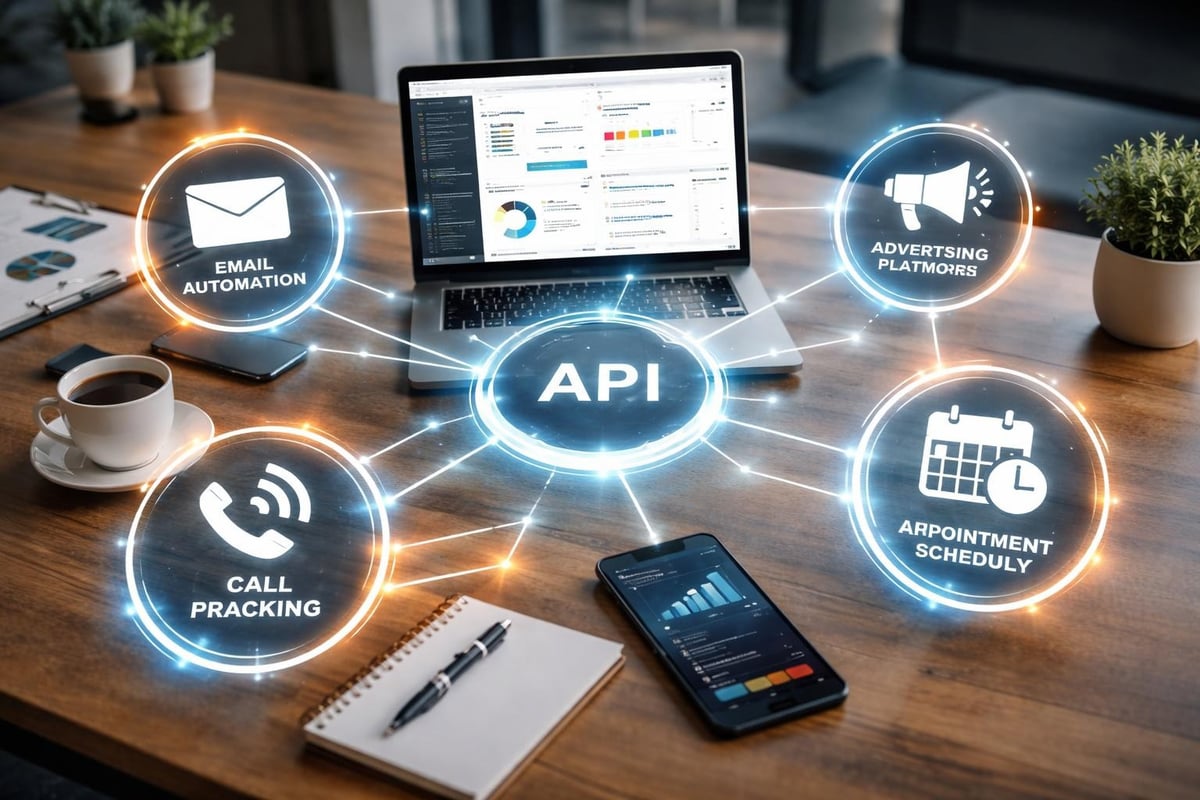
Connected marketing requires robust technology infrastructure connecting various platforms into a unified ecosystem. The typical healthcare marketing technology stack includes:
- Customer Relationship Management (CRM): Central database storing all patient and prospect information
- Marketing Automation Platform: System managing email campaigns, lead scoring, and workflow triggers
- Website Analytics: Tools tracking visitor behavior and conversion paths
- Advertising Platforms: Google Ads, Facebook Ads Manager, and other paid media channels
- Call Tracking Software: Solution attributing phone inquiries to specific marketing sources
- Appointment Scheduling: System managing consultation bookings and calendar availability
- SMS Communication: Platform enabling text message marketing and reminders
The integration between these systems determines marketing effectiveness. When a prospect books a consultation through your website, this information should automatically flow to your CRM, trigger appointment confirmation messages, update lead scoring, pause active retargeting campaigns, and notify your team. Mobile marketing capabilities prove particularly important as healthcare consumers increasingly research and book services via smartphones.
Franchise System Applications
Healthcare franchise organizations face unique connected marketing challenges and opportunities. Corporate marketing teams must generate national brand awareness while simultaneously driving qualified leads to individual franchisees who maintain autonomy over local operations.
Connected marketing resolves this tension through coordinated campaigns that flow seamlessly from corporate to local levels. A medical spa franchise might run national Facebook campaigns promoting a new service, with leads automatically routed to the nearest franchise location where local teams execute standardized follow-up protocols customized with location-specific details.
This approach ensures consistent brand experiences while respecting franchisee independence. The corporate team provides marketing infrastructure, creative assets, and lead generation technology. Franchisees maintain control over appointment scheduling, consultation delivery, and local relationship building.
Franchise Marketing Coordination Framework
Corporate Responsibilities:
- National brand awareness campaigns across major media channels
- Development of conversion-optimized landing pages and marketing assets
- Implementation of lead identification and routing technology
- Creation of standardized follow-up sequences and response protocols
- Performance tracking and optimization across the franchise system
Franchisee Responsibilities:
- Local market advertising and community engagement initiatives
- Appointment scheduling and consultation delivery execution
- Patient relationship management and retention programs
- Feedback provision to corporate regarding lead quality and messaging effectiveness
- Implementation of corporate-provided systems and protocols
This division of labor enables franchise systems to achieve scale economies in marketing while maintaining the personalized service that drives patient satisfaction and referrals.
Overcoming Healthcare Marketing Challenges
Healthcare marketers face distinct obstacles that connected marketing strategies help overcome. Regulatory compliance requirements like HIPAA create complexity around data collection and patient communications. Long consideration cycles for elective procedures require sustained engagement over weeks or months. Multiple decision-makers in family healthcare decisions demand messaging that addresses diverse concerns.
Connected marketing platforms designed for healthcare incorporate compliance safeguards, ensuring patient data remains protected while still enabling personalized marketing. Automated nurture sequences maintain engagement throughout extended research periods without requiring constant manual intervention. Segmentation capabilities allow messaging customization for different audience members involved in healthcare decisions.
The strategic approach also addresses the challenge of anonymous website traffic. Advanced visitor identification technology can reveal contact information for a significant percentage of anonymous website visitors, transforming unknown browsers into marketable leads. When integrated with comprehensive follow-up systems, this capability dramatically expands the pool of prospects healthcare providers can actively convert.
Research on network-based marketing demonstrates how understanding connection patterns between consumers enables more effective targeting and messaging. Healthcare providers can apply these principles by identifying and leveraging patient referral networks, online community engagement patterns, and social media influence relationships.
Building Patient Loyalty Through Connected Experiences
Acquisition represents just the beginning of the patient relationship. Connected marketing extends beyond initial conversion to encompass retention, referral generation, and lifetime value maximization. The same systems that attract new patients can nurture existing relationships through appointment reminders, educational content delivery, and re-engagement campaigns for lapsed patients.
A wound care center might use connected marketing to send automated follow-up messages after treatment completion, educational content about prevention strategies, and timely reminders for follow-up appointments. These touchpoints maintain relationships that generate referrals and repeat business while demonstrating genuine care for patient outcomes.
The hyper-personalized customer experiences enabled by integrated data and AI technologies create competitive differentiation in crowded healthcare markets. Patients remember and recommend providers who deliver seamless, personalized experiences that make them feel valued and understood.
Optimizing Conversion Rates Systematically
Connected marketing transforms conversion rate optimization from occasional testing to continuous improvement. With complete visibility into every step of the patient journey, healthcare marketers can identify exactly where prospects abandon the conversion process and implement targeted solutions.
Common conversion friction points include:
- Confusing website navigation that prevents visitors from finding desired information
- Lengthy contact forms requesting excessive information before consultation booking
- Lack of social proof elements like patient testimonials and provider credentials
- Inconsistent messaging between advertisements and landing pages
- Delayed response times to consultation inquiries and questions
Systematic testing addresses each obstacle. A telehealth provider might test shorter versus longer consultation request forms, discovering that reducing fields from twelve to five increases submissions by forty-two percent. An orthopedic practice might test different headline formulations on landing pages, identifying messaging that resonates most effectively with specific demographics.
The key lies in data-driven decision making. Rather than implementing changes based on assumptions or industry best practices, connected marketing enables testing and measurement that reveals what actually works for your specific audience and services. This empirical approach eliminates guesswork and drives continuous performance improvement.
Strategic Implementation Roadmap
Healthcare organizations implementing connected marketing should follow a phased approach that builds capabilities progressively. Attempting to deploy all systems and strategies simultaneously typically overwhelms teams and produces suboptimal results.
Phase One: Foundation Building (Months 1-3)
Establish core technology infrastructure by selecting and implementing CRM, marketing automation, and analytics platforms. Ensure proper integration between systems so data flows smoothly. Develop comprehensive tracking to capture all prospect interactions across channels.
Phase Two: Channel Integration (Months 4-6)
Connect advertising platforms, email systems, and communication tools to the central data infrastructure. Implement basic automation workflows for inquiry response, appointment confirmation, and follow-up nurturing. Begin systematic lead routing and response protocols.
Phase Three: Optimization and Scaling (Months 7-12)
Analyze performance data to identify high-performing channels and tactics. Implement advanced personalization based on behavioral segmentation. Expand automation sophistication with complex nurture sequences and triggered campaigns. Scale successful strategies across additional service lines and locations.
This measured approach allows teams to develop competency with each system component before adding complexity. It also generates early wins that build organizational confidence and support for continued investment.
Connected marketing represents the future of healthcare lead generation, unifying channels and data to create seamless patient experiences that drive conversions and build lasting relationships. By implementing integrated strategies that leverage real-time data, cross-channel orchestration, and systematic follow-up, healthcare providers can dramatically improve acquisition efficiency while delivering the personalized experiences today's patients expect. RevSpark Media specializes in implementing these connected marketing systems for healthcare providers and franchise systems, combining proprietary visitor identification technology with systematic lead nurturing and rapid response protocols that transform anonymous website traffic into scheduled consultations and loyal patients.