
Healthcare providers face unique challenges when attracting new patients and growing their practices. The competitive landscape demands more than generic advertising-it requires strategic, data-driven campaigns that speak directly to patient needs while navigating compliance requirements and building trust. Creating campaigns for healthcare organizations involves balancing clinical expertise with compelling messaging, regulatory compliance with conversion optimization, and multi-channel visibility with measurable results. Whether you run a compounding pharmacy, medical spa, telehealth platform, or specialty clinic, understanding the fundamental principles of campaign development determines the difference between wasted advertising dollars and sustainable patient acquisition.
Understanding Your Healthcare Audience Before Creating Campaigns
The foundation of any successful marketing initiative starts with comprehensive audience research. Healthcare campaigns require deeper insight than typical consumer marketing because patients make decisions based on pain points, insurance coverage, proximity, and trust factors that vary significantly across specialties.
Before launching any campaign, identify your ideal patient demographics including age ranges, geographic locations, insurance types, and specific health concerns. A men's health clinic targeting testosterone replacement therapy needs dramatically different messaging than a wound care center serving diabetic patients or a veterinary practice focusing on exotic animals.
Key audience research components include:
- Current patient database analysis to identify patterns
- Competitor research to understand market positioning
- Search behavior analysis to discover patient intent
- Insurance acceptance and coverage considerations
- Geographic service area limitations
Successful healthcare marketers invest time understanding patient journey stages. Someone researching "knee pain treatment options" sits at a different awareness level than someone searching "best orthopedic surgeon near me." Your campaign messaging must address both early-stage researchers and high-intent prospects ready to schedule consultations.

Regulatory Compliance in Healthcare Marketing
Creating campaigns in healthcare means navigating HIPAA regulations, FDA guidelines, state medical board requirements, and advertising standards that don't apply to other industries. Every claim must be substantiated, patient testimonials require proper authorization, and before-and-after photos need careful handling.
Work with legal counsel to establish approved messaging frameworks. This upfront investment prevents costly violations and campaign shutdowns mid-flight. Understanding what you can and cannot say shapes your creative approach and channel selection from the beginning.
Setting Campaign Objectives That Drive Results
Vague goals produce vague results. Mailchimp outlines five steps to create effective marketing campaigns, emphasizing the critical importance of setting measurable objectives that align with business growth targets.
Healthcare campaigns typically focus on these primary objectives:
- New patient acquisition – Direct bookings for consultations or treatments
- Brand awareness – Establishing expertise in competitive markets
- Service line promotion – Launching new treatments or expanding offerings
- Franchise development – Attracting qualified franchise partners for expansion
- Patient retention – Encouraging repeat visits and ongoing treatment adherence
Each objective requires different key performance indicators (KPIs) and campaign structures. A brand awareness campaign for a new addiction treatment center measures reach and engagement differently than a direct-response campaign promoting Botox treatments at a medical spa.
| Campaign Objective | Primary KPI | Secondary KPIs |
|---|---|---|
| New Patient Acquisition | Cost Per Appointment | Conversion Rate, Show Rate, Lifetime Value |
| Brand Awareness | Impressions & Reach | Engagement Rate, Website Traffic, Search Volume |
| Service Line Promotion | Procedure Bookings | Landing Page Conversion, Lead Quality Score |
| Franchise Development | Qualified Applications | Cost Per Lead, Application-to-Signing Ratio |
Setting realistic benchmarks based on industry standards and historical performance data prevents disappointment and allows for meaningful optimization. A telehealth platform should expect different conversion rates than a physical wound care center due to appointment friction differences.
Crafting Compelling Healthcare Messages
The messaging phase separates effective campaigns from ineffective ones. Healthcare marketing walks a delicate line between addressing patient fears and offering hope, between clinical accuracy and accessible language, between differentiation and trust-building.
Start with your unique value proposition. What makes your practice different from competitors within a five-mile radius? Perhaps you offer same-day appointments, specialized equipment, specific insurance acceptance, or unique treatment protocols. This differentiation becomes your messaging anchor.
Effective healthcare messaging includes:
- Clear benefit statements that address patient pain points
- Credibility indicators like years of experience or success rates
- Social proof through patient testimonials and reviews
- Specific call-to-action directing next steps
- Urgency elements when appropriate and ethical
A compounding pharmacy creating campaigns around custom hormone therapy needs messaging that educates about personalization benefits while differentiating from standard pharmacy offerings. The copy should build trust through expertise demonstration rather than aggressive sales tactics.
Emotional Resonance Without Manipulation
Healthcare decisions carry significant emotional weight. Patients dealing with chronic pain, fertility challenges, addiction recovery, or aesthetic concerns bring vulnerability to their provider search. Your messaging should acknowledge these emotions authentically without exploiting them.
Forbes provides 19 tips for crafting compelling stories in marketing campaigns, highlighting how narrative connection drives engagement and trust-particularly valuable in healthcare contexts where patients seek providers who understand their journey.
Selecting Channels for Multi-Touch Healthcare Campaigns
Creating campaigns across multiple touchpoints significantly outperforms single-channel approaches. Patients rarely convert after one advertisement exposure. They research, compare, read reviews, visit websites, and often consult family members before scheduling appointments.
Your channel selection should reflect where your target patients spend attention and how they prefer consuming information. Younger demographics seeking aesthetic treatments respond differently to social media than older patients researching orthopedic procedures who might prefer search engines and local publications.
Primary healthcare marketing channels include:
- Paid Search (Google Ads) – Captures high-intent searches with immediate needs
- Social Media Advertising – Builds awareness and targets specific demographics
- Display Advertising – Maintains visibility during research phases
- Email Marketing – Nurtures existing patients and qualified leads
- Content Marketing – Establishes expertise and supports SEO efforts
- Direct Mail – Reaches older demographics and specific geographic areas
Advanced healthcare marketers implement integrated campaigns that coordinate messaging across channels. A patient might first see your Facebook ad about weight loss programs, later encounter a retargeting display ad, then search for your practice name and click a paid search ad before finally converting through your website contact form.
Landing Page Optimization for Healthcare Conversions
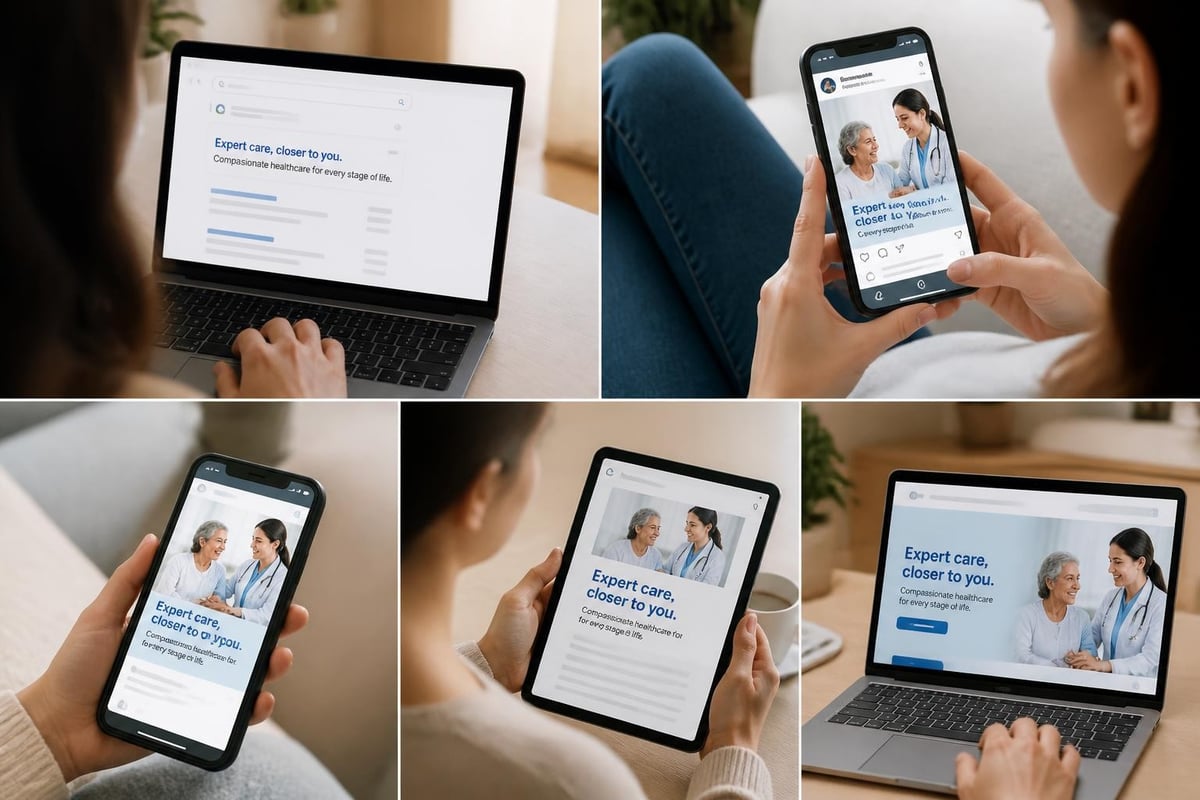
Every campaign needs dedicated landing pages aligned with ad messaging. Sending traffic to your homepage creates confusion and abandonment. A wound care campaign advertising diabetic ulcer treatment should direct to a focused landing page about that specific service, not a general services overview.
High-converting healthcare landing pages include these essential elements:
| Element | Purpose | Best Practice |
|---|---|---|
| Headline Match | Confirms relevance | Mirror ad copy language |
| Trust Indicators | Builds credibility | Display certifications, awards, testimonials |
| Clear Value Proposition | Differentiates offering | Specific benefits over competitors |
| Simple Form | Reduces friction | Ask minimum required information |
| Strong CTA | Drives action | Use action verbs and benefit language |
| Mobile Optimization | Captures mobile traffic | Responsive design with thumb-friendly buttons |
Testing different landing page variations reveals what resonates with your specific patient population. An addiction treatment center might find that empathy-focused copy outperforms clinical messaging, while an orthopedic practice discovers that surgeon credentials drive more conversions than facility photos.
Budget Allocation and Bidding Strategies
Creating campaigns requires strategic budget distribution across channels, audiences, and campaign phases. Forbes outlines 20 essential steps when building a marketing campaign, emphasizing financial planning and resource allocation as foundational elements.
Start with your target cost per acquisition (CPA) and work backward. If your average patient lifetime value for men's health treatments equals three thousand dollars and you need a 3:1 return on ad spend, you can afford up to one thousand dollars per new patient acquisition. This calculation determines your maximum bid strategies and daily budget requirements.
Budget allocation considerations:
- Reserve twenty percent for testing new channels and audiences
- Allocate larger budgets to proven high-performing campaigns
- Maintain separate budgets for brand awareness versus direct response
- Plan for seasonal fluctuations in healthcare demand
- Account for learning phases on new platforms requiring initial investment
Different specialties experience varying costs per click and conversion rates. Telehealth platforms often see lower CPCs than surgical practices due to competition levels and patient lifetime values. Geographic targeting also impacts costs-major metropolitan markets demand higher bids than rural areas.
Tracking and Attribution in Healthcare Campaigns
Accurate tracking separates successful campaigns from mediocre ones. Implement comprehensive conversion tracking that follows patients from initial ad click through appointment booking and actual show-up. Many healthcare practices celebrate lead generation without measuring show rates or conversion to paying patients-a critical oversight.
Proper attribution requires call tracking systems that assign unique phone numbers to campaigns, CRM integration that captures lead source data, and coordinated offline tracking for walk-in patients who mention specific advertisements. Modern healthcare marketers leverage technology that identifies anonymous website visitors, enabling remarketing to prospects who didn't initially convert.
Testing, Optimization, and Scaling Successful Campaigns
Campaign launch represents the beginning, not the end, of creating campaigns that deliver sustainable results. Continuous testing and optimization improve performance while reducing acquisition costs over time.
Implement A/B testing across these campaign elements:
- Ad creative variations – Headlines, images, video versus static
- Audience segments – Demographics, interests, behaviors, custom audiences
- Offer types – Free consultations, discounts, limited-time promotions
- Landing page elements – Headlines, forms, testimonials, layouts
- Bid strategies – Manual versus automated, different optimization goals
Give tests sufficient time and volume to reach statistical significance. Declaring winners after fifty clicks creates false conclusions. Most healthcare campaigns need at least one hundred conversions per variation to identify meaningful performance differences.

When campaigns consistently exceed performance targets, scale gradually. Doubling budgets overnight often disrupts algorithm learning and audience quality. Increase spending by twenty to thirty percent weekly while monitoring CPA and lead quality metrics.
Lead Management Systems That Convert Campaigns into Patients
Even perfectly executed campaigns fail without proper lead management infrastructure. Healthcare consumers expect immediate responses-delays of hours or days result in lost opportunities to faster-responding competitors.
Implement these lead management best practices:
- Two-minute response times – Contact new leads within 120 seconds of inquiry
- Multi-touch follow-up sequences – Combine calls, texts, and emails
- CRM integration – Track all interactions and campaign attribution
- Qualification protocols – Screen for insurance, location, and treatment fit
- Appointment confirmation systems – Reduce no-shows through reminders
- Staff training programs – Ensure consistent, professional patient interactions
The gap between lead generation and patient acquisition causes most healthcare marketing failures. A campaign generating one hundred qualified leads monthly with a ten percent conversion rate produces ten new patients. Improving conversion to twenty percent through better lead management doubles patient acquisition without additional advertising spend.
Campaign Alignment with Practice Capacity
Creating campaigns without considering practice capacity creates operational nightmares. Overwhelming staff with more leads than they can handle damages patient experience and wastes advertising dollars. Conversely, underfilled schedules represent missed revenue opportunities.
Coordinate marketing intensity with provider schedules, seasonal patterns, and growth objectives. A medical spa launching new services might run aggressive campaigns to build awareness and fill appointment slots, while an established orthopedic practice might focus on maintaining steady flow rather than explosive growth.
Measuring Campaign Success Beyond Vanity Metrics
Click-through rates and impressions matter less than appointments booked and revenue generated. Shopify provides a comprehensive guide on creating successful marketing campaigns, detailing how measuring campaign performance against business objectives determines true success.
Track these meaningful healthcare campaign metrics:
| Metric Category | Key Measurements | Why It Matters |
|---|---|---|
| Lead Generation | Total Leads, Cost Per Lead | Volume and efficiency |
| Lead Quality | Qualification Rate, Insurance Match | Conversion potential |
| Conversion | Appointment Booking Rate, Show Rate | Patient acquisition effectiveness |
| Revenue | Patient Lifetime Value, ROI | Financial performance |
| Long-term Impact | Retention Rate, Referral Generation | Sustainable growth |
Calculate return on investment by tracking revenue generated from campaign-acquired patients versus total campaign costs. A women's health clinic spending ten thousand dollars monthly on campaigns that generate fifty new patients averaging two thousand dollars lifetime value achieves a 10:1 return-clearly justifying continued investment.
Advanced analytics reveal which campaigns attract the most valuable patients. Perhaps your Facebook campaigns generate higher volume at lower cost per lead, but your Google search campaigns produce patients with higher treatment acceptance rates and longer retention. This insight guides budget reallocation toward maximum profitability rather than minimum cost.
Franchise Development Campaigns for Healthcare Systems
Healthcare franchise systems require specialized campaign approaches targeting aspiring entrepreneurs rather than patients. Creating campaigns for franchise development involves longer sales cycles, higher-value transactions, and different decision criteria than patient acquisition campaigns.
Franchise campaigns emphasize business opportunity, support systems, market demand data, and return on investment projections. The messaging attracts individuals seeking business ownership in recession-resistant healthcare sectors with proven operational models.
Effective franchise development campaigns include:
- Detailed information packets and discovery calls rather than immediate sales
- Multi-step nurture sequences educating prospects about the opportunity
- Qualification criteria ensuring financial capacity and cultural fit
- Success stories from existing franchisees demonstrating profitability
- Clear differentiation from competing franchise opportunities
The lead management process for franchise development requires more sophisticated nurturing than patient acquisition. Prospects need months of education, multiple touchpoints with leadership, financial disclosure reviews, and often territory analysis before committing to franchise agreements.
Seasonal and Event-Based Campaign Strategies
Healthcare demand fluctuates throughout the year based on insurance cycles, seasonal health concerns, and cultural events. Strategic marketers creating campaigns around these patterns capture demand spikes while competitors miss opportunities.
January brings New Year's resolution seekers to medical spas, weight loss clinics, and men's health providers. Summer generates demand for aesthetic treatments before vacations and weddings. Fall sees increased interest in addiction treatment as families address concerns before holidays.
Plan campaign calendars that align with these predictable patterns while maintaining baseline campaigns year-round. Pre-launch campaigns before peak seasons to capture early demand. Adjust messaging to reflect seasonal motivations-"summer-ready body" resonates differently than "holiday confidence boost" despite targeting similar services.
Event-based campaigns tied to health awareness months provide timely hooks for relevant messaging. Breast Cancer Awareness Month in October creates opportunities for women's health clinics, while Men's Health Month in June supports testosterone and wellness campaigns.
Creating campaigns that consistently generate qualified healthcare leads requires strategic planning, multi-channel execution, continuous optimization, and seamless lead management systems. The difference between campaigns that drain budgets and campaigns that fill appointment calendars lies in the details-audience targeting precision, message resonance, conversion optimization, and rapid lead response. RevSpark Media specializes in building comprehensive marketing campaigns for healthcare providers and franchise systems, combining proprietary visitor identification technology with in-house pre-sales teams that convert leads into scheduled appointments with two-minute response times. With a track record of generating over one hundred million dollars in client growth, RevSpark Media handles every aspect from campaign setup through patient onboarding, ensuring your marketing investment translates into measurable revenue growth.