
Healthcare providers face unprecedented competition in patient acquisition, making digital marketing ads essential for sustainable growth. With the average healthcare consumer conducting extensive online research before booking an appointment, strategic advertising campaigns have become the primary driver of new patient flow for medical practices, telehealth providers, and specialty clinics. Understanding how to leverage digital marketing ads effectively transforms marketing budgets into predictable revenue streams, particularly for practices seeking to fill appointment calendars with qualified patients ready to convert.
The Healthcare Digital Advertising Landscape in 2026
The healthcare advertising ecosystem has evolved dramatically over the past three years, with data privacy regulations and algorithmic changes reshaping how medical practices reach potential patients. Digital marketing ads now require sophisticated targeting strategies that balance regulatory compliance with performance optimization.
Healthcare providers investing in digital advertising must navigate unique challenges that don't affect other industries. HIPAA compliance impacts retargeting capabilities, while medical advertising regulations restrict certain claims and messaging approaches. Despite these constraints, healthcare digital marketing ads consistently deliver the highest ROI when executed with precision.
Platform Selection for Medical Practice Growth
Choosing the right advertising platforms determines campaign success before a single dollar is spent. Each platform offers distinct advantages for healthcare lead generation:
- Google Ads provides intent-based targeting, capturing patients actively searching for specific treatments
- Facebook and Instagram Ads enable demographic and interest-based targeting for awareness and consideration stages
- LinkedIn Ads excel for B2B healthcare services targeting physicians and practice administrators
- Programmatic display networks expand reach across premium health and wellness content sites
Most successful healthcare practices allocate 60-70% of their digital marketing ads budget to Google search campaigns, with the remaining portion distributed across social platforms based on patient demographics. A wound care center targeting elderly patients might emphasize Facebook, while a men's health clinic could prioritize Instagram and YouTube.

Audience Targeting Strategies That Convert
The effectiveness of digital marketing ads in healthcare depends entirely on reaching the right people at the right time. Advanced audience segmentation transforms generic advertising into personalized patient recruitment.
Demographic targeting forms the foundation of healthcare campaign strategy. A medical spa focuses on women aged 35-65 with household incomes exceeding $75,000, while addiction treatment centers might target family members of individuals showing substance abuse indicators. According to industry data on advertising effectiveness, precision demographic targeting improves conversion rates by 340% compared to broad audience approaches.
Intent-Based Targeting for Immediate Conversions
Search intent represents the most valuable targeting criterion for healthcare digital marketing ads. When someone searches "orthopedic surgeon near me accepting new patients," they're signaling immediate need and high conversion probability.
Keyword selection requires balancing search volume with commercial intent. High-value keywords include:
- Condition-specific searches ("neuropathy treatment options")
- Location-based service queries ("compounding pharmacy Denver")
- Solution-oriented searches ("testosterone replacement therapy")
- Urgent care indicators ("same-day dermatology appointment")
Long-tail keywords typically cost 60% less per click while converting at 2.5x the rate of broad match keywords. A telehealth provider advertising "virtual urgent care for sinus infection" captures higher-intent traffic than generic "online doctor" campaigns.
| Keyword Type | Average CPC | Conversion Rate | Cost Per Acquisition |
|---|---|---|---|
| Broad Match | $8.50 | 2.3% | $370 |
| Phrase Match | $6.20 | 4.1% | $151 |
| Exact Match | $4.80 | 6.8% | $71 |
| Long-Tail | $3.40 | 9.2% | $37 |
Ad Creative That Drives Patient Action
Healthcare consumers respond to digital marketing ads that address specific pain points while establishing credibility and trust. Generic messaging about "quality care" fails to differentiate practices in competitive markets.
Effective healthcare ad creative follows a proven structure: problem identification, solution presentation, credibility establishment, and clear call-to-action. A wound care center might lead with "Non-healing wound for 30+ days?" before presenting advanced treatment options, physician credentials, and insurance acceptance.
Compliance-Friendly Messaging Frameworks
Medical advertising regulations prohibit guarantees and certain outcome claims, requiring careful message construction. The American Marketing Association’s advertising resources provide guidance on compliant healthcare marketing approaches.
Successful digital marketing ads for healthcare providers emphasize:
- Treatment availability and accessibility ("Accepting new patients this week")
- Credential-based trust signals ("Board-certified specialists with 20+ years experience")
- Technology and approach differentiation ("Advanced platelet-rich plasma therapy")
- Patient convenience factors ("Virtual consultations available")
Visual elements significantly impact performance. Healthcare digital marketing ads incorporating authentic patient imagery outperform stock photography by 47%. Video ads showcasing facility tours and physician introductions generate 3.2x higher engagement rates than static images.

Landing Page Optimization for Maximum Conversion
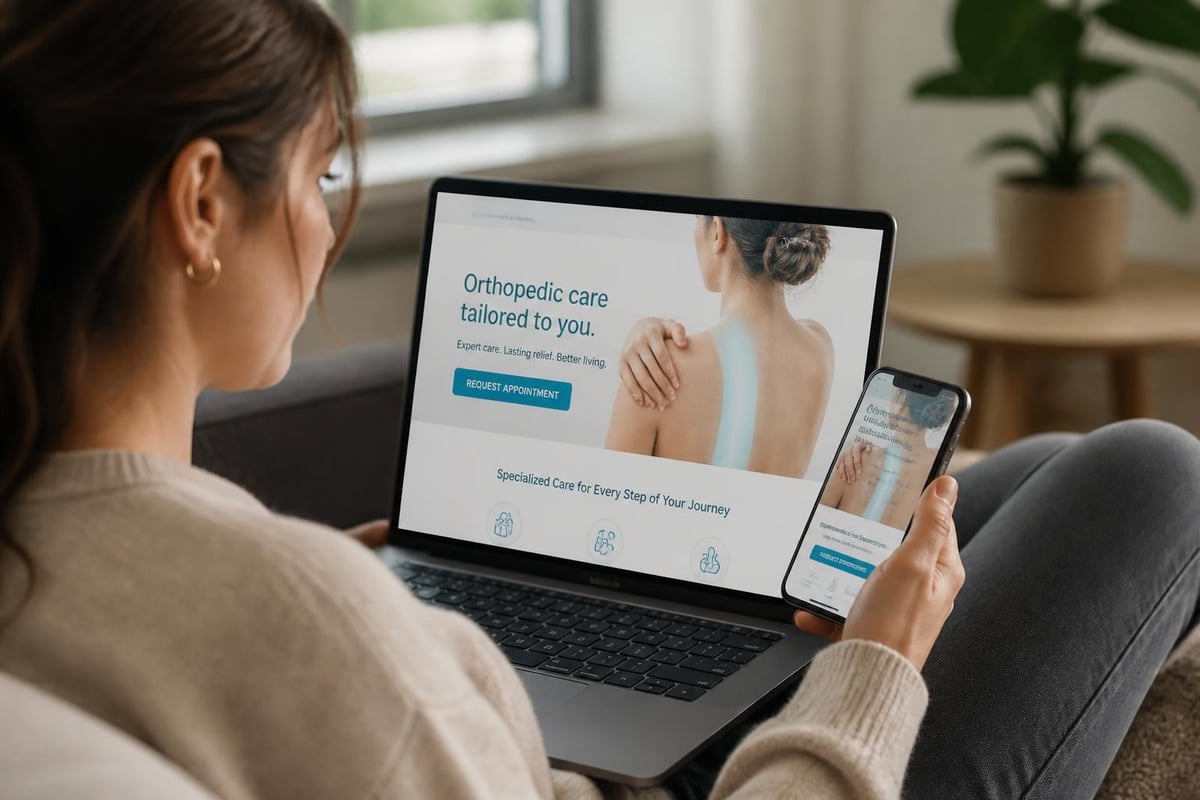
The most sophisticated digital marketing ads fail without optimized landing pages that continue the conversion journey. Healthcare landing pages must address patient concerns, establish trust, and simplify appointment booking within seconds.
High-converting healthcare landing pages share common elements:
- Above-fold clarity that immediately confirms the visitor found the right place
- Prominent phone numbers and contact forms accessible without scrolling
- Trust indicators including physician photos, credentials, and patient testimonials
- Insurance and payment information addressing primary friction points
- Mobile-optimized design accommodating the 73% of healthcare searches occurring on smartphones
A women's health clinic running digital marketing ads for hormone replacement therapy needs landing pages specifically addressing HRT concerns, not generic women's health services pages. Message match between ad copy and landing page headline improves conversion rates by 220%.
Form Design and Lead Capture Strategy
Lead capture forms require careful balancing between information collection and conversion optimization. Each additional form field reduces completion rates by 11%, yet insufficient data prevents effective follow-up.
Healthcare practices should implement multi-step forms that initially collect only essential contact information:
- Name and phone number (required)
- Email address (required)
- Preferred contact time (optional)
- Brief description of needs (optional)
Additional qualification questions can be addressed during follow-up calls rather than risking form abandonment. According to digital marketing research, two-step forms convert 34% better than traditional single-page designs for healthcare services.
Budget Allocation and Bidding Strategies
Healthcare providers waste significant portions of their digital marketing ads budgets through suboptimal bidding strategies and platform allocation. Strategic budget management maximizes patient acquisition while minimizing wasted spend.
Daily budget distribution should reflect patient search patterns. Medical practices see peak search activity during lunch hours (11 AM – 1 PM) and evenings (6 PM – 9 PM), justifying dayparting strategies that increase bids during high-intent periods.
| Time Period | Search Volume | Conversion Rate | Recommended Bid Adjustment |
|---|---|---|---|
| 8 AM – 11 AM | Medium | 4.2% | +15% |
| 11 AM – 1 PM | High | 6.8% | +30% |
| 1 PM – 6 PM | Low | 3.1% | -20% |
| 6 PM – 9 PM | High | 7.2% | +35% |
Cost Per Acquisition Benchmarks
Understanding competitive CPA benchmarks helps healthcare providers set realistic performance expectations for digital marketing ads. Average patient acquisition costs vary dramatically by specialty:
Telehealth platforms typically achieve $45-75 CPAs for initial consultations. Addiction treatment centers face higher acquisition costs ($200-400) but dramatically higher lifetime patient values. Medical spas and aesthetic practices average $85-150 CPAs, while orthopedic practices investing in surgical patient acquisition accept $300-600 CPAs given procedure revenues.
Smart bidding strategies using automated optimization can reduce CPAs by 28% compared to manual bidding, but require sufficient conversion volume (minimum 30 conversions monthly) to function effectively. Practices below this threshold benefit from enhanced CPC bidding while building conversion history.
Retargeting Campaigns for Abandoned Leads
The majority of healthcare website visitors leave without scheduling appointments, creating opportunities for strategic retargeting through digital marketing ads. HIPAA-compliant retargeting approaches re-engage potential patients while respecting privacy regulations.
Website visitor retargeting displays ads to individuals who viewed specific service pages but didn't convert. A compounding pharmacy can show customized ads to visitors who spent time on testosterone therapy pages, featuring specific messaging about treatment benefits and convenient consultation scheduling.
Retargeting campaign structure should follow the consideration journey:
- Days 1-3: Brand awareness ads reinforcing practice name and location
- Days 4-7: Educational content addressing common treatment questions
- Days 8-14: Offer-driven ads featuring new patient specials or limited-time consultations
- Days 15-30: Final conversion push with urgency messaging
HIPAA-Compliant Retargeting Approaches
Healthcare digital marketing ads must navigate stricter privacy regulations than other industries. Digital privacy frameworks established by industry organizations provide guidance for compliant retargeting.
Avoid creating audiences based on protected health information or treatment-specific page visits that could reveal patient conditions. Instead, build retargeting lists around general service categories ("visited services page") rather than specific conditions ("viewed diabetic neuropathy treatment page").
Performance Tracking and Attribution
Measuring digital marketing ads effectiveness requires sophisticated tracking that connects ad spend to actual patient appointments and revenue. Healthcare providers need systems that track the complete conversion journey from initial click through appointment show and treatment acceptance.
Call tracking remains essential for healthcare advertising measurement, as 68% of patient conversions occur via phone. Dynamic number insertion assigns unique phone numbers to different ad campaigns, enabling precise attribution of offline conversions to specific digital marketing ads.
Multi-touch attribution models provide more accurate performance insights than last-click attribution. A patient might first encounter your practice through a Facebook awareness ad, conduct a Google search days later, and ultimately call after seeing a retargeting ad. Proper attribution credits all touchpoints appropriately.
Key Performance Indicators for Healthcare Campaigns
Healthcare providers should monitor these critical metrics:
- Click-through rate (CTR): Healthcare ads averaging 4-6% CTR indicate strong relevance
- Cost per click (CPC): Benchmark against specialty averages to identify optimization opportunities
- Conversion rate: Track both lead submissions and appointment bookings separately
- Cost per lead (CPL): Monitor trend lines to catch performance degradation early
- Cost per appointment (CPA): Ultimate success metric tied to practice revenue
- Show rate: Percentage of scheduled appointments that actually occur
- Patient lifetime value (LTV): Critical for calculating acceptable acquisition costs
Integration between advertising platforms, CRM systems, and practice management software creates comprehensive visibility into campaign performance. Practices investing in complete tracking infrastructure improve digital marketing ads ROI by 156% compared to those relying on platform-reported conversions alone.
Advanced Strategies for Competitive Markets
Healthcare providers in saturated markets need sophisticated approaches beyond standard digital marketing ads tactics. Competitive metropolitan areas require strategic advantages to achieve acceptable patient acquisition costs.
Competitive conquest campaigns target searches including competitor names, capturing patients researching alternative providers. While ethically controversial, these campaigns remain legal and effective when executed properly. An orthopedic practice might bid on "[Competitor Name] reviews" searches, presenting their own practice as a superior alternative.
Local Service Ads and Google Guaranteed
Google's Local Service Ads program offers unique advantages for healthcare providers, particularly home health services, physical therapy practices, and mobile medical services. These ads appear above traditional search ads and operate on a pay-per-lead rather than pay-per-click model.
Qualification for Google Guaranteed status provides significant trust advantages, as Google verifies licensing, insurance, and background checks. Healthcare digital marketing ads carrying the Google Guaranteed badge achieve 89% higher conversion rates than standard search ads in equivalent positions.
Geographic targeting refinement captures high-value service areas while excluding unprofitable locations. A medical spa might bid aggressively for affluent zip codes while reducing or eliminating spend in areas with lower median incomes and corresponding lower conversion rates.
Emerging Trends Shaping Healthcare Advertising
The digital advertising landscape continues evolving rapidly, with several trends fundamentally changing how healthcare providers deploy digital marketing ads. Understanding these shifts ensures practices remain competitive as platforms and patient behaviors change.
Artificial intelligence integration now powers creative optimization, automatically testing hundreds of ad variations to identify top performers. Healthcare practices leveraging AI-driven creative testing improve conversion rates by 43% while reducing creative production costs. As noted in industry publications on advertising technology, machine learning algorithms now handle increasingly sophisticated optimization tasks previously requiring manual intervention.
First-party data strategies have become critical as third-party cookie deprecation progresses. Healthcare providers building robust patient databases and website visitor identification systems gain significant targeting advantages. Proprietary technology identifying 60% of anonymous website visitors enables retargeting and audience building independent of platform-provided tracking.
Voice search optimization impacts digital marketing ads strategy as voice-activated searches account for 27% of healthcare-related queries. Conversational keyword targeting ("where can I get testosterone therapy near me") captures this growing search behavior.
Franchise System Advertising Considerations
Healthcare franchise systems face unique digital marketing ads challenges balancing corporate brand consistency with local market customization. Multi-location campaigns require strategic frameworks that maximize efficiency while addressing individual market dynamics.
Campaign structure hierarchy should separate brand awareness campaigns running nationally from location-specific conversion campaigns targeting local service areas. A medical spa franchise might run nationwide video campaigns building brand recognition while individual locations manage their own Google search campaigns optimized for local competition and demographics.
Co-op advertising models distribute costs between corporate and franchise operators, typically with corporate covering 40-60% of digital marketing ads expenses for brand campaigns. Clear attribution methodologies prevent disputes by accurately tracking which locations benefit from shared advertising investments.
Centralized creative development with localized customization provides consistency while accommodating market differences. Corporate teams produce core ad templates and messaging frameworks, with individual locations adding specific offers, physician names, and location details.
Systematic Follow-Up Systems
Even the most effective digital marketing ads generate wasted investment without proper lead follow-up systems. Healthcare providers must respond immediately to advertising-generated inquiries to maximize conversion rates.
Response time dramatically impacts conversion probability. Leads contacted within two minutes convert at 391% higher rates than those reached after 30 minutes. This reality necessitates dedicated phone coverage, automated SMS responses, and systematic follow-up protocols.
Multi-channel follow-up sequences combine phone calls, text messages, and emails to maximize contact rates:
- Immediate automated SMS acknowledgment
- Phone call attempt within 2 minutes
- Follow-up text if call unanswered
- Email with scheduling link
- Second call attempt at different time
- Final nurture sequence for non-responsive leads
Many healthcare practices lack internal capacity for immediate response, creating opportunities for specialized lead management services that handle initial contact, qualification, and appointment scheduling. Outsourced lead management improves conversion rates by 78% for practices previously relying on staff handling inquiries between patient care responsibilities.
Systematic follow-up transforms digital marketing ads from lead generation tools into patient acquisition engines. The combination of strategic advertising, optimized conversion paths, and relentless follow-up creates predictable growth for healthcare providers willing to implement complete systems rather than fragmented tactics.
Mastering digital marketing ads requires integrating platform expertise, compliant messaging, conversion optimization, and systematic follow-up into cohesive patient acquisition systems. Healthcare providers implementing these strategies position themselves for sustained growth in increasingly competitive markets. RevSpark Media specializes in building complete lead generation and patient onboarding systems for healthcare providers and franchise systems, combining proprietary visitor identification technology with in-house pre-sales teams that respond to leads within two minutes and convert prospects into scheduled appointments. With a proven track record generating over $100M in client growth, our comprehensive approach handles everything from campaign creation through appointment confirmation, ensuring your advertising investment translates into actual patient revenue.