
Healthcare providers face a critical challenge: generating qualified leads is only half the battle. Without a systematic approach to converting those leads into scheduled appointments and actual patients, even the best marketing campaigns fall short of revenue goals. This disconnect between marketing efforts and revenue outcomes has driven the evolution of end to end marketing, a comprehensive approach that integrates every touchpoint from initial awareness through patient acquisition. For healthcare practices and franchise systems, understanding and implementing this strategy represents the difference between sporadic results and predictable, scalable growth.
What Defines End to End Marketing in Healthcare
End to end marketing encompasses the complete patient journey, creating seamless integration between awareness, lead generation, qualification, and conversion. Unlike traditional marketing that focuses solely on attracting prospects, this approach takes full ownership of results by connecting every phase of the patient acquisition process.
The end-to-end marketing process integrates marketing and sales functions to eliminate the gaps where potential patients typically fall through the cracks. For healthcare providers, this means tracking a prospect from the moment they click on an ad through their first appointment and beyond.
Key components of this comprehensive approach include:
- Initial campaign strategy and audience targeting
- Multi-channel advertising across search, social, and display networks
- Landing page optimization designed for healthcare conversions
- Lead capture and identification technology
- Rapid response sales development and qualification
- Appointment scheduling and confirmation systems
- Follow-up sequences to maximize show rates
- Patient onboarding and retention strategies

The Critical Gap in Traditional Healthcare Marketing
Most healthcare practices invest thousands monthly in advertising without knowing whether those dollars translate to actual patient revenue. Traditional marketing agencies deliver leads, then their responsibility ends. This creates a fundamental accountability gap.
A wound care center might generate 100 inquiries monthly through Google Ads, but if only 15 become scheduled appointments and just 8 actually show up, the marketing investment yields minimal return. The problem isn't necessarily the marketing quality but rather the lack of systematic follow-through from lead to patient.
Research on tracking marketing impact to prove ROI demonstrates that understanding full customer journeys enables healthcare providers to optimize at every conversion point, not just the initial lead generation phase.
Building a Complete Patient Acquisition System
End to end marketing transforms fragmented tactics into a unified revenue engine. For healthcare providers, this systematic approach addresses the specific challenges of regulated industries where trust, compliance, and relationship-building determine conversion success.
Lead Generation with Advanced Identification
The foundation begins with attracting qualified prospects through precisely targeted campaigns. Healthcare marketing requires sophisticated audience segmentation based on demographics, health conditions, treatment readiness, and geographic service areas.
Modern lead generation extends beyond simple form fills. Proprietary visitor identification technology can reveal 60% of anonymous website traffic, transforming casual browsers into actionable leads. This capability proves particularly valuable in healthcare, where prospects often research extensively before making contact.
| Lead Source | Typical Identification Rate | Enhanced Technology Rate | Revenue Impact |
|---|---|---|---|
| Organic Search | 2-3% (form fills only) | 35-40% (with ID tech) | 15x increase |
| Paid Advertising | 3-5% (landing page forms) | 45-50% (with ID tech) | 12x increase |
| Social Media | 1-2% (form fills only) | 25-30% (with ID tech) | 18x increase |
This expanded lead identification creates dramatically larger opportunity pools for healthcare practices, but only when paired with systematic follow-up.
Rapid Response Sales Development
The critical conversion moment occurs within minutes of a prospect's inquiry. Healthcare consumers researching treatment options often contact multiple providers simultaneously. The first practice to respond professionally typically wins the appointment.
End to end marketing incorporates dedicated sales development teams trained specifically in healthcare communication. These specialists handle:
- Two-minute response times to all incoming leads
- Qualification conversations that assess treatment fit and urgency
- Objection handling addressing cost, insurance, and treatment concerns
- Appointment scheduling directly into provider calendars
- Confirmation sequences reducing no-show rates
This professional touch point transforms anonymous website visitors into scheduled consultations. For medical spas, men's health clinics, and telehealth providers, this human connection establishes trust before the first clinical interaction.

Complete CRM Integration and Transparency
Technology infrastructure forms the backbone of successful end to end marketing. Complete CRM integration ensures every lead, interaction, appointment, and outcome is tracked and visible.
Healthcare providers gain real-time visibility into:
- Daily lead volume by source and campaign
- Response times and conversion rates by team member
- Appointment scheduling rates and show percentages
- Revenue attribution connecting marketing spend to patient value
- Pipeline forecasting predicting future patient acquisition
This transparency enables data-driven optimization. When a compounding pharmacy can see that Facebook ads generate leads at $45 each with 28% appointment rates, while Google Ads cost $78 per lead with 42% appointment rates, strategic budget allocation becomes clear.
Optimizing Each Stage for Maximum Conversion
The power of end to end marketing lies in systematic improvement across every conversion milestone. Rather than accepting industry-average performance, this approach identifies and eliminates bottlenecks throughout the patient journey.
Campaign and Creative Excellence
Effective healthcare advertising speaks directly to patient pain points while maintaining compliance with regulatory requirements. Campaign optimization focuses on:
Ad copy testing that balances emotional connection with clinical credibility. Orthopedic practices might emphasize returning to active lifestyles, while addiction treatment centers focus on confidential care and insurance acceptance.
Landing page conversion designed specifically for healthcare decision-making. The components of end-to-end marketing solutions include brand awareness through customer retention, with each page optimized for its specific conversion goal.
Offer development that reduces initial commitment friction. Free consultations, virtual appointments, and flexible payment options remove barriers between interest and action.
Consultation Framework Training
Healthcare providers excel at clinical care but often struggle with sales conversations. End to end marketing includes consultation framework training that helps doctors and staff convert appointments into patients.
Structured frameworks guide providers through:
- Building rapport and understanding patient concerns
- Presenting treatment options with clear value propositions
- Addressing financial objections with payment solutions
- Creating urgency without pressure tactics
- Securing commitment to start treatment
For franchise systems, standardized consultation frameworks ensure consistent conversion performance across all locations, turning patient acquisition into a predictable, scalable process.
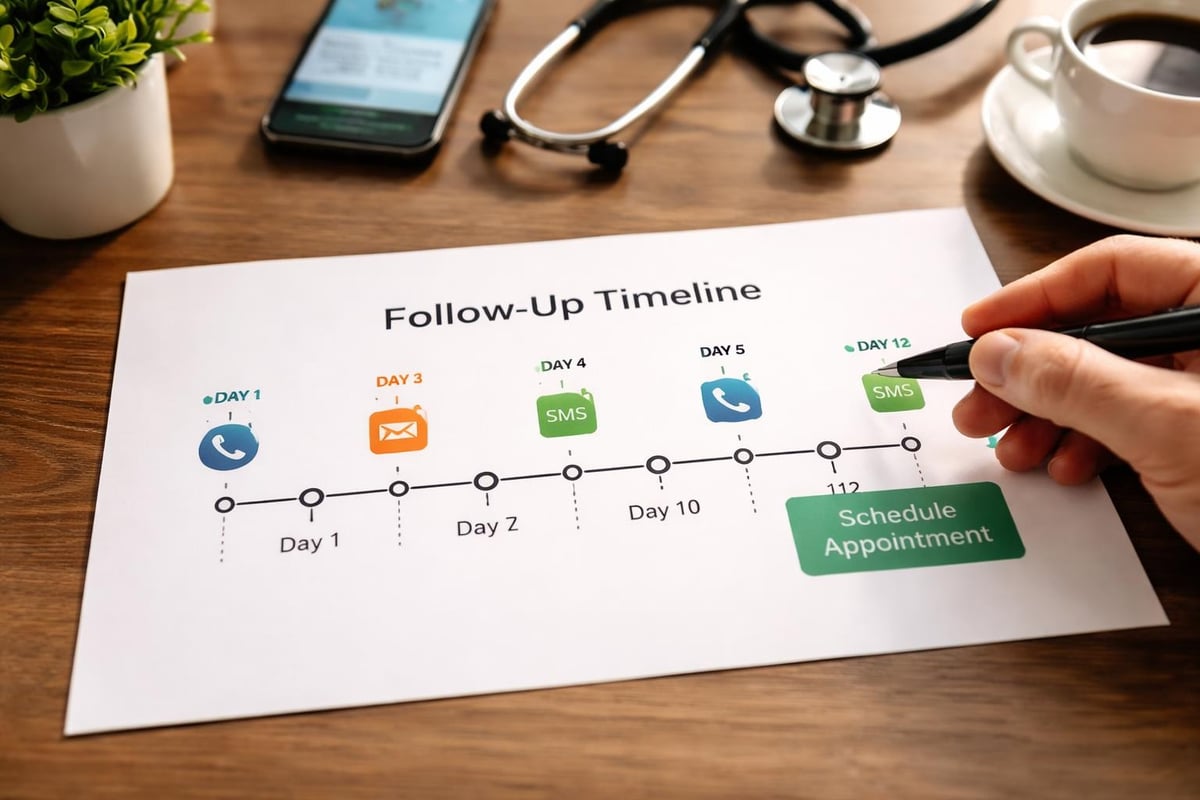
Systematic Follow-Up Management
Most healthcare leads require multiple touchpoints before scheduling appointments. Automated follow-up sequences maintain engagement without requiring manual effort from busy practitioners.
| Touchpoint | Timing | Channel | Purpose | Conversion Lift |
|---|---|---|---|---|
| Initial Response | 2 minutes | Phone/SMS | Immediate engagement | Baseline |
| Follow-up #1 | 4 hours | Educational content | +18% | |
| Follow-up #2 | 24 hours | SMS | Appointment availability | +23% |
| Follow-up #3 | 3 days | Phone | Personal outreach | +31% |
| Follow-up #4 | 7 days | Special offer | +14% |
This persistence, delivered professionally through varied channels, captures prospects who need time to make healthcare decisions. Women's health clinics and veterinary practices particularly benefit from nurture sequences that build trust over weeks.
Measuring What Matters: Revenue-Focused Metrics
Traditional marketing metrics like impressions, clicks, and cost-per-lead tell an incomplete story. End to end marketing shifts focus to revenue outcomes that directly impact practice profitability.
Advanced Attribution and ROI Tracking
Understanding which marketing channels actually produce patients requires sophisticated attribution. The importance of integrating various digital marketing channels becomes clear when tracking complete patient journeys across multiple touchpoints.
Healthcare providers should monitor:
- Cost per scheduled appointment (not just cost per lead)
- Appointment show rate by lead source and campaign
- Cost per acquired patient including all marketing and sales costs
- Patient lifetime value by acquisition channel
- Revenue per marketing dollar as the ultimate success metric
A telehealth provider might discover that while Google Ads cost more per lead than Facebook, Google leads schedule appointments at twice the rate and show up 30% more consistently, making them far more profitable despite higher initial costs.
Performance Optimization Cycles
Data visibility enables continuous improvement. Monthly performance reviews identify opportunities across the entire patient acquisition funnel.
Campaign level optimization adjusts targeting, messaging, and budget allocation based on conversion performance. Underperforming ad sets get paused while winners receive increased investment.
Sales process refinement analyzes call recordings and conversion data to improve qualification scripts, objection responses, and scheduling techniques. Top-performing team members provide templates for standardizing excellence.
Systems enhancement streamlines technology workflows to reduce manual work and accelerate response times. CRM automation handles routine tasks while humans focus on high-value patient interactions.
Scaling Healthcare Growth Predictably
The ultimate advantage of end to end marketing is predictability. When every stage of patient acquisition operates systematically with clear conversion metrics, growth becomes a function of investment rather than hope.
Capacity Planning and Resource Allocation
Healthcare providers can forecast patient acquisition based on historical performance data. If a medical spa knows that $10,000 in monthly ad spend generates 180 leads, yields 54 scheduled appointments, produces 43 show-ups, and converts 31 new patients, growth planning becomes mathematical.
Expanding capacity to serve additional patients justifies increased marketing investment. Adding another provider or treatment room enables proportional increases in advertising budget with predictable patient volume outcomes.
Geographic expansion for franchise systems leverages proven formulas. When challenges solved by end-to-end marketing include standardized execution across locations, opening new markets becomes less risky.
Competitive Advantages in Healthcare Markets
Healthcare markets grow increasingly competitive as providers vie for the same patient populations. End to end marketing creates sustainable advantages through superior execution and conversion efficiency.
Practices implementing comprehensive systems can:
- Outbid competitors for advertising placements because higher conversion efficiency allows profitable acquisition at higher costs
- Respond faster than competitors still relying on manual lead follow-up
- Convert more efficiently through systematic sales development and consultation frameworks
- Retain patients longer with integrated onboarding and engagement sequences
- Scale faster with proven systems rather than reinventing processes
A wound care center with a 35% lead-to-patient conversion rate can profitably acquire patients at twice the cost of a competitor converting at 18%, dominating local advertising channels and capturing market share.
Implementation Considerations for Healthcare Providers
Transitioning from fragmented marketing tactics to integrated end to end marketing requires strategic planning and operational adjustments. Healthcare providers should consider both the technological infrastructure and human resource requirements.
Technology Stack Requirements
Effective implementation demands integrated systems that connect advertising platforms, CRM databases, communication tools, and analytics dashboards. The technology ecosystem should enable:
- Real-time lead routing from landing pages to sales development teams
- Automated response triggers initiating follow-up sequences instantly
- Call tracking and recording for quality assurance and training
- Calendar synchronization allowing direct appointment booking
- Attribution reporting connecting marketing spend to patient revenue
Many healthcare practices struggle with disconnected point solutions. End to end marketing requires either significant integration work or purpose-built platforms designed specifically for healthcare patient acquisition.
Team Structure and Expertise
While some providers attempt to manage patient acquisition internally, successful execution typically requires specialized expertise across multiple disciplines. The necessary skill sets include:
Campaign management specialists who understand healthcare advertising regulations, HIPAA compliance, and medical terminology while optimizing for conversion performance.
Sales development professionals trained in healthcare communication who can quickly build rapport with prospects, navigate sensitive health discussions, and overcome objections about cost and treatment commitment.
Technology administrators who maintain CRM systems, manage integrations, ensure data accuracy, and generate performance reports that drive optimization decisions.
For most practices, partnering with specialized healthcare marketing providers delivers better results than building internal capabilities from scratch. The right partner brings proven systems, dedicated teams, and performance guarantees that reduce risk.
Compliance and Regulatory Considerations
Healthcare marketing operates under strict regulatory oversight including HIPAA privacy rules, FDA advertising restrictions, and state-specific requirements. End to end marketing systems must incorporate compliance safeguards throughout the patient journey.
Data security protocols protect patient information from capture through conversion. CRM systems require HIPAA-compliant infrastructure with proper access controls and audit trails.
Advertising compliance ensures claims about treatments, outcomes, and procedures meet regulatory standards. Review processes catch potential violations before campaigns launch.
Communication consent manages patient preferences for phone, email, and SMS contact according to TCPA and state regulations. Opt-out handling prevents compliance violations that trigger expensive penalties.
End to end marketing transforms healthcare patient acquisition from unpredictable lead generation into systematic revenue growth by integrating every stage from awareness through conversion. For healthcare providers and franchise systems seeking consistent patient volume and measurable ROI, this comprehensive approach delivers accountability that traditional marketing cannot match. RevSpark Media specializes in complete patient acquisition systems for healthcare providers, combining proprietary lead identification technology with dedicated sales development teams that convert anonymous visitors into scheduled appointments with two-minute response times. Our performance-driven approach has generated over $100M in client growth by taking full ownership of the revenue generation process from campaign creation through patient onboarding.