
Healthcare providers face unprecedented challenges in patient acquisition. The digital landscape has fundamentally transformed how medical practices, wound care centers, compounding pharmacies, and specialty clinics attract new patients. An effective internet marketing campaign combines strategic planning, data-driven decision-making, and systematic execution to convert online searchers into scheduled appointments. For healthcare organizations seeking sustainable growth, understanding the mechanics of digital patient acquisition isn't optional-it's essential for survival in an increasingly competitive marketplace.
Understanding the Healthcare Internet Marketing Landscape
The healthcare sector requires specialized approaches to digital marketing that account for regulatory compliance, patient privacy concerns, and the unique decision-making process prospective patients undertake when selecting medical providers. Unlike retail purchases, healthcare decisions involve significant research, emotional considerations, and trust-building requirements.
Modern patients exhibit distinct behavioral patterns:
- 77% research healthcare providers online before booking appointments
- Average of 8-12 touchpoints required before patient conversion
- Mobile devices account for 63% of initial healthcare searches
- Online reviews influence 84% of patient decisions
These statistics underscore why a fragmented or inconsistent internet marketing campaign fails to deliver results for medical practices. Healthcare providers must develop comprehensive strategies that address every stage of the patient journey, from initial awareness through appointment scheduling and follow-up.

Defining Campaign Objectives for Healthcare Growth
Revenue generation in healthcare marketing requires precise goal-setting tied to measurable business outcomes. Vague objectives like "increase brand awareness" provide no actionable framework for optimization or performance measurement.
Healthcare-focused internet marketing campaigns should establish specific targets:
- Lead volume goals – Defined by total qualified inquiries per month
- Conversion rate benchmarks – Percentage of leads booking consultations
- Cost per acquisition metrics – Maximum acceptable cost per new patient
- Lifetime value calculations – Expected revenue per patient relationship
- Show rate optimization – Percentage of booked appointments attended
For specialized healthcare services like men's health clinics or addiction treatment centers, understanding patient lifetime value becomes particularly critical. A single patient may represent $15,000-$50,000 in recurring revenue, justifying higher acquisition costs than general practice medicine.
Building a Multi-Channel Healthcare Marketing Strategy
Effective internet marketing campaigns require strategic channel selection aligned with patient behavior and practice specialization. Medical spas targeting aesthetic procedures require different channel strategies than orthopedic practices marketing joint replacement procedures.
Paid Search Campaigns for Immediate Patient Acquisition
Pay-per-click advertising delivers immediate visibility for high-intent healthcare searches. When prospective patients search "knee pain specialist near me" or "telehealth weight loss doctor," paid search positions your practice directly in their decision path.
Critical elements for healthcare PPC success:
- Geo-targeted campaigns focusing on service area radius
- Negative keyword implementation to filter unqualified traffic
- Ad extensions highlighting unique value propositions
- Landing page alignment with search intent and ad messaging
- Conversion tracking through consultation bookings
Healthcare providers must approach paid search with realistic ROI expectations. Competitive specialties like plastic surgery or addiction treatment may command $50-$200 per click in major metropolitan markets. This reality necessitates sophisticated conversion optimization to maintain positive return on ad spend.
| Healthcare Specialty | Avg. CPC Range | Conversion Rate Benchmark | Cost Per Lead Target |
|---|---|---|---|
| Men's Health | $45-$125 | 8-15% | $300-$900 |
| Wound Care | $25-$75 | 12-20% | $125-$625 |
| Medical Spa | $35-$95 | 6-12% | $300-$1,600 |
| Compounding Pharmacy | $15-$45 | 10-18% | $85-$450 |
Content Marketing for Authority Building
Educational content establishes clinical expertise while addressing patient questions throughout their research process. A well-executed content strategy positions healthcare providers as trusted authorities, nurturing prospects who aren't yet ready for consultation booking.
Successful healthcare content strategies incorporate multiple formats addressing different patient learning preferences. Blog articles optimize for search visibility, video content demonstrates procedures and builds personal connections, downloadable guides capture lead information, and patient testimonials provide social proof critical for healthcare decision-making.
Leveraging Email Marketing for Patient Nurturing
Email remains one of the most cost-effective channels for healthcare patient acquisition, particularly for services requiring extended decision cycles. Optimizing email marketing campaigns through segmentation and personalization dramatically improves conversion rates.
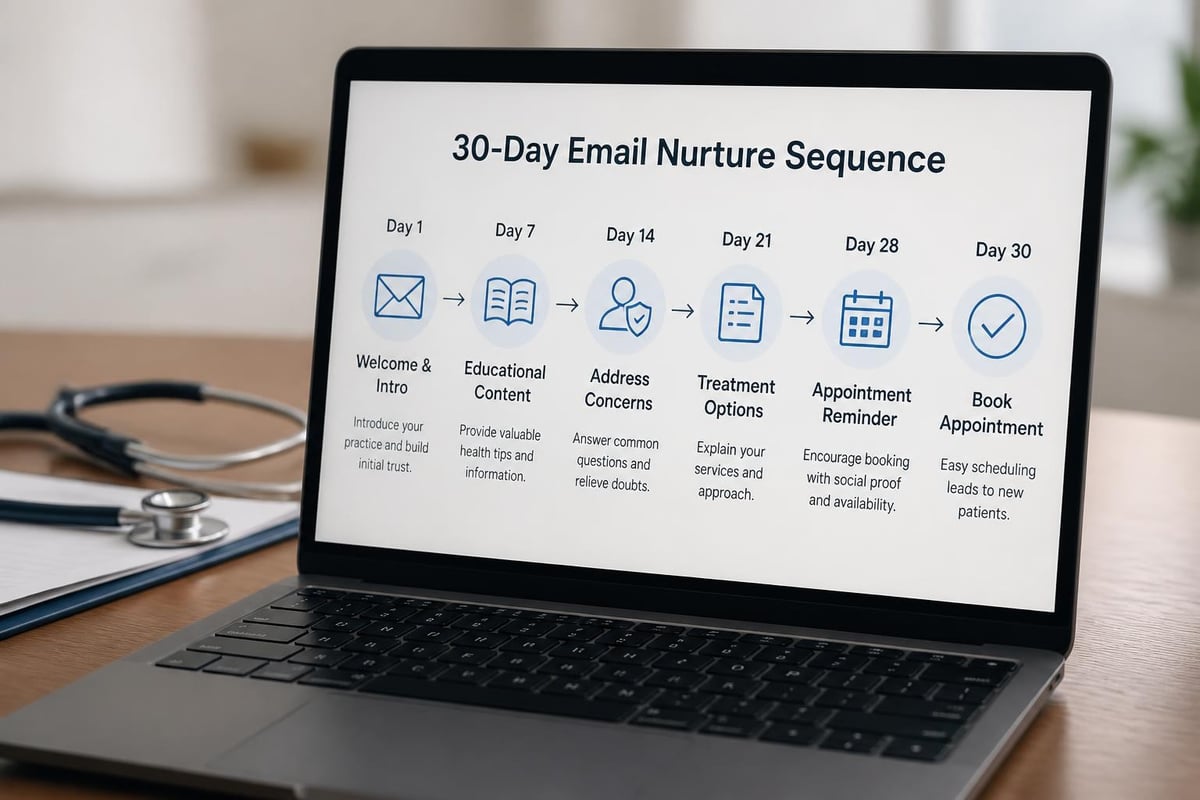
Healthcare email campaigns should segment audiences based on service interest, engagement level, and position in the patient journey. A prospect researching hormone replacement therapy requires different messaging than someone who downloaded a surgical preparation guide.
Effective healthcare email sequences include:
- Welcome series introducing practice philosophy and provider credentials
- Educational nurture content addressing common patient questions
- Procedure-specific information based on expressed interest
- Promotional campaigns highlighting limited-time offers or new services
- Re-engagement campaigns for inactive leads
Compliance with HIPAA regulations and CAN-SPAM requirements remains non-negotiable for healthcare email marketing. Even pre-patient communications require careful attention to privacy protections and opt-out mechanisms.
Automation for Systematic Follow-Up
Marketing automation transforms sporadic outreach into systematic patient nurturing. Automated workflows ensure every lead receives timely, relevant communication regardless of team capacity or operational demands.
Advanced healthcare marketing automation tracks website behavior, email engagement, and form submissions to trigger appropriate follow-up sequences. When a prospect views pricing information for regenerative medicine treatments three times in one week, automated systems can flag them for direct outreach from patient coordinators.
Conversion Optimization Through Landing Page Excellence
Traffic generation represents only half the equation. Converting website visitors into consultation bookings requires purpose-built landing pages optimized for single conversion objectives. Generic website homepage traffic converts at 2-3%, while optimized landing pages achieve 15-25% conversion rates for qualified healthcare traffic.
High-performing healthcare landing pages incorporate specific elements proven to drive patient action. Clear value propositions immediately communicate unique benefits, trust indicators including certifications and patient testimonials reduce decision anxiety, streamlined forms minimize friction in the booking process, and compelling calls-to-action create urgency without appearing pushy.
For specialized services like compounding pharmacy solutions or veterinary medicine, landing pages must educate while converting. Many prospective patients lack familiarity with these services, requiring educational content alongside conversion elements.
Speed-to-Lead: The Critical Success Factor
Response time dramatically impacts healthcare conversion rates. Research consistently demonstrates that practices contacting leads within five minutes convert at 10x the rate of those responding after an hour. For time-sensitive services like addiction treatment or urgent care alternatives, immediate response becomes even more critical.
Response time impact on conversion:
| Response Time | Conversion Rate | Relative Performance |
|---|---|---|
| Under 2 minutes | 35-42% | Benchmark |
| 5 minutes | 22-28% | -35% |
| 15 minutes | 12-18% | -60% |
| 1 hour | 5-8% | -80% |
| 24 hours | 2-4% | -90% |
Healthcare providers lacking dedicated staff for immediate lead response experience devastating conversion losses. An internet marketing campaign generating 100 qualified leads monthly but responding slowly may convert only 5-8 patients, while the same campaign with 2-minute response times converts 35-42 patients-a 500% improvement without additional advertising spend.

Data Analytics and Campaign Performance Measurement
Successful digital marketing campaigns require continuous measurement and optimization based on performance data. Healthcare providers must track metrics across the entire patient acquisition funnel, from initial ad impressions through consultation bookings and patient lifetime value.
Key Performance Indicators for Healthcare Campaigns
Website traffic volume and sources provide visibility into campaign reach and channel effectiveness. Conversion rates at each funnel stage identify bottlenecks preventing patient acquisition. Cost per lead and cost per patient acquisition metrics determine financial efficiency. Consultation show rates measure the quality of booked appointments. Patient lifetime value calculations justify acquisition costs and inform budget allocation.
Modern analytics platforms enable attribution modeling that credits appropriate channels for patient conversions. A prospective patient might discover a medical spa through Instagram advertising, research services through organic search, read blog content, receive nurture emails, and finally book a consultation after clicking a retargeting ad. Proper attribution ensures budget flows to channels actually driving results rather than those receiving last-click credit.
Proprietary Technology for Visitor Identification
Advanced internet marketing campaigns leverage technology that identifies anonymous website visitors, dramatically expanding lead capture beyond traditional form submissions. While standard websites convert 2-5% of visitors, visitor identification technology captures data on 50-60% of site traffic.
This technology particularly benefits healthcare providers offering services with extended research cycles. Prospects researching hormone replacement therapy or franchise opportunities may visit websites multiple times over weeks or months before submitting contact information. Visitor identification enables proactive outreach to engaged prospects before competitors capture their attention.
Healthcare-compliant visitor identification integrates with CRM systems, triggering automated outreach sequences based on pages viewed, time on site, and return visit frequency. A prospect viewing pricing information for regenerative medicine treatments receives different follow-up than someone researching basic preventive care services.
Integration and Systematic Execution
Fragmented marketing technology creates operational inefficiencies and conversion losses. Comprehensive internet marketing campaigns require integrated systems connecting advertising platforms, landing pages, CRM databases, email marketing tools, and phone systems.
Critical integration points:
- Advertising platforms push lead data directly to CRM
- Landing page submissions trigger immediate notification to sales teams
- Phone call tracking attributes conversions to specific campaigns
- Email marketing platforms sync with CRM contact records
- Analytics dashboards consolidate data from multiple sources
For healthcare franchise systems supporting multiple locations, centralized campaign management with location-specific customization ensures brand consistency while addressing local market dynamics. A wound care franchise operating in fifteen markets requires coordinated internet marketing campaigns that maintain corporate messaging while optimizing for regional competition and patient demographics.
Testing and Continuous Improvement
Static campaigns quickly lose effectiveness as competition intensifies and patient behavior evolves. Engaging audiences effectively requires systematic testing across all campaign elements.
Healthcare marketers should implement structured testing protocols examining ad copy variations, landing page layouts and messaging, form length and field requirements, call-to-action wording and placement, email subject lines and content formats, and audience targeting parameters.
Monthly testing cycles with controlled variables enable conclusive results without disrupting overall campaign performance. Testing multiple elements simultaneously creates confusion about which changes drove results, while methodical single-variable testing builds knowledge about what resonates with prospective patients.
A/B Testing Framework for Healthcare
Successful testing follows scientific methodology with clear hypotheses, controlled execution, and statistical significance thresholds. Testing ad headlines emphasizing "board-certified specialists" against "same-day appointments available" provides actionable insights into patient priorities.
For specialized healthcare services requiring trust and credibility like addiction treatment or pharmaceutical distribution, messaging tests often reveal surprising insights. Prospects may respond more strongly to emotional appeals around life transformation than clinical descriptions of treatment protocols.
Compliance Considerations in Healthcare Marketing
Healthcare internet marketing campaigns must navigate complex regulatory requirements including HIPAA privacy protections, FDA guidelines for pharmaceutical and medical device marketing, FTC truth-in-advertising standards, and state medical board advertising restrictions.
Patient testimonials require proper authorization and cannot guarantee specific outcomes. Before-and-after photos for aesthetic procedures must include appropriate disclaimers. Pharmaceutical distribution marketing must accurately represent approved uses and potential side effects.
Working with marketing partners experienced in healthcare compliance reduces legal risk while maintaining campaign effectiveness. Generic marketing agencies lacking healthcare expertise often create compliant but ineffective campaigns, or effective but non-compliant campaigns creating regulatory exposure.
Case Study Applications for Healthcare Growth
Real-world performance data demonstrates the impact of strategic internet marketing campaigns. Targeted campaigns have generated thousands of qualified leads in compressed timeframes through systematic execution and conversion optimization.
Healthcare providers implementing comprehensive digital strategies consistently outperform competitors relying on referrals or traditional advertising. A men's health clinic investing $15,000 monthly in integrated digital marketing generating 85 qualified leads at $176 cost per lead achieves far superior results than competitors spending the same budget on radio advertising generating 20 leads at $750 each.
The critical difference lies in systematic execution across multiple touchpoints, immediate lead response, and sophisticated nurturing for prospects requiring extended decision cycles. Single-channel campaigns or fragmented multi-channel approaches without integration fail to capitalize on the compound effects of coordinated strategy.
Scaling Patient Acquisition Systematically
Growth-oriented healthcare practices require scalable patient acquisition systems that maintain efficiency as volume increases. An internet marketing campaign generating 50 monthly consultation bookings with 40% show rates produces different operational demands than one generating 200 bookings.
Systematic scaling requires infrastructure supporting increased lead volume including dedicated patient coordinators for consultation booking, CRM systems with automated workflows, standardized scripts and consultation frameworks, appointment reminder systems to maximize show rates, and quality control monitoring to maintain conversion standards.
Healthcare franchise systems face additional scaling complexities as new locations require localized campaigns while maintaining brand consistency. Centralized campaign management with local customization enables efficient scaling without reinventing strategy for each market.
Building a successful internet marketing campaign for healthcare requires strategic planning, systematic execution, and continuous optimization across multiple channels. The healthcare providers who thrive in 2026's competitive landscape leverage integrated technology, respond to leads instantly, and nurture prospects through comprehensive patient journeys. If your practice or healthcare franchise system is ready to implement a performance-driven growth platform that guarantees results through proprietary technology and systematic execution, RevSpark Media specializes in transforming anonymous website visitors into scheduled patients with proven systems that have generated over $100M in client growth. Our comprehensive approach handles everything from campaign setup through appointment booking, ensuring your internet marketing campaign delivers measurable revenue growth.