
Healthcare providers face unprecedented competition in 2026, making effective marketing and acquisition strategies more critical than ever. Whether you're operating a compounding pharmacy, wound care center, medical spa, or telehealth practice, the ability to consistently attract and convert qualified patients directly impacts your bottom line. The most successful healthcare organizations have moved beyond traditional marketing approaches to embrace integrated systems that combine lead generation, rapid response protocols, and systematic conversion processes. Understanding how to build and optimize these systems separates thriving practices from those struggling to fill their schedules.
The Foundation of Healthcare Marketing and Acquisition
Modern healthcare marketing and acquisition requires a fundamentally different approach than conventional business-to-consumer marketing. Patients make decisions based on trust, credibility, and perceived outcomes rather than simple product features or pricing. This dynamic creates unique challenges for providers attempting to scale their patient base.
The traditional marketing funnel has evolved into a more complex patient journey that includes multiple touchpoints, research phases, and decision-making criteria. Healthcare providers must address regulatory compliance, privacy concerns, and ethical marketing standards while competing for attention in an increasingly crowded digital landscape.
Building a Multi-Channel Presence
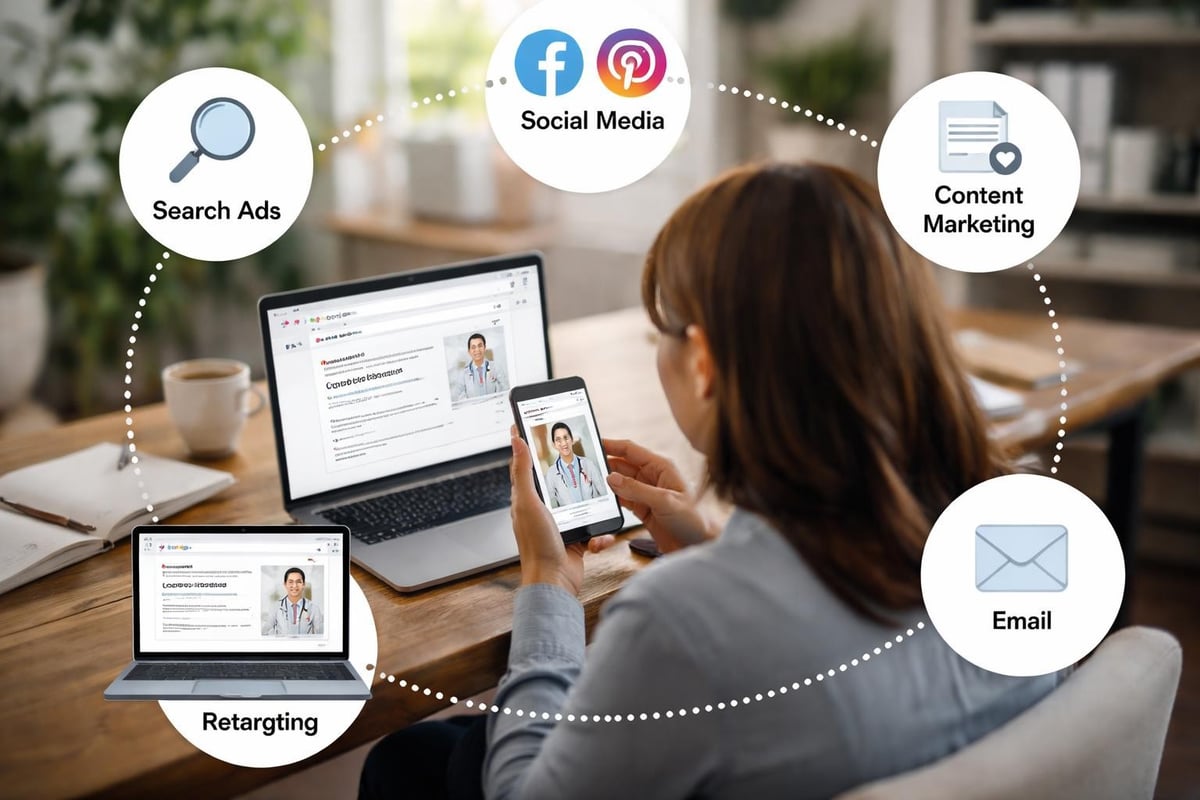
Successful marketing and acquisition strategies leverage multiple channels simultaneously to reach potential patients where they spend their time. This approach ensures consistent visibility and multiple opportunities for engagement.
Essential channels for healthcare acquisition include:
- Search engine marketing targeting condition-specific and treatment-related keywords
- Social media platforms where health-conscious consumers seek information
- Content marketing that establishes expertise and builds trust
- Retargeting campaigns that reconnect with interested prospects
- Email nurture sequences that educate and convert leads over time
Each channel serves a specific purpose within the broader acquisition ecosystem. Search campaigns capture high-intent prospects actively seeking solutions, while social media builds awareness and credibility among audiences who may not yet recognize their need for your services.
Customer acquisition strategies vary widely based on budget constraints and organizational goals, but the most effective approaches share common characteristics: they focus on qualified lead generation rather than vanity metrics, they implement systematic follow-up processes, and they track conversion rates at every stage of the patient journey.
Lead Generation Technology for Healthcare
The gap between visitors and conversions represents the most significant missed opportunity in healthcare marketing and acquisition. Most medical practices lose 60-80% of potential patients who visit their websites but never schedule an appointment.
Advanced visitor identification technology has transformed this landscape by revealing the identity of anonymous website visitors. This capability allows healthcare providers to engage prospects who previously would have disappeared without a trace.
The Power of Visitor Intelligence
| Traditional Analytics | Visitor Identification Technology |
|---|---|
| Shows page views and bounce rates | Reveals actual contact information |
| Reports aggregate behavior | Identifies individual visitors |
| Requires form submissions | Captures 60% of anonymous traffic |
| Passive data collection | Enables proactive outreach |
Implementing visitor identification creates an immediate competitive advantage. When a prospective patient researches your wound care center or men's health clinic online, your team receives their contact information within minutes, enabling rapid follow-up before they contact competitors.
This technology integrates seamlessly with existing CRM systems, automatically feeding qualified leads into your sales pipeline. The result is a continuous flow of warm prospects who have already expressed interest by visiting your website and reviewing your services.
The Critical Importance of Response Time
Response velocity determines conversion rates in healthcare marketing and acquisition more than any other single factor. Research consistently demonstrates that the first practice to contact a prospective patient wins their business in the majority of cases.
Response time benchmarks and their impact on conversion:
- Under 2 minutes: 78% conversion rate potential
- 5-10 minutes: 52% conversion rate potential
- 30 minutes: 31% conversion rate potential
- 1+ hours: 18% conversion rate potential
- 24+ hours: Less than 5% conversion rate potential
These numbers reveal a stark reality: practices that respond within two minutes convert prospects at rates more than fifteen times higher than those taking 24 hours or longer. This creates an enormous competitive advantage for organizations with systems designed for rapid response.
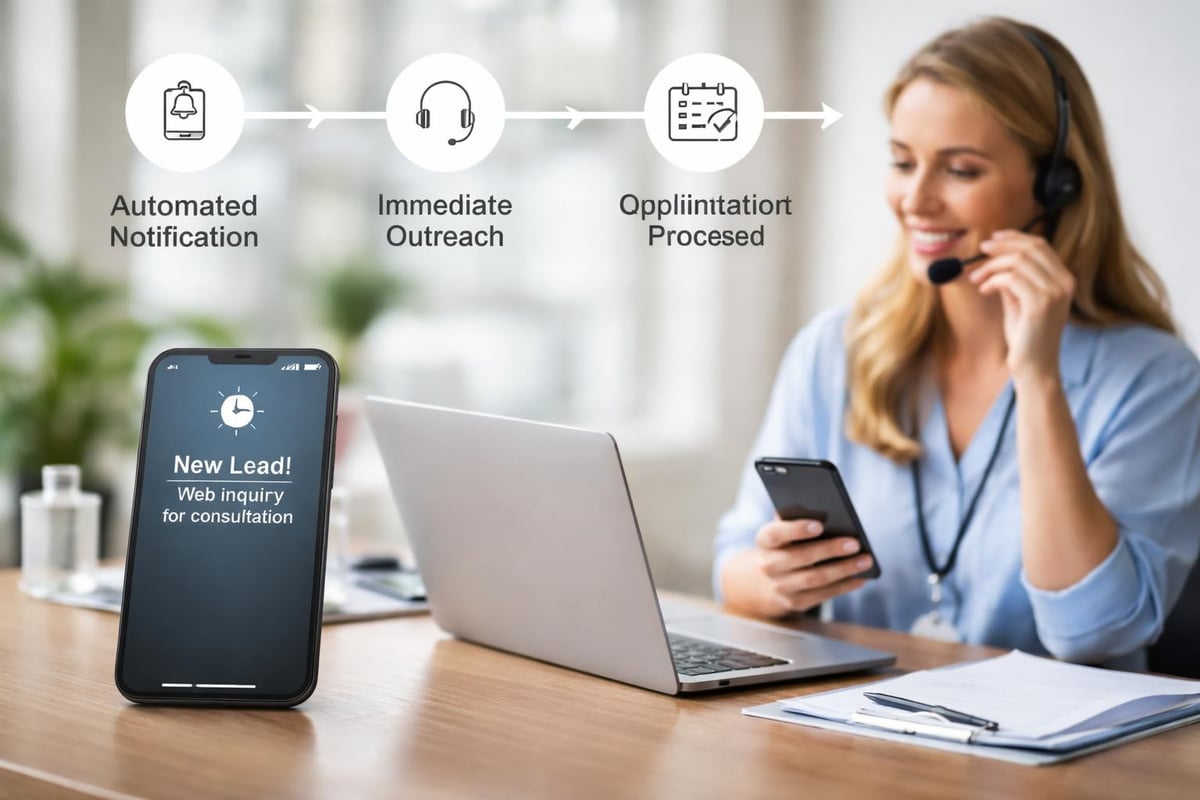
Most healthcare practices lack the infrastructure to maintain two-minute response times. Providers focus on patient care, administrative staff juggle multiple responsibilities, and leads slip through the cracks. Acquisition marketing success depends not only on generating leads but also on having systems in place to convert them immediately.
Building a Response-Ready Organization
Implementing rapid response protocols requires dedicated resources and clear processes. The most successful healthcare organizations separate lead qualification from clinical operations, ensuring that every inquiry receives immediate attention from trained professionals.
A dedicated pre-sales development team serves as the critical bridge between marketing and acquisition efforts and actual patient onboarding. These specialists focus exclusively on answering questions, addressing concerns, qualifying prospects, and scheduling consultations with minimal delay.
Conversion Optimization Through Systematic Follow-Up
Single-touch marketing and acquisition approaches fail in healthcare because patients rarely make immediate decisions about medical services. The purchase cycle for elective procedures, ongoing treatments, and specialized care typically spans days or weeks, requiring multiple touchpoints before conversion.
Marketing tactics that accelerate acquisition include systematic follow-up sequences that nurture prospects through education, social proof, and value demonstration. These sequences maintain top-of-mind awareness while addressing the specific concerns preventing immediate commitment.
Designing Effective Nurture Sequences
| Touchpoint | Timing | Purpose | Channel |
|---|---|---|---|
| Initial response | Immediate | Qualify interest | Phone |
| Value delivery | Day 1 | Educate and build trust | |
| Social proof | Day 3 | Demonstrate results | SMS |
| Objection handling | Day 5 | Address barriers | Phone |
| Urgency creation | Day 7 | Motivate action | |
| Final offer | Day 10 | Convert or disqualify | Phone |
This structured approach ensures no prospect falls through the cracks while respecting the decision-making timeline required for healthcare services. Each touchpoint delivers specific value rather than simply asking for the appointment, positioning your practice as a trusted advisor rather than a pushy salesperson.
Automation plays a crucial role in maintaining consistency across hundreds or thousands of leads simultaneously. Modern CRM systems trigger specific actions based on prospect behavior, ensuring timely follow-up without requiring manual intervention for every interaction.
Specialization in Healthcare Verticals
Generic marketing and acquisition strategies underperform in specialized healthcare niches. A compounding pharmacy serves fundamentally different patient needs than an addiction treatment center or veterinary clinic, requiring tailored messaging, positioning, and conversion approaches.
Successful healthcare acquisition begins with deep understanding of the specific conditions, concerns, and decision-making criteria relevant to your patient population. Men's health clinics must address stigma and privacy concerns that don't exist for medical spas. Telehealth providers face different objections than physical wound care centers.
Vertical-Specific Acquisition Strategies
Compounding pharmacies benefit from physician referral programs and condition-specific educational content that positions custom medications as superior alternatives to mass-produced options.
Addiction treatment centers require empathy-driven messaging that addresses both the patient and their family members, emphasizing hope, evidence-based treatment, and long-term recovery support.
Medical spas leverage visual results, before-and-after galleries, and social proof from satisfied clients to overcome skepticism about cosmetic procedure efficacy.
Orthopedic practices focus on pain relief, restored mobility, and return to normal activities, using patient testimonials that describe specific functional improvements.
Each vertical requires distinct targeting parameters, ad creative, landing page messaging, and qualification criteria. User acquisition best practices emphasize the importance of tailoring approaches to specific audience segments rather than attempting one-size-fits-all solutions.
Campaign Infrastructure and Performance Tracking
Effective marketing and acquisition programs require more than running ads and hoping for results. Success demands comprehensive campaign infrastructure that includes optimized landing pages, conversion-focused copywriting, and transparent performance tracking.
Landing pages serve as the critical conversion point where interested prospects become qualified leads. These pages must load quickly, communicate value immediately, address specific concerns, and minimize friction in the conversion process.
Elements of high-converting healthcare landing pages:
- Clear headline stating the specific problem solved
- Benefit-focused subheadline reinforcing the value proposition
- Trust indicators including credentials, certifications, and testimonials
- Specific call-to-action with minimal required information
- Mobile-optimized design ensuring functionality across all devices
- HIPAA-compliant form handling protecting patient privacy
Copy across all campaign elements must speak directly to patient concerns using their language rather than clinical terminology. Prospects searching for solutions to low testosterone don't use medical jargon; they describe symptoms like fatigue, decreased motivation, and reduced performance.

Measuring What Matters
Vanity metrics like impressions, clicks, and website visits provide minimal insight into marketing and acquisition effectiveness. Healthcare providers must track metrics directly connected to revenue generation and practice growth.
Critical performance indicators include:
- Cost per qualified lead
- Lead-to-appointment conversion rate
- Appointment show rate
- New patient acquisition cost
- Patient lifetime value
- Return on ad spend
These metrics reveal the true efficiency of acquisition efforts and identify specific bottlenecks limiting growth. A practice generating abundant leads but experiencing poor conversion rates requires different interventions than one struggling with lead volume.
Integration with Existing Systems
Marketing and acquisition success depends on seamless integration between campaign platforms, CRM systems, scheduling software, and practice management tools. Disconnected systems create data silos, prevent accurate attribution, and allow leads to disappear without proper follow-up.
Modern healthcare marketing requires full-stack integration that automatically routes leads from ad platforms into CRM systems, triggers immediate response protocols, schedules appointments directly into practice calendars, and attributes revenue back to specific campaigns and channels.
This level of integration enables true performance-based optimization. When every dollar spent can be traced to specific patient acquisitions and revenue generation, providers can make data-driven decisions about budget allocation, channel mix, and campaign scaling.
Customer acquisition done right involves building comprehensive systems that handle every aspect of the patient journey from initial awareness through conversion and onboarding. Piecemeal approaches that excel at one stage while neglecting others create bottlenecks that limit overall performance.
Franchise System Acquisition Strategies
Healthcare franchise systems face a dual acquisition challenge: attracting both patients for existing locations and qualified franchise partners for system expansion. Marketing and acquisition strategies must address both audiences simultaneously while maintaining brand consistency across locations.
Franchise development requires completely different messaging and targeting than patient acquisition. Prospective franchisees evaluate investment opportunities, growth potential, training systems, and support infrastructure rather than medical services and treatment outcomes.
Multi-Tiered Marketing Approaches
| Audience | Primary Goal | Key Messages | Channels |
|---|---|---|---|
| Patients | Book appointments | Treatment benefits, results | Local search, social ads |
| Franchisees | System investment | ROI, support, proven model | LinkedIn, industry events |
| Referral sources | Generate referrals | Partnership benefits | Direct outreach, education |
Successful franchise marketing balances corporate-level brand building with location-specific patient acquisition. Corporate campaigns establish credibility and system-wide recognition while local marketing drives patient volume for individual locations.
The most effective franchise acquisition systems provide turnkey marketing support for new locations, including pre-launch campaigns, grand opening promotions, and ongoing lead generation services. This support reduces the risk for franchisees while ensuring consistent performance across the system.
Scaling Acquisition Through Systematic Execution
Sporadic marketing efforts produce inconsistent results that make growth planning impossible. Sustainable healthcare expansion requires systematic marketing and acquisition execution that delivers predictable patient flow regardless of seasonality, competition, or market conditions.
Systematic execution begins with documented processes for every aspect of the acquisition funnel. From ad creation and testing protocols to lead qualification scripts and appointment scheduling procedures, successful organizations operate from proven playbooks rather than improvising their approach.
Components of systematic execution:
- Weekly campaign optimization based on performance data
- A/B testing protocols for continuous improvement
- Documented response scripts for common scenarios
- Quality assurance monitoring of all patient interactions
- Regular performance reviews identifying improvement opportunities
- Proactive troubleshooting preventing small issues from becoming major problems
This level of systematization transforms marketing from a cost center into a predictable revenue generation engine. When providers know that investing X dollars in acquisition campaigns will yield Y qualified appointments with Z conversion rates, they can confidently scale their marketing budgets to achieve specific growth targets.
Customer acquisition strategies must evolve continuously as markets change, competition intensifies, and patient behavior shifts. Organizations that treat acquisition as an ongoing optimization process rather than a set-it-and-forget-it campaign consistently outperform competitors relying on static approaches.
Effective marketing and acquisition in healthcare requires the integration of advanced technology, rapid response systems, and systematic execution across every stage of the patient journey. From identifying anonymous website visitors to converting qualified leads through two-minute response times and comprehensive follow-up sequences, success depends on treating acquisition as a complete system rather than isolated campaigns. RevSpark Media specializes in building and operating these complete acquisition systems for healthcare providers and franchise organizations, combining proprietary visitor identification technology with dedicated pre-sales teams and transparent performance tracking to deliver predictable patient growth. If you're ready to transform your practice's acquisition performance and achieve sustainable revenue growth, discover how our proven systems can generate consistent results for your organization.