
Struggling to transform website traffic into real customers? You are not alone. In fact, 61% of marketers report that generating quality leads is their biggest challenge today.
In the fast-changing digital landscape of 2025, the need for quality leads has never been greater. This comprehensive guide offers proven, actionable strategies to help you attract and convert the right prospects for your business.
You will learn how to define your ideal customer, select effective channels, craft offers that resonate, nurture your pipeline, and measure what truly matters. Ready to overcome the lead generation challenge? Keep reading for expert guidance that will elevate your results.
Step 1: Define Your Ideal Lead Profile
Every successful lead generation strategy starts with clarity. If you want to attract quality leads, you must know exactly who you are targeting. Defining your ideal lead profile helps you focus on prospects most likely to convert, saving your team time and resources.

Understanding Your Target Audience
Creating detailed buyer personas is essential for generating quality leads. Start by segmenting your audience using demographic factors like age, location, and job title. Psychographic segmentation, which looks at interests, values, and motivations, reveals what drives your prospects to take action. Behavioral segmentation examines how users interact with your website, emails, and ads.
The approach to profiling varies between B2B and B2C. B2B lead profiles often focus on company size, industry, and decision-making roles, while B2C targets individual preferences and buying triggers. Mapping the customer journey helps you spot high-intent prospects at each stage, improving your ability to find quality leads.
Consider this: A SaaS company recently refined its ideal customer profile by analyzing user behavior and feedback. The result was a 37% increase in conversions, simply by focusing efforts on leads that truly matched their profile. To dive deeper into proven methods for attracting and qualifying quality leads, review the qualified lead generation best practices.
Leveraging Data and Analytics
Data-driven insights are fundamental to consistently attracting quality leads. Use CRM systems and analytics tools to gather actionable information about your prospects. Focus on key data points such as lead source, engagement level, and previous conversion history. These details reveal valuable patterns that help you refine your targeting.
Integrating first-party data from your website and CRM with reputable third-party sources broadens your understanding of your audience. This combined data approach gives you a more complete view, making it easier to identify the prospects most likely to become quality leads.
According to HubSpot, companies that use data-driven personas experience a 73% higher conversion rate. This highlights the impact of comprehensive analytics on your lead generation outcomes. Leverage these insights to continually update and perfect your ideal lead profile, ensuring your strategy evolves with your market.
Step 2: Select the Right Lead Generation Channels
Choosing the right channels is crucial for generating quality leads in today’s competitive market. With so many options available, it’s essential to align your strategy with your audience and industry trends. This section shows how to evaluate both digital and offline tactics, prioritize your budget, and analyze return on investment to maximize lead quality.

Evaluating Digital Marketing Channels
The digital landscape offers a wide array of channels to attract quality leads. Organic search remains foundational, driving intent-based traffic to your website. Paid ads, whether on Google or social platforms, enable precise targeting and rapid scalability. Social media, especially LinkedIn for B2B and Facebook or Instagram for B2C, helps brands engage communities and build trust.
Email marketing continues to deliver strong returns, particularly for nurturing relationships and reactivating dormant contacts. Referral programs can tap into existing customers to expand your reach organically.
Channel effectiveness varies by industry and audience. For example, a healthcare provider increased quality leads by 52% by launching targeted LinkedIn campaigns that prioritized professional audiences. If you’re in healthcare, consider reviewing these Healthcare lead generation strategies to discover proven, industry-specific tactics.
The trend for 2025 points to video content and webinars as top-performing channels. These formats enable real-time engagement and provide valuable education, often moving prospects further down the funnel.
Here’s a quick comparison of common channels and their strengths:
| Channel | Best For | Typical CPL* |
|---|---|---|
| Organic Search | High-intent prospects | $$ |
| Paid Ads | Quick scaling, targeting | $$$ |
| Social Media | Brand awareness, B2C/B2B | $$ |
| Nurturing, retention | $ | |
| Referral | Trust-based expansion | $ |
*Cost per lead varies by industry and campaign.
Offline and Hybrid Tactics
While digital dominates, offline and hybrid approaches are powerful for certain audiences. Events and trade shows offer face-to-face engagement, ideal for building trust and qualifying leads in real time. Direct mail, though traditional, can still cut through digital noise for niche or local markets.
Franchise systems often see success by hosting local events and integrating them with digital tracking tools. This hybrid model ensures every prospect is attributed correctly, improving follow-up and conversion rates. For example, a franchise brand used local workshops to drive attendance, then captured attendee data with QR codes, seamlessly linking offline interest to their CRM.
Integrating offline efforts with digital tracking is key. Use unique URLs, QR codes, or event-specific landing pages to monitor which sources yield the most quality leads. This approach allows you to measure the true impact of your offline investments and optimize future campaigns.
Combining these tactics creates a holistic lead generation strategy. By meeting prospects where they are—whether online or in person—you maximize your chances of attracting and converting quality leads.
Budget Allocation and ROI Analysis
Allocating your budget effectively is essential for optimizing quality leads. Start by calculating the cost-per-lead (CPL) for each channel. Use tools like Google Analytics, HubSpot, or Salesforce to track spend and results.
Marketers should prioritize high-performing channels while continuously testing new ones. According to a Demand Gen Report (2024), those who allocate 60% of their budget to top channels report a 41% increase in lead quality.
Monitor ROI by comparing CPL, conversion rates, and the lifetime value of new customers. Regularly review your data to ensure you’re investing in the channels that deliver the best quality leads. Adjust your strategy as needed to maintain a strong pipeline and stay ahead of the competition.
Step 3: Craft Compelling Offers and Lead Magnets
Attracting quality leads begins with irresistible offers that speak directly to your ideal customer’s needs. In today’s crowded digital space, generic giveaways no longer cut through the noise. Instead, you must design value-driven lead magnets tailored to each stage of the buyer journey.

Creating Value-Driven Offers
The foundation of generating quality leads is a well-crafted offer. Consider what your target audience values most. Is it actionable insights, exclusive access, or a hands-on experience?
Common lead magnets include:
- eBooks and whitepapers: Ideal for audiences needing in-depth knowledge.
- Free trials and demos: Effective for software or service-based businesses.
- Consultations and audits: Perfect for B2B or high-ticket services.
- Quizzes and assessments: Engage prospects while collecting valuable data.
To maximize quality leads, align your offers with the buyer’s intent and funnel stage. For example, a medical spa attracted high-value clients by hosting exclusive webinars, addressing specific concerns and showcasing expert knowledge. This approach filtered out less engaged visitors, focusing on those likely to convert.
| Lead Magnet Type | Best Funnel Stage | Example Use Case |
|---|---|---|
| eBook | Awareness | SaaS educational content |
| Free Trial | Consideration | Software demo |
| Consultation | Decision | B2B marketing audit |
| Webinar | Consideration/Decision | Medical spa event |
| Quiz | Awareness | Health assessment |
Quality leads respond to offers that solve their problems. Keep your value proposition clear and your format accessible.
Optimizing Landing Pages and CTAs
Once you have a compelling offer, your landing page becomes the gateway for capturing quality leads. A high-performing landing page is simple, focused, and designed around trust.
Key elements include:
- Clear, benefit-driven headline
- Concise copy highlighting value
- Strong visual cues and trust signals (testimonials, badges)
- Minimal form fields to reduce friction
- Personalized calls-to-action (CTAs)
A/B testing is crucial. Experiment with headlines, button text, and images to discover what resonates most. According to HubSpot, landing pages with personalized CTAs convert 202% better than generic ones.
For step-by-step guidance on optimizing your landing pages for quality leads, explore Effective lead generation landing pages. This resource offers practical tips to boost conversions and improve lead quality.
Remember, every landing page element should reinforce your offer and build trust, ensuring visitors feel confident sharing their information.
Ensuring Compliance and Trust
Protecting user data is essential for both regulatory compliance and reputation. Adhering to standards like GDPR and HIPAA is non-negotiable when collecting quality leads.
Key compliance practices include:
- Clear privacy policies: State how you use and protect data.
- Explicit consent checkboxes: Let users opt-in transparently.
- Secure data handling: Use encrypted forms and secure storage.
Trust is also built with social proof. Testimonials, third-party certifications, and recognizable client logos reassure visitors that your brand is credible and reliable.
By combining transparency with robust data protection, you not only meet legal requirements but also foster confidence in your process. This trust is foundational for attracting and retaining quality leads.
Step 4: Qualify and Nurture Leads Effectively
Struggling to convert website visitors into quality leads? The secret lies in how you qualify and nurture each prospect. This step is crucial for boosting conversion rates and driving long-term business growth.
Lead Scoring and Qualification Frameworks
Defining what makes a lead "quality" is the foundation of successful lead generation. Start by creating a clear set of criteria that reflect your ideal customer profile. Consider these essential categories:
| Criteria | Description | Example |
|---|---|---|
| Fit | Alignment with your target market | Company size, job title |
| Intent | Demonstrated interest in your solution | Downloaded a whitepaper |
| Engagement | Interactions with your brand | Opened emails, attended demo |
Automated lead scoring systems assign points based on these factors, helping teams focus on quality leads that are most likely to convert. Manual scoring still plays a role for complex or high-value sales, especially in healthcare and B2B sectors.
For instance, an orthopedic clinic implemented a lead scoring framework that prioritized prospects who engaged with educational webinars and requested consultations. As a result, they increased their conversion rate for quality leads and optimized resource allocation.
Lead Nurturing Strategies
Once you identify quality leads, nurturing them is essential. Effective strategies include drip email campaigns, retargeting ads, and personalized follow-ups. These touchpoints keep your brand top-of-mind and guide leads through the buyer’s journey.
Timing matters. Studies show that reaching out within minutes of an inquiry dramatically improves engagement. Optimal nurturing often involves a mix of automated and human touchpoints, tailored to each stage of the funnel.
Nurtured leads generate 20% more sales opportunities, according to DemandGen. Leveraging content like case studies, webinars, and interactive tools can further engage quality leads and move them closer to a decision. For more statistics on current lead nurturing trends, see the Lead Generation Statistics 2025.
Leveraging Technology for Lead Management
Technology is a game changer for managing quality leads efficiently. Integrating your CRM with marketing automation platforms ensures seamless tracking, scoring, and follow-up. This integration enables real-time updates, so no lead falls through the cracks.
Sophisticated automation tools can trigger personalized messages based on specific actions, such as downloading a guide or attending a webinar. These systems also provide analytics that highlight which nurturing tactics are most effective for quality leads.
A telehealth provider recently adopted automated lead management, reducing response time by 60%. Their team could now focus on high-priority tasks, while technology ensured every quality lead received timely, relevant communication.
Aligning Sales and Marketing Teams
Alignment between sales and marketing is vital for maximizing quality leads. Both teams must agree on the definition of a quality lead and establish clear Service Level Agreements (SLAs) to ensure a consistent handoff process.
Regular feedback loops help refine lead criteria and highlight opportunities for improvement. Performance reviews and shared metrics keep everyone accountable and focused on results.
Companies with strong sales-marketing alignment achieve 67% better lead conversion, according to Marketo. This collaboration ensures quality leads are nurtured effectively from first touch to final sale.
How RevSpark Media Accelerates Healthcare Lead Generation
RevSpark Media offers proprietary technology that identifies 60% of anonymous website visitors, a breakthrough for healthcare and franchise systems seeking more quality leads. Their in-house pre-sales team responds to inquiries within two minutes, thoroughly qualifying each lead for readiness.
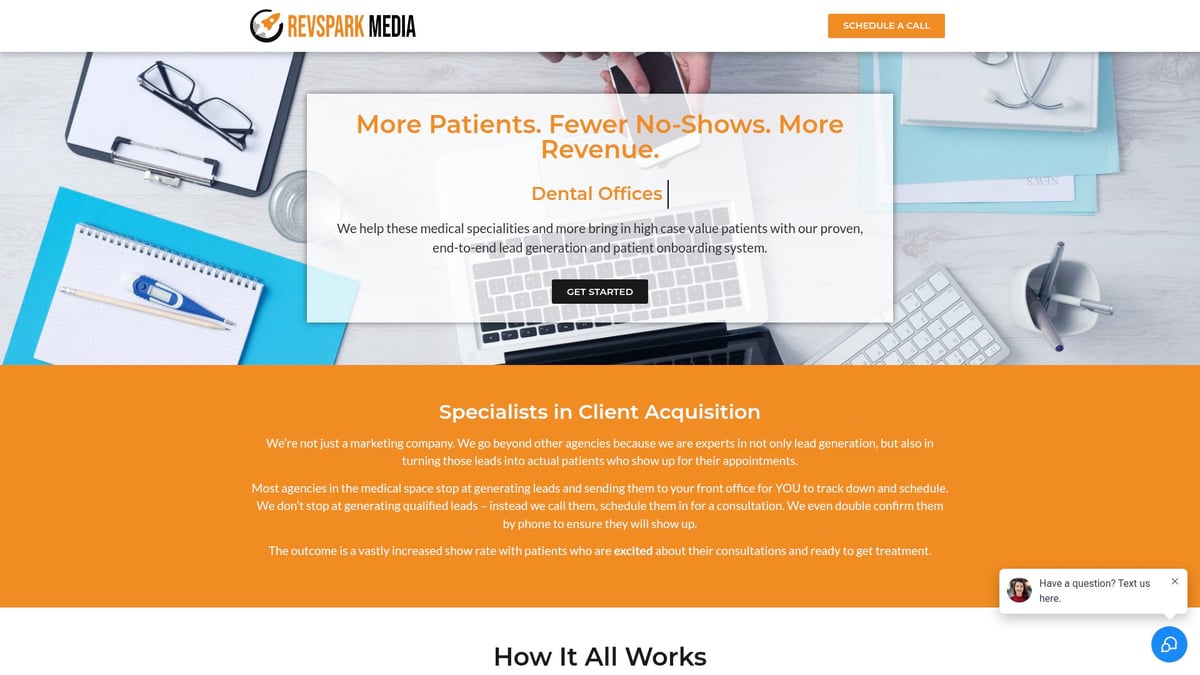
Clients benefit from comprehensive campaign support, including ad copywriting, landing page creation, CRM integration, and systematic follow-up. This full-service model has driven more than $100M in client growth and improved appointment show rates.
For example, a compounding pharmacy partnered with RevSpark Media and saw a measurable increase in patient acquisition. By integrating digital and offline tactics, the pharmacy attracted more quality leads and achieved guaranteed, performance-based outcomes.
Step 5: Measure, Analyze, and Optimize Lead Quality
Turning leads into real customers requires more than just volume. To maximize your results, you need to consistently measure, analyze, and optimize the quality leads you attract. This step is crucial for understanding which strategies work, refining your process, and ensuring your marketing dollars drive genuine growth.
Key Metrics for Lead Quality Assessment
To optimize your lead generation, you must track more than just the number of contacts. Focus on metrics that reveal the true value of your quality leads:
- Marketing Qualified Leads (MQLs) vs. Sales Qualified Leads (SQLs): MQLs show interest, while SQLs are ready to buy.
- Conversion rates: Track how many leads move from one stage to the next.
- Cost-per-lead (CPL): Analyze how much you invest to acquire quality leads.
- Lifetime Value (LTV): Calculate the long-term revenue from each customer.
Here is a quick comparison:
| Metric | What It Measures | Why It Matters |
|---|---|---|
| MQL vs. SQL | Lead stage and readiness | Focuses resources on high-potential buyers |
| Conversion Rate | % moving to next funnel stage | Identifies bottlenecks and opportunities |
| CPL | Investment per lead | Optimizes marketing spend |
| LTV | Revenue generated over customer lifespan | Informs ROI and long-term strategy |
For example, a women’s health clinic improved campaign performance by tracking lead-to-patient conversions, allowing them to prioritize high-value sources and refine messaging. By monitoring these metrics, you can pinpoint which channels consistently deliver quality leads and identify areas for improvement.
Attribution and Tracking Techniques
Understanding what drives your best quality leads starts with attribution. Multi-touch attribution models such as first-touch, last-touch, linear, and time-decay reveal how different marketing efforts contribute to conversions.
Integrating analytics platforms with your CRM provides a full-funnel view. This means you can track every interaction, from the first click to the final sale, and identify which touchpoints matter most.
According to Salesforce, 84% of marketers using multi-touch attribution report improved lead quality. By adopting best practices like those outlined in B2B Lead Generation Best Practices 2025, you can ensure your tracking systems capture accurate data across all channels.
Effective attribution lets you optimize spend, double down on high-performing tactics, and eliminate waste. With the right systems in place, you will see a clear picture of which efforts generate quality leads that are most likely to convert.
Continuous Improvement and Testing
Optimizing quality leads is an ongoing process. Regular A/B and multivariate testing on campaigns and landing pages helps you discover what resonates with your audience.
Feedback loops are essential. Use insights from your sales team to refine lead criteria and qualification processes. For instance, an addiction treatment center improved their qualified lead rates by iterating ad copy based on sales feedback.
Implementing continuous improvement means you never settle for average results. Test different messaging, offers, and channels to see what consistently delivers quality leads. Document changes, track results, and adjust your strategy based on real performance data.
Stay proactive. The market evolves rapidly, and so do your prospects’ needs. Frequent testing ensures your approach to quality leads remains effective and relevant.
Benchmarking and Industry Comparisons
Benchmarking allows you to set realistic goals for quality leads by comparing your metrics to industry standards. Use up-to-date benchmarks for healthcare, SaaS, and franchise sectors to see where you stand.
For example, referencing the B2B Organic Lead Growth Report 2025 can help you understand trends in lead volume, conversion rates, and cost per lead for your industry. Top-performing companies review lead quality metrics weekly, according to MarketingSherpa, 2024.
Regular benchmarking uncovers gaps and highlights areas for improvement. This practice ensures your team stays competitive and adapts quickly to changing market dynamics.
By measuring, analyzing, and optimizing your quality leads, you set the foundation for sustainable growth and higher conversion rates. The most successful organizations treat this as an ongoing journey, not a one-time task.
Step 6: Scale Your Lead Generation Efforts
Scaling your lead generation is the key to sustainable growth, but it requires more than increasing volume. Without clear processes, automation, and ongoing team development, quality leads can slip through the cracks. In this final step, we show how to expand your efforts while maintaining the high standards needed for conversion.
Building Repeatable Systems and Processes
To scale effectively, start by documenting every step of your lead generation workflow. Standardized processes ensure that each team member follows best practices, making it easier to replicate success across campaigns and locations.
Automation tools can handle routine tasks, such as lead assignment and follow-up reminders, freeing your team to focus on nurturing relationships. However, personalization should never be sacrificed, especially when pursuing quality leads.
For franchises or multi-unit businesses, adopting franchise lead generation systems can centralize your approach, ensuring consistent execution across locations. For example, a franchise system using standardized playbooks was able to scale lead gen across 20+ locations without losing focus on quality leads.
Expanding into New Channels and Markets
Growth often means reaching new audiences. Test emerging platforms like podcasts, voice search, or AI chatbots to connect with prospects in innovative ways. Localizing your content for different markets or industry verticals also increases relevance, which in turn attracts more quality leads.
Stay updated with the latest inbound lead generation strategies for 2025 to ensure your tactics remain fresh and effective. According to Gartner, businesses that diversify their channels see a 35% increase in quality leads, especially when they tailor their approach to each platform.
Investing in Training and Team Development
Scaling your efforts requires a knowledgeable and agile team. Regular workshops and upskilling sessions help both marketing and sales professionals stay ahead of trends and master new tools.
For instance, a medical spa saw a surge in quality leads after investing in social selling training for their staff. Encourage knowledge sharing and cross-functional collaboration to build a culture of continuous improvement.
Maintaining Lead Quality at Scale
As your lead generation expands, constant monitoring is essential to prevent a drop in quality leads. Establish feedback loops between sales and marketing to quickly identify issues and refine your criteria.
Implement quality control checkpoints at each stage of your funnel. Companies with proactive quality control processes maintain 25% higher conversion rates, even as they scale. By prioritizing quality leads and regular reviews, you can ensure sustained success as your business grows.